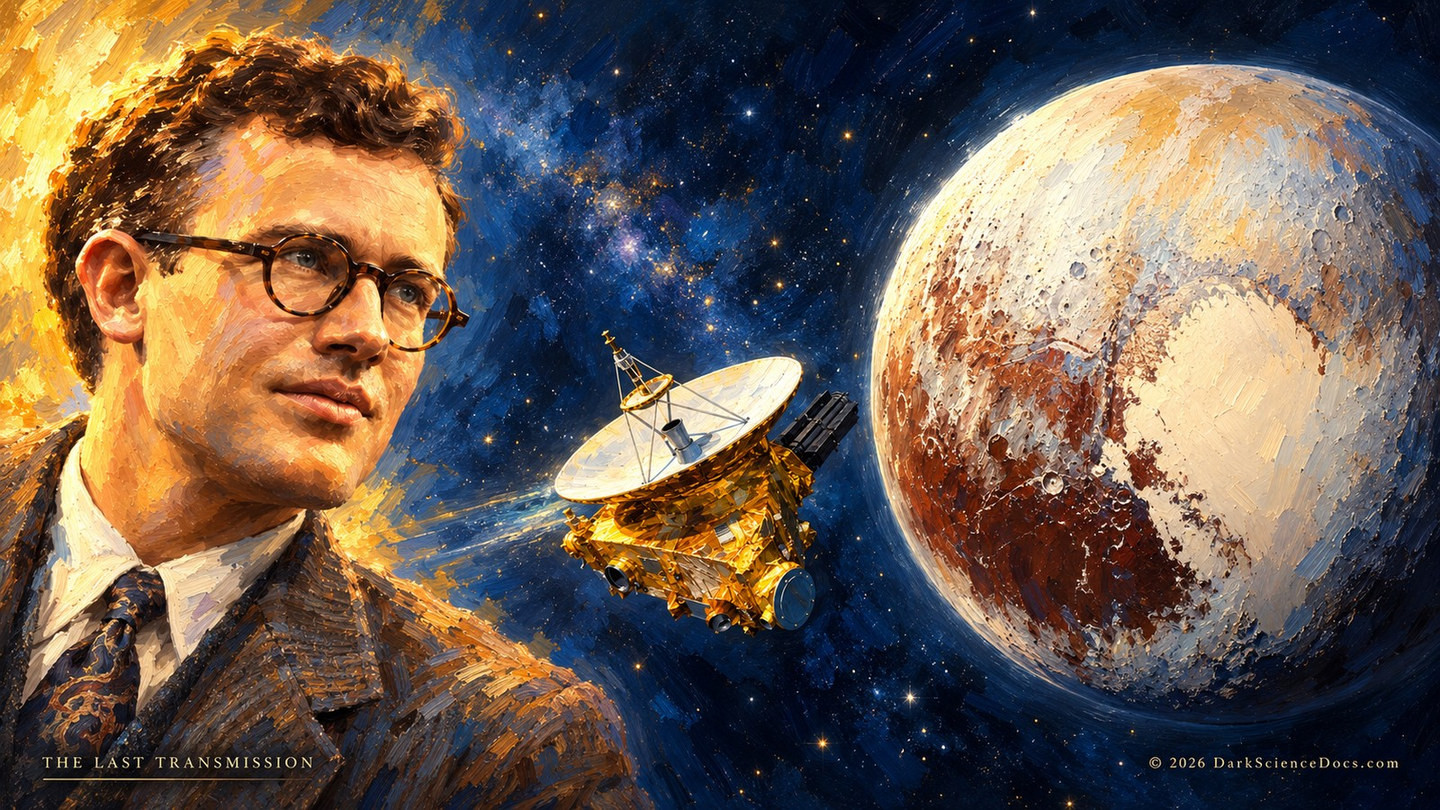
DOCUMENTARIES / THE LAST TRANSMISSION
The Promise That Came Home: NASA’s Mission to Asteroid Bennu
OSIRIS-REx crossed the solar system to return an asteroid sample, then researchers found a remarkable chemical inventory inside it.
On YouTube: NASA Found Life’s Ingredients on Bennu. He Never Lived to See It.
If the player is unavailable, watch directly on YouTube ↗
THE QUESTION BEHIND THE FILM
What can a handful of asteroid material tell us about the chemistry before life?
ORIGINAL VIEWING GUIDE
Look closer.
The return matters as much as the destination
A controlled sample return gives researchers material whose journey through Earth’s atmosphere and handling on the ground are documented. That is a different kind of evidence from a meteorite recovered after an unknown period of exposure.
Ingredients are not organisms
Analyses of Bennu material identified amino acids and nucleobases; later work identified sugars including ribose. These are molecules associated with biology on Earth, but their presence in an asteroid is evidence of prebiotic chemistry, not evidence that Bennu hosted life.
The human thread
The documentary follows the people who kept the mission alive through setbacks and waited for the return capsule. Watch the science and the promise together: a measurement can take years of work, decisions, and trust to reach a laboratory.
THE EVIDENCE TRAIL / RESEARCH COMPANION
What the record says.
Bennu's value is not simply that it contains familiar molecules. The mission returned material whose collection and handling can be traced, giving researchers a better way to ask whether prebiotic chemistry was widespread in the early solar system.
CHOOSE A CLUE / FOLLOW THE RECORD
These are research waypoints, not video timestamps. Explore them in any order, then return to the film.
First, secure a traceable sample
Observed or documented
OSIRIS-REx delivered its sample capsule to Earth on September 24, 2023. NASA reported 121.6 grams of Bennu material in the sample collection system. Scientists can study grains from a specific asteroid with documented collection and curation steps.
What it suggests
That context makes it easier to separate asteroid chemistry from changes after arrival on Earth than it is for a meteorite found after an unknown exposure history. It does not make laboratory contamination impossible, which is why controls and sample handling matter.
Where the claim stops
The returned sample represents material collected at one location and moment on Bennu; it cannot by itself describe every part of the asteroid or every early solar-system body.
The chemical inventory expanded
Observed or documented
NASA reported 14 of the 20 amino acids used by life on Earth and all five nucleobases used in DNA and RNA in Bennu samples. These are chemical identifications in asteroid material, supported by laboratory analysis rather than a claim based on its appearance.
What it suggests
Some ingredients useful to life can form without organisms and travel in small bodies. Delivery by asteroids is one possible contribution to early Earth's chemical inventory; detecting those molecules does not tell us exactly how terrestrial life began.
Where the claim stops
Amino acids and nucleobases are ingredients, not a cell, fossil, or self-replicating system. Finding them in an extraterrestrial sample is not evidence of extraterrestrial life.
Later analyses found sugars
Observed or documented
A later study reported sugars including ribose and glucose in Bennu material. Ribose is part of RNA; glucose is a familiar biological fuel on Earth. The paper is a separate result from the earlier amino-acid and nucleobase announcement.
What it suggests
These results broaden the set of organic compounds found in a returned asteroid sample. They support research into possible nonbiological pathways that make life-related chemistry in space.
Where the claim stops
The coexistence of several ingredients does not show that they assembled into RNA or a living system. The route from chemistry to biology remains a distinct, much harder question.
What the result cannot answer
Observed or documented
The sample preserves a record of processes on Bennu and its parent body. Laboratory teams can compare mineral and organic compounds and test how those compounds relate to a history involving water and chemical reactions.
What it suggests
If similar inventories are found in other well-characterized samples, scientists can ask whether such chemistry was common across the early solar system or depended on Bennu's particular history.
Where the claim stops
Bennu does not provide a direct photograph of Earth's origin of life. The mission supplies ingredients and context; any account of how life began must connect those to additional evidence and experiments.
Which reactions made these molecules in Bennu's parent body, and how similar is its chemical history to other returned samples?
EXPLORE IN 3D / MAP 08
Turn the asteroid from the film
Inspect Bennu’s measured shape and Nightingale terrain, then follow its returned sample from the spacecraft to the laboratory.
Open Bennu mapFOLLOW THE EVIDENCE
Keep the question open.
Watch the documentary, check the research, and continue into the illustrated archive.
MORE DOCUMENTARIES
 Nancy Grace Roman: The Woman Who Made Hubble Possible
 Voyager 1 Is Going Dark: NASA’s 2026 Mission Status
 Tabby’s Star: The Complete Story of the Alien Megastructure Mystery