One dark asteroid. One narrow place to touch. Turn Bennu under the light, then follow the sample into the evidence.
BENNU / 08 OSIRIS-REX SHAPE MODEL · ARCHIVAL DATA
Choose a file. Drag to inspect Bennu; pinch or use the zoom buttons.
FILE 01 / BENNU
Bennu
A small world with a long record
What can an asteroid carry across the age of the Solar System?
Bennu is a near-Earth asteroid assembled from material with a much older history. OSIRIS-REx mapped its shape, surveyed its rocky surface, touched it, and returned material for laboratory study. The rotating object uses a NASA shape model and a separately mapped albedo mosaic. It is a model of measured form, not a live image.
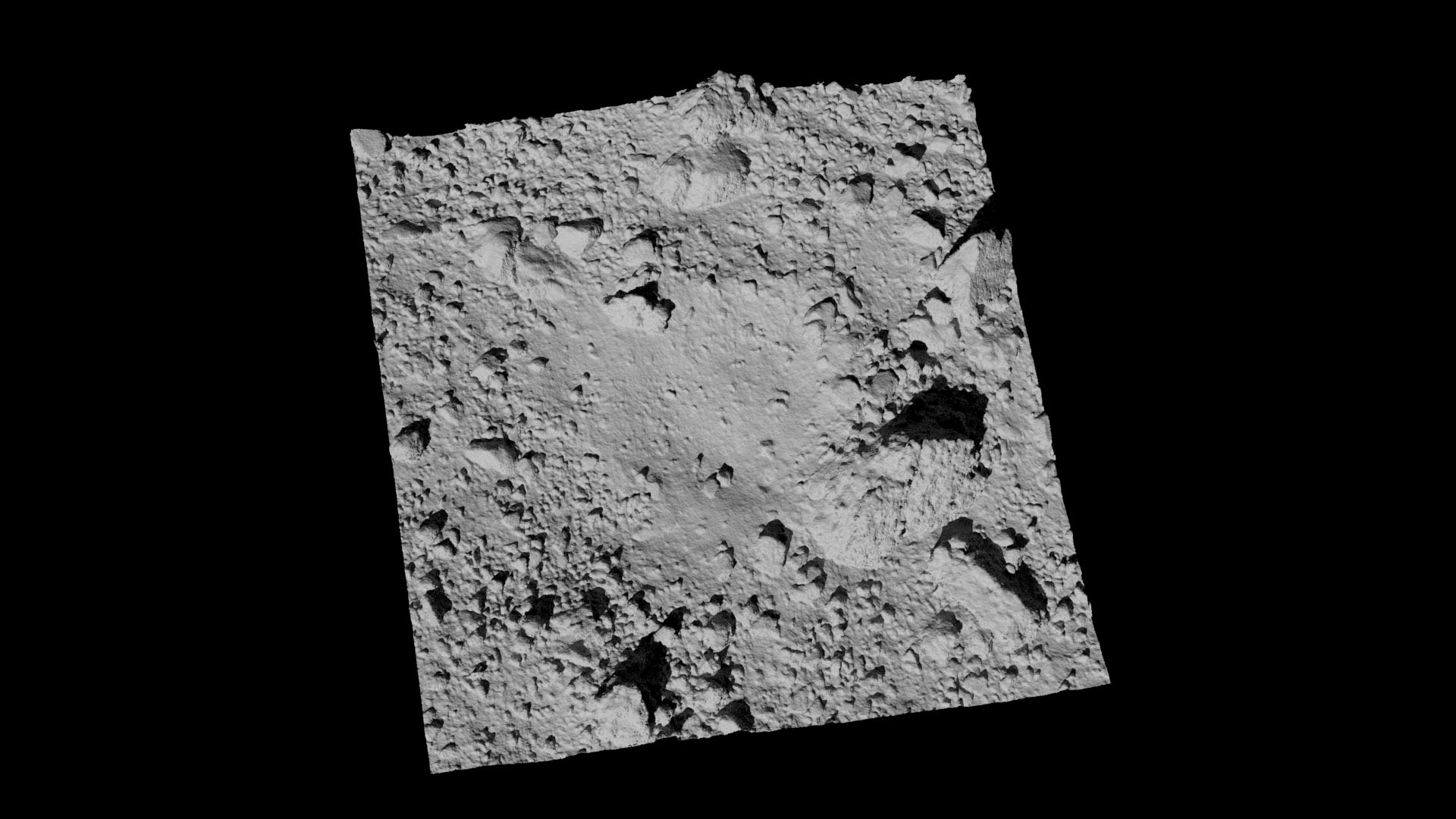
Mission planners expected broad, relatively smooth terrain. The arrival images revealed boulders and very few forgiving clearings. Nightingale, a crater in Bennu’s northern hemisphere, became the chosen site. OSIRIS-REx touched there on October 20, 2020. The detailed terrain tile below shows the site independently; this simplified global viewer does not mark a meter-accurate touchdown point.
What did the spacecraft learn in the seconds after contact?
Bennu is a loose aggregation of rock rather than a solid monolith. Its surface was rough to look at, yet the sampling head encountered little resistance: material scattered as the spacecraft touched down. The global model records shape at its own resolution. It cannot show the grains that moved during collection or the full mechanical behavior beneath the arm.
Where does an ingredient stop, and evidence of life begin?
The returned material contains amino acids, nucleobases, salts, and, in later analyses, sugars. These detections reveal prebiotic chemistry and a history of water in Bennu’s parent body. They do not establish that Bennu ever hosted life. A rotating exterior cannot show the chemistry inside the laboratory samples.
On September 24, 2023, a capsule carrying Bennu material landed in Utah. Curators ultimately measured 121.6 grams of asteroid material. A laboratory can repeat tests with instruments far beyond what a spacecraft could carry and preserve portions for future methods. The return is a human and scientific story beyond the surface model.
Bennu is a near-Earth asteroid. Its orbit is measured, but predicting encounters centuries ahead requires accounting for small forces, including heat radiated from its sunlit surface. OSIRIS-REx observations sharpened estimates of that drift. This page does not simulate an orbit or forecast an impact; the rotating shape is an inspection view only.
The shape is converted from NASA’s public Bennu 3D printable model into a compact web mesh. The dark surface layer is a separate OSIRIS-REx albedo image mosaic projected onto that mesh. Because the two assets were published separately and the printable mesh has limited detail, the visual alignment and the apparent locations of individual rocks or the Nightingale site are not verified. The separate Nightingale terrain image provides closer context. No touchdown marker is placed on the globe.
Shape and chemistry come from different measurements.
A measured shape model helps locate the asteroid’s terrain and sampling area. Laboratory analysis of returned material addresses composition. Compare the question each record can answer before combining them into a story about Bennu’s history or life’s ingredients.
Ask yourself What was actually observed, and what has been inferred from it?
THE SIGNAL CONTINUES
Some discoveries stay with you.
Get the illustrated investigations delivered to your inbox. Then follow the questions that refuse to leave.