SCIENCE COUNTDOWNS / ESA / EUCLID
Euclid opens the next map of the dark universe
The DR1-Foundation release brings survey material into public view. The interesting part is what independent researchers can test with it.
Until the tentative public-release date begins
WHERE THE MISSION STANDS
The threshold ahead.
Euclid's survey is designed to study the dark universe through the shapes and distribution of galaxies. DR1-Foundation is a public release of survey material, including calibrated images, spectra and catalogues, accompanied by technical and science work. It gives more researchers an opportunity to examine how the measurements were made.
A release is an invitation to test, compare and find limits. Images can reveal striking objects, while reliable measurements require calibration and an understanding of what the survey misses. The Foundation milestone should not be confused with a final verdict on dark matter or dark energy.
WHY THE SCIENCE MATTERS
Questions worth returning for.
What bends the light behind a galaxy?
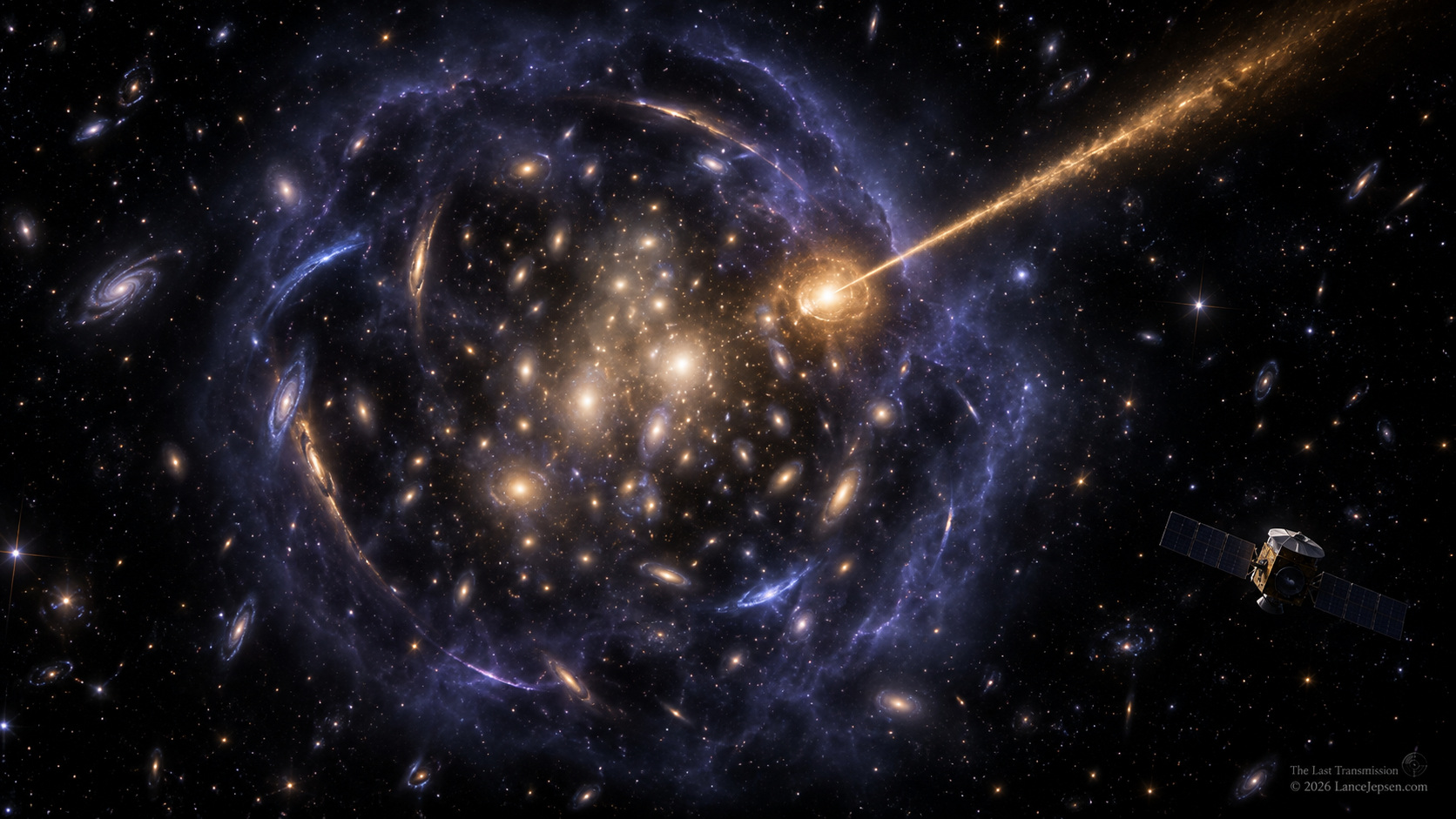
Gravitational lensing connects the apparent shapes of background galaxies with matter along the line of sight. Before interpreting that signal, researchers must account for the telescope's image response and other distortions. A beautiful arc opens a question; a calibrated measurement helps answer it.
When does a pattern become evidence?
Galaxy positions can be compared with models of cosmic structure. That comparison also depends on which objects entered the catalogue and how distances were estimated. A meaningful test asks whether a pattern survives changes in selection and analysis.
Can another team reproduce the result?
Return for the release documentation, uncertainty estimates and independent analyses. Public data let researchers examine a claim with different methods. Agreement can strengthen an inference; disagreement can expose a limitation that an attractive image would never reveal.
CONTINUE THE INVESTIGATION
Follow the thread.
Explore related investigations, Evidence Files, image stories and films.
DATE & SCIENCE SOURCES
ESA's Euclid timeline lists November 12, 2026 for DR1-Foundation and warns that release dates are tentative. The Consortium describes a fall-2026 Foundation release. This is distinct from the later full DR1 release. The clock uses 00:00 UTC on November 12, not a confirmed publication hour; check the release notices for changes.
Source review: October 10, 2026. Check the mission agency for later schedule changes.EXPLORE IN 3D / MAP 13
Step outward into the cosmic structure question
Move through an illustrated cosmic neighborhood and follow the scale of galaxies. Return to Euclid for measured survey data; this view does not reconstruct the release or measure dark matter.
Open Universe mapTHE NEXT FILES
Keep watching.
Hera returns to the DART impact site
A spacecraft changed a moonlet's orbit. Hera goes back to discover what the collision actually did to the asteroid.
Enter the event fileBepiColombo enters Mercury's orbit
After years of flybys and braking, two science orbiters prepare to investigate a small planet with an outsized interior.
Enter the event fileRoman approaches the dark side of Earth
The telescope has already seen starlight. Its next threshold is the orbit where its wide-field search can begin.
Enter the event file