
EVIDENCE FILE 45 / IMPACTS & HABITABILITY
Do Impact Craters Tell Us Where to Look for Life?
Separate impact-winter models, Chicxulub mineral dates, microbial isotope evidence, and Martian alteration from claims those observations cannot establish.
THE SHORT ANSWER
They identify environments to investigate. They do not supply a universal test for life.
Earth’s rocks preserve evidence of impact-driven water circulation, and a separate isotope record has been interpreted biologically. Martian alteration points to a possible habitat. The strength and scope of those claims differ.
THREE CLAIMS TO KEEP APART
A habitat, an inhabitant, an origin.
Could organisms live there?
Water, energy, appropriate chemistry, and tolerable conditions help establish habitability. Those conditions vary within a cooling system.
Did organisms live there?
A biological interpretation needs evidence that can be distinguished from nonbiological processes, with the geological context intact.
Did life begin there?
This asks how nonliving chemistry became a living system. Later occupation of a crater cannot establish an origin event.
THE EVIDENCE TRAIL / RESEARCH COMPANION
Follow each claim to its record.
These are research waypoints, not video timestamps. The companion research extends the film’s survival question into crater habitats and astrobiology.
The light crisis
Observed or modeled
Sediment measurements inform impact-winter simulations. The 2023 fine-dust study models a severe reduction in photosynthetic light for almost two years.
What it suggests
Food webs dependent on sunlight would face a crisis extending beyond the moment of impact.
Where the claim stops
That interval is a model result, not a directly measured global stopwatch. Dust, soot, and sulfur contributions depend on the inputs and assumptions.
Senel et al. (2023): impact winter and fine silicate dustSurvival and recovery
Observed or modeled
The Corral Bluffs fossil sequence records changes in mammals and plants during the first million years after the extinction.
What it suggests
Recovery unfolded through changing ecological opportunities; surviving the initial disaster and rebuilding an ecosystem are different events.
Where the claim stops
One regional record cannot represent every environment. Survival did not make humans, intelligence, or a particular evolutionary outcome inevitable.
Lyson et al. (2019): Corral Bluffs recovery recordThe crater’s second environment
Observed or modeled
Drilled rocks record heat-driven water circulation. The 2026 mineral-dating and simulation study supports at least eight million years of hydrothermal activity at Chicxulub.
What it suggests
An impact’s aftermath can include an extended interaction between water, heat, and rock.
Where the claim stops
System duration does not show that every location stayed habitable, that one microbial community persisted throughout, or that life originated there.
Pickersgill et al. (2026): hydrothermal durationA chemical clue to microbial activity
Observed or modeled
Sulfur isotope differences in Chicxulub pyrite are interpreted as evidence of microbial sulfate reduction.
What it suggests
Mineral chemistry can preserve information about possible biological processes after the impact.
Where the claim stops
This is an interpretation of an isotope record, not recovered DNA or a direct photograph of microbes. It is distinct from dating the hydrothermal system.
Kring, Whitehouse & Schmieder (2021): sulfur isotope evidenceA target on Mars
Observed or modeled
CRISM mineral mapping at Ritchey crater shows alteration patterns interpreted as an impact-melt and groundwater system.
What it suggests
Crater rims can offer targets for examining water-rock interaction and possible preservation of biological traces.
Where the claim stops
The study reports geology, not life. A setting capable of supporting organisms and a detected biosignature require different evidence.
Zeng & Horgan (2025): alteration at Ritchey crater, MarsStill open: which observations would separate a suitable environment from a preserved biological signal?
What would make the interpretation stronger?
Connect dated minerals with local temperature and fluid histories. Test isotope patterns against nonbiological alternatives. At Mars, pair mineral context with measurements capable of assessing preserved biological traces. For exoplanets, compare atmospheric hypotheses against repeated observations and stellar behavior.
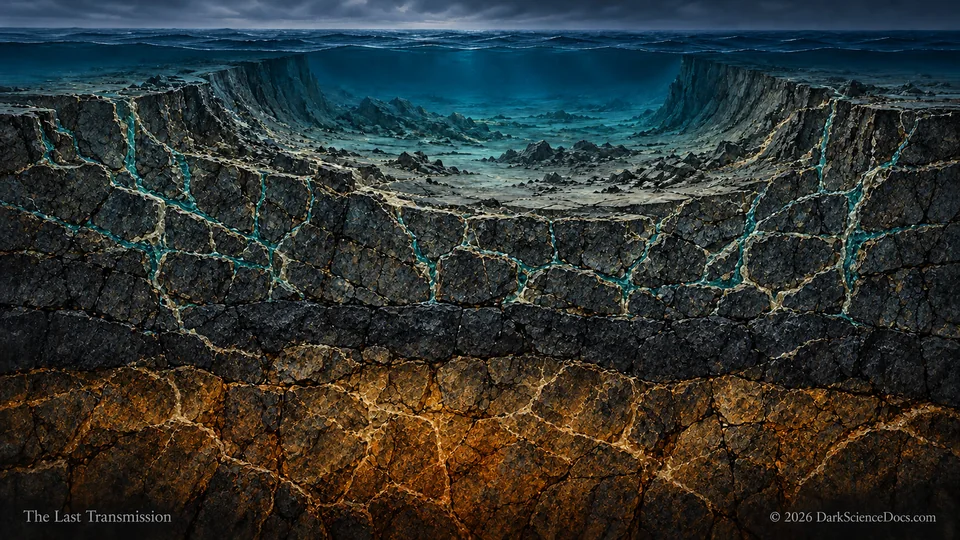
None of these tests is replaced by an illustration. All artwork on these pages is AI-generated conceptual art, with the imagined elements identified in each image story.
ORIGINAL RECORDS
Check the research.
- NASA Earth Observatory: the Chicxulub setting
- Senel et al. (2023): impact winter and fine silicate dust
- Lyson et al. (2019): Corral Bluffs recovery record
- Kring et al. (2020): the Chicxulub hydrothermal system
- Pickersgill et al. (2026): hydrothermal duration
- Kring, Whitehouse & Schmieder (2021): sulfur isotope evidence
- Osinski et al. (2020): impacts and origin-of-life hypotheses
- Zeng & Horgan (2025): alteration at Ritchey crater, Mars
- NASA Webb: the challenge of atmospheric biosignatures
Compare a second impact setting.
Read the Hapcheon Evidence File