
DOCUMENTARY / THE LAST TRANSMISSION
Dinosaur Extinction: Why Mammals Survived When Dinosaurs Didn’t
If the player is unavailable, watch directly on YouTube .
Video published Runtime: 13 min 44 sec
Watch The Last Transmission’s documentary, then examine mammal survival, the impact winter, and the distinction between a potential habitat and evidence of life.
THE QUESTION BEHIND THE FILM
Why did some lineages endure when so many others disappeared?
ORIGINAL VIEWING GUIDE
Watch the event. Question the aftermath.
Watch the food web
Look beyond the visible collision to the loss of sunlight and the interruption of food supplies. Ask which resources remain available to different organisms.
Treat survival as a combination
A refuge, a flexible diet, or a small body may matter in a particular setting. Ask whether the film’s example explains every survivor or illustrates one possible advantage.
Separate survival from recovery
An animal enduring the crisis and a diverse ecosystem returning are different stories. Compare the dramatic moment with the slower record preserved in fossils.
Follow the companion research carefully
The article extends the survival story into cooling crater habitats and the search for life elsewhere. That extension is a research question; it does not turn a Martian mineral map into a biological discovery.
THE EVIDENCE TRAIL / RESEARCH COMPANION
Follow each claim to its record.
These are research waypoints, not video timestamps. The companion research extends the film’s survival question into crater habitats and astrobiology.
01 / 05
The light crisis
Observed or modeled
Sediment measurements inform impact-winter simulations. The 2023 fine-dust study models a severe reduction in photosynthetic light for almost two years.
What it suggests
Food webs dependent on sunlight would face a crisis extending beyond the moment of impact.
Where the claim stops
That interval is a model result, not a directly measured global stopwatch. Dust, soot, and sulfur contributions depend on the inputs and assumptions.
Senel et al. (2023): impact winter and fine silicate dust02 / 05
Survival and recovery
Observed or modeled
The Corral Bluffs fossil sequence records changes in mammals and plants during the first million years after the extinction.
What it suggests
Recovery unfolded through changing ecological opportunities; surviving the initial disaster and rebuilding an ecosystem are different events.
Where the claim stops
One regional record cannot represent every environment. Survival did not make humans, intelligence, or a particular evolutionary outcome inevitable.
Lyson et al. (2019): Corral Bluffs recovery record03 / 05
The crater’s second environment
Observed or modeled
Drilled rocks record heat-driven water circulation. The 2026 mineral-dating and simulation study supports at least eight million years of hydrothermal activity at Chicxulub.
What it suggests
An impact’s aftermath can include an extended interaction between water, heat, and rock.
Where the claim stops
System duration does not show that every location stayed habitable, that one microbial community persisted throughout, or that life originated there.
Pickersgill et al. (2026): hydrothermal duration04 / 05
A chemical clue to microbial activity
Observed or modeled
Sulfur isotope differences in Chicxulub pyrite are interpreted as evidence of microbial sulfate reduction.
What it suggests
Mineral chemistry can preserve information about possible biological processes after the impact.
Where the claim stops
This is an interpretation of an isotope record, not recovered DNA or a direct photograph of microbes. It is distinct from dating the hydrothermal system.
Kring, Whitehouse & Schmieder (2021): sulfur isotope evidence05 / 05
A target on Mars
Observed or modeled
CRISM mineral mapping at Ritchey crater shows alteration patterns interpreted as an impact-melt and groundwater system.
What it suggests
Crater rims can offer targets for examining water-rock interaction and possible preservation of biological traces.
Where the claim stops
The study reports geology, not life. A setting capable of supporting organisms and a detected biosignature require different evidence.
Zeng & Horgan (2025): alteration at Ritchey crater, MarsStill open: which observations would separate a suitable environment from a preserved biological signal?
CONTINUE THE INVESTIGATION
From the film to the evidence.
The text above is an original viewing guide and research companion, not a verbatim transcript or a list of timed video chapters.
SIX ILLUSTRATIONS / SIX QUESTIONS
Look beyond the first impact.
AI-generated conceptual artwork from the companion article. The scenes illustrate research and possibilities; they are not observations.
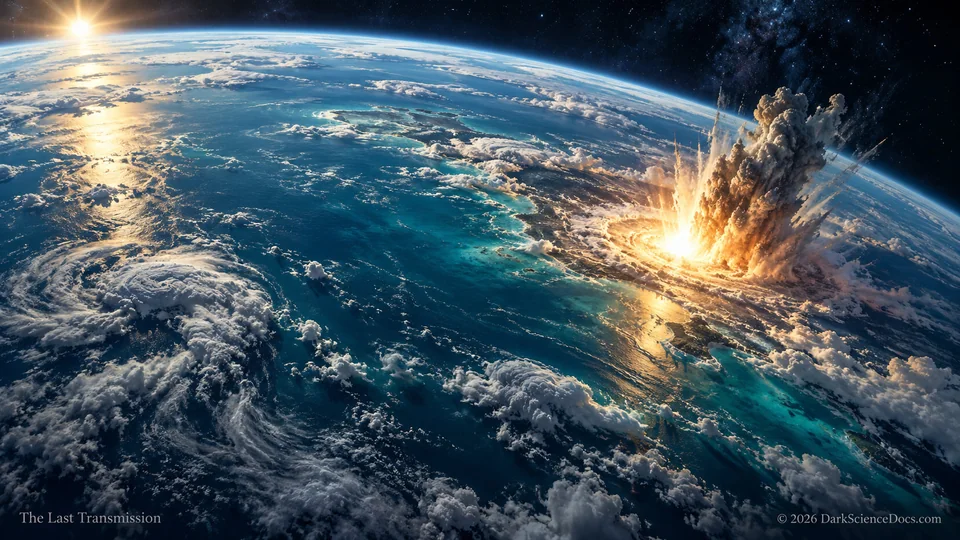
The glowing impact and the planet’s appearance are AI-generated conceptual art. This is neither a satellite photograph of Chicxulub nor an observed impact on an exoplanet.
© 2026 DarkScienceDocs.com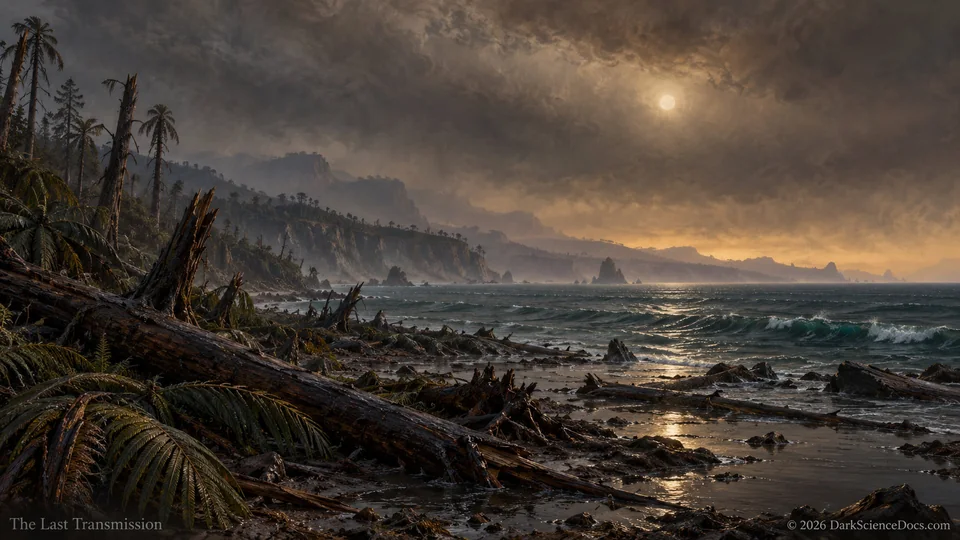
The dim sky and devastated coast illustrate an impact winter. They are not a measured view of a particular day or a claim that every location experienced identical conditions.
© 2026 DarkScienceDocs.com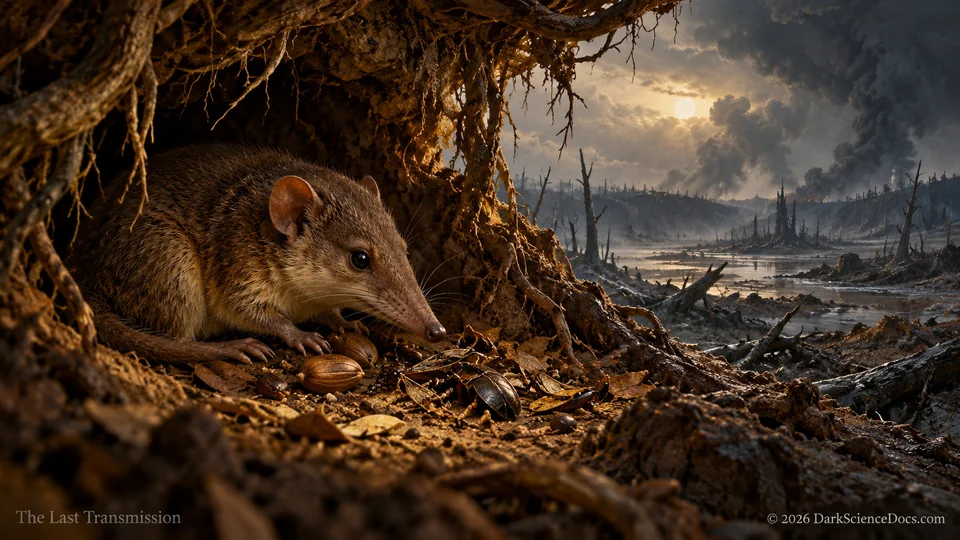
The animal, shelter, and landscape are an AI-generated conceptual reconstruction. This is not a photograph or an identification of a particular fossil species, and later human evolution was not inevitable.
© 2026 DarkScienceDocs.com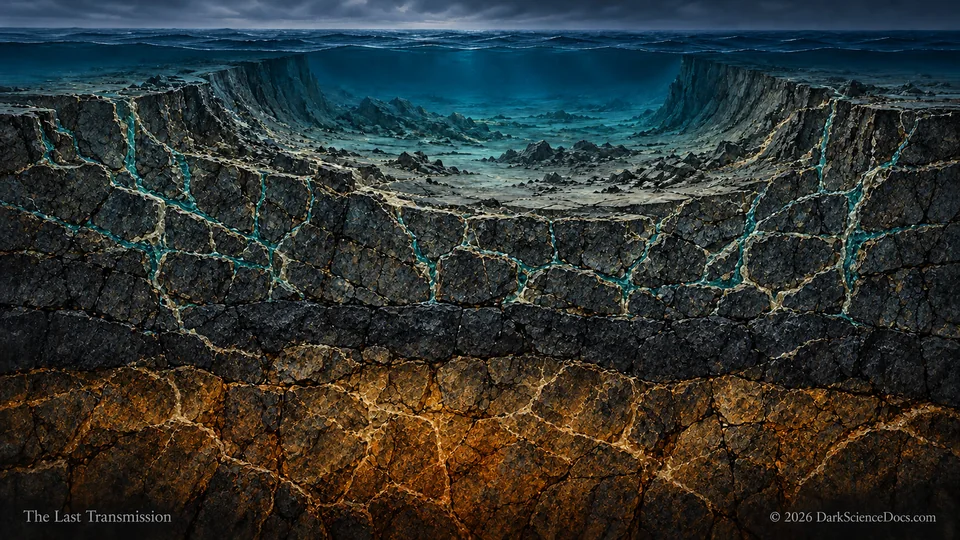
The removed rock face makes hidden pathways visible. Fractures, colors, and geometry are illustrative, not a surveyed cross-section; the scene is not to scale.
© 2026 DarkScienceDocs.com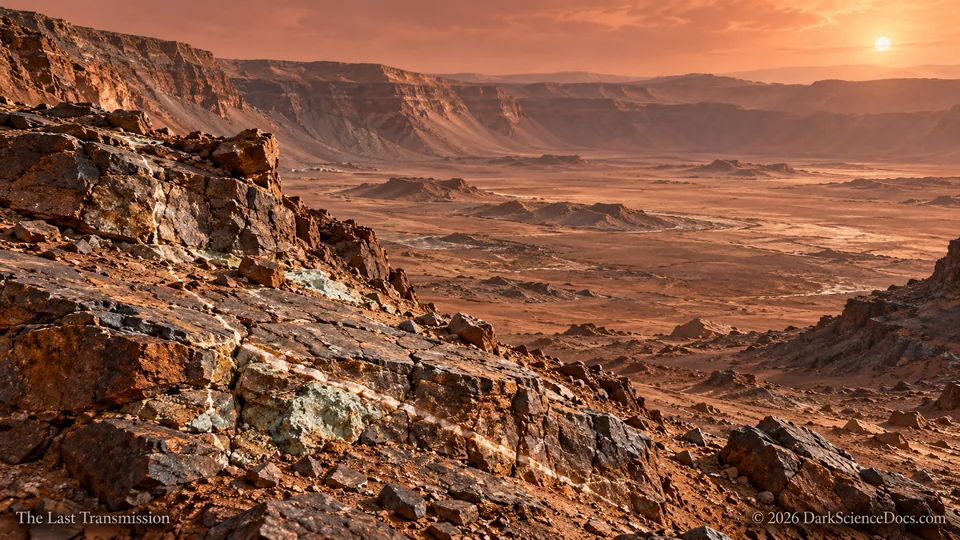
This AI-generated view imagines the geology at human scale. It is not rover footage, a sample photograph, or a detection of Martian life.
© 2026 DarkScienceDocs.com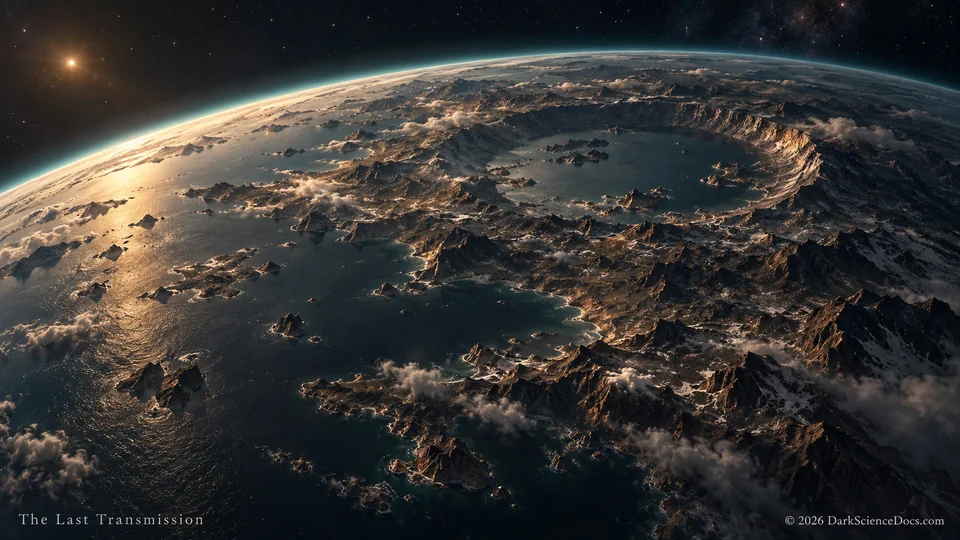
This planet and its surface are invented. No such world has been observed here; the possibility of hidden or recovering life is an inference to investigate, not a reported biosignature.
© 2026 DarkScienceDocs.com