
94 / ALIEN WORLDS & LIFE / FIELD NOTE
Asteroid Craters: Destruction, Survival, and the Search for Life
Follow the evidence from Chicxulub’s impact winter to crater hydrothermal systems, mammal recovery, and the search for habitats on Mars.
A crater can mark both a biological catastrophe and the beginning of a different geological environment. Follow the sequence before deciding what that means for life.
A collision can have more than one aftermath
An impact is an event. Its consequences are a sequence. Chicxulub’s immediate destruction, the later disruption of sunlight and food webs, and the subsequent history of its cooling rocks belong to that sequence, but they answer different scientific questions.
The companion article follows those questions from the end-Cretaceous extinction into astrobiology. It asks us to hold two ideas together: a collision can erase ecosystems, and its damaged crust can later contain places where water and chemical energy meet. Neither idea makes the catastrophe beneficial to everything that lived through it.
Follow the survivors without writing an inevitable ending
The documentary begins with a world that changes too quickly for most of its inhabitants. Small mammals offer an intimate way into that story, but the scientific explanation reaches beyond body size or a single refuge. Food sources, habitat, physiology, and chance shaped which lineages survived.
Fossils then supply a different kind of evidence: a record of recovery. The Corral Bluffs sequence links changes in plants and mammals during the first million years after the extinction. It does not describe an instant replacement of dinosaurs by modern ecosystems. Nor does it turn the distant arrival of humans into the purpose of an asteroid strike.
Look below the damaged surface
Broken rock can allow water to move. Residual heat can drive that circulation, while reactions between water and minerals change the surrounding chemistry. These are reasons to investigate cooling impact structures as potential habitats.
Chicxulub offers drilled samples against which that mechanism can be tested. The duration of hydrothermal activity, the temperatures and chemistry of particular locations, and evidence for biological activity must still be evaluated separately. A system may persist while its habitable regions shift or disappear.
Keep the biological claim attached to its evidence
Sulfur isotope evidence has been interpreted as microbial sulfate reduction in Chicxulub’s hydrothermal system. That is a specific argument about a chemical record. It does not establish that life began in the crater.
Origin-of-life proposals ask a harder question: could a setting help nonliving chemistry cross into living systems? Organisms occupying a habitat afterward cannot by themselves identify the place where that transition first happened. The Evidence File follows this distinction through the original research.
Carry the question to Mars, carefully
At Ritchey crater, mineral mapping supports an interpretation involving impact melt and water moving through fractured rock. That gives researchers a geological reason to look more closely. It does not supply a Martian organism or a confirmed biological signal.
The useful next question is what observations could discriminate among mineral-forming processes and reveal whether biological traces were ever present and preserved. An attractive setting is a starting point for a search, rather than its conclusion.
A quiet atmosphere may leave a question open
Looking at a distant planet’s atmosphere is a different measurement from drilling an impact structure. Clouds, stellar behavior, atmospheric composition, and the limits of a telescope all affect what can be inferred from a spectrum.
The idea that sparse, sheltered, or recovering life could leave a weak atmospheric imprint is a possibility raised by this comparison. It is not a diagnosis of an observed exoplanet. The search becomes stronger when we specify both the evidence we would need and the alternatives we would have to rule out.
READ THE RECORD
Test the steps in the story.
- NASA Earth Observatory: the Chicxulub setting
- Senel et al. (2023): impact winter and fine silicate dust
- Lyson et al. (2019): Corral Bluffs recovery record
- Kring et al. (2020): the Chicxulub hydrothermal system
- Pickersgill et al. (2026): hydrothermal duration
- Kring, Whitehouse & Schmieder (2021): sulfur isotope evidence
- Osinski et al. (2020): impacts and origin-of-life hypotheses
- Zeng & Horgan (2025): alteration at Ritchey crater, Mars
- NASA Webb: the challenge of atmospheric biosignatures
SIX ILLUSTRATIONS / SIX QUESTIONS
Look beyond the first impact.
AI-generated conceptual artwork from the companion article. The scenes illustrate research and possibilities; they are not observations.
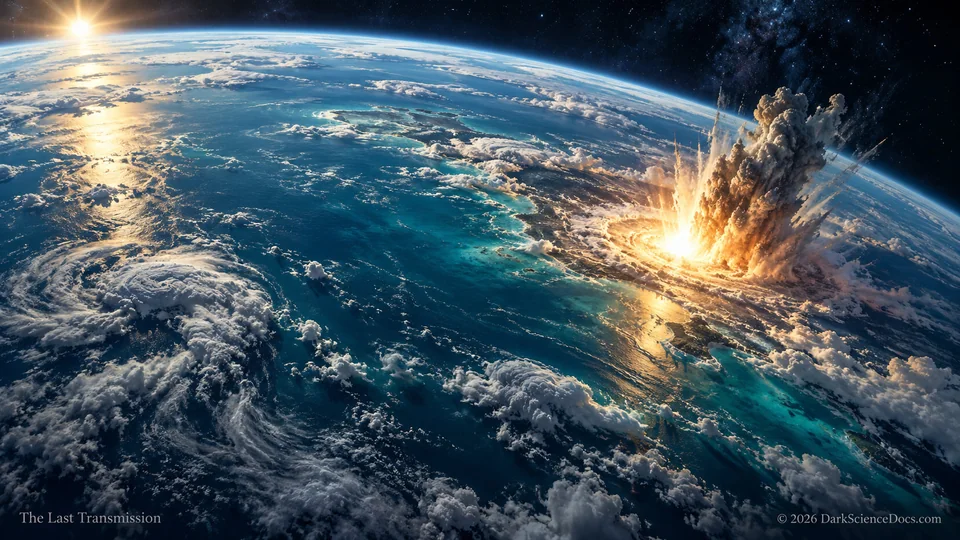
The glowing impact and the planet’s appearance are AI-generated conceptual art. This is neither a satellite photograph of Chicxulub nor an observed impact on an exoplanet.
© 2026 DarkScienceDocs.com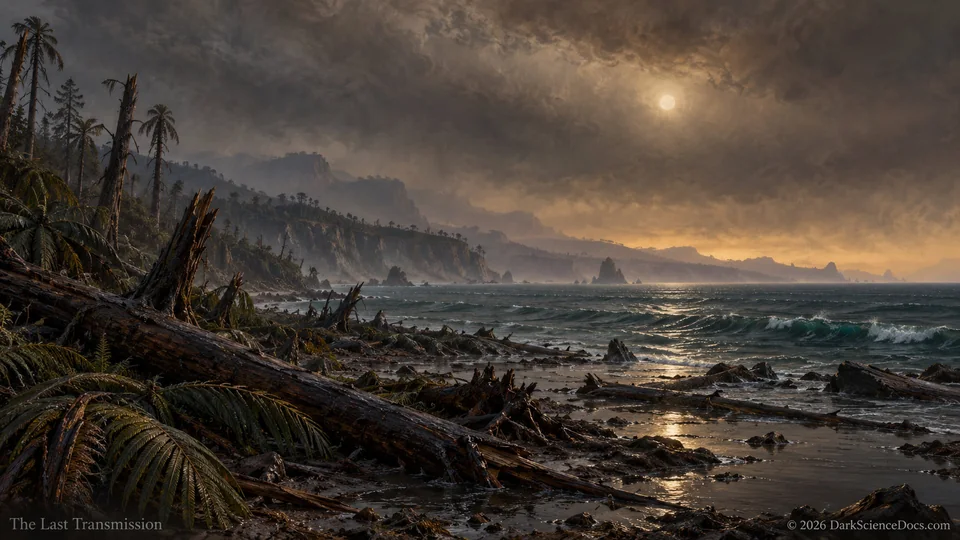
The dim sky and devastated coast illustrate an impact winter. They are not a measured view of a particular day or a claim that every location experienced identical conditions.
© 2026 DarkScienceDocs.com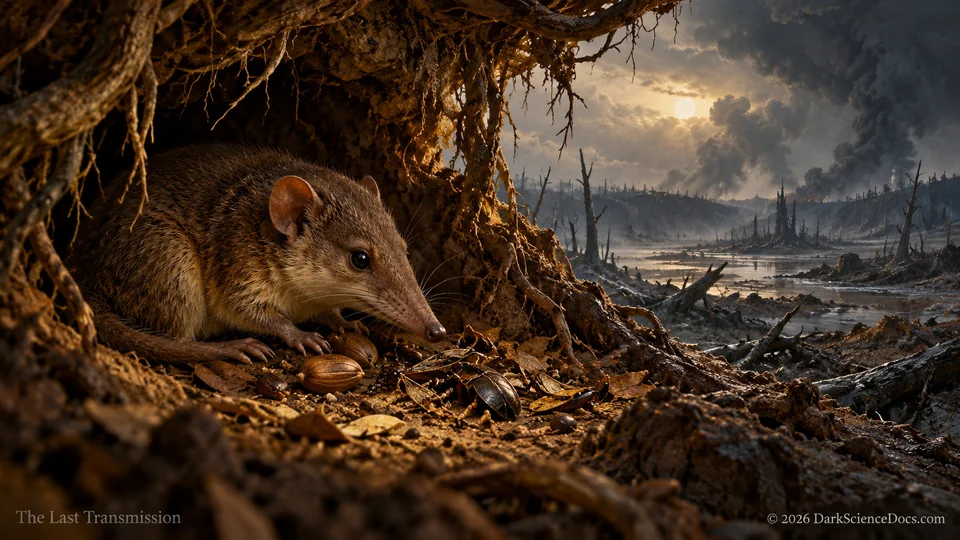
The animal, shelter, and landscape are an AI-generated conceptual reconstruction. This is not a photograph or an identification of a particular fossil species, and later human evolution was not inevitable.
© 2026 DarkScienceDocs.com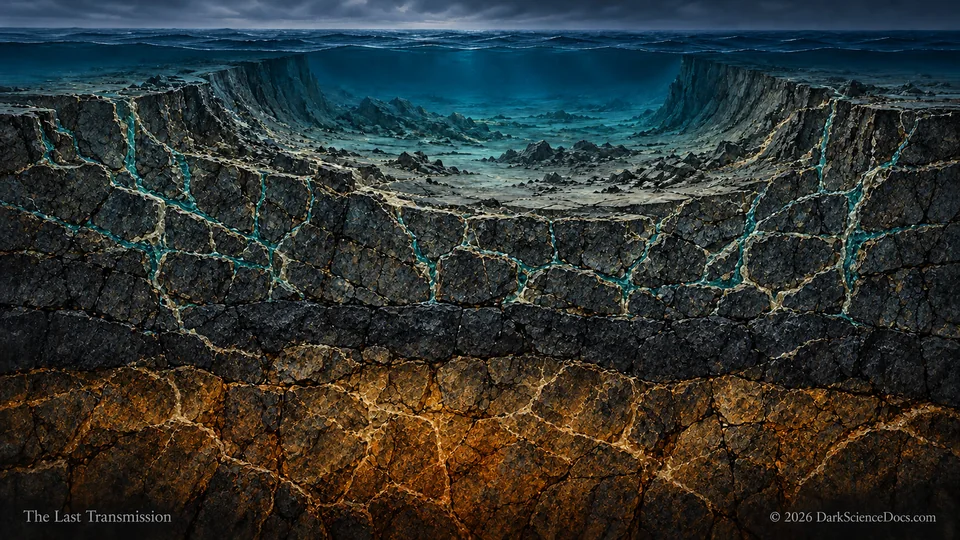
The removed rock face makes hidden pathways visible. Fractures, colors, and geometry are illustrative, not a surveyed cross-section; the scene is not to scale.
© 2026 DarkScienceDocs.com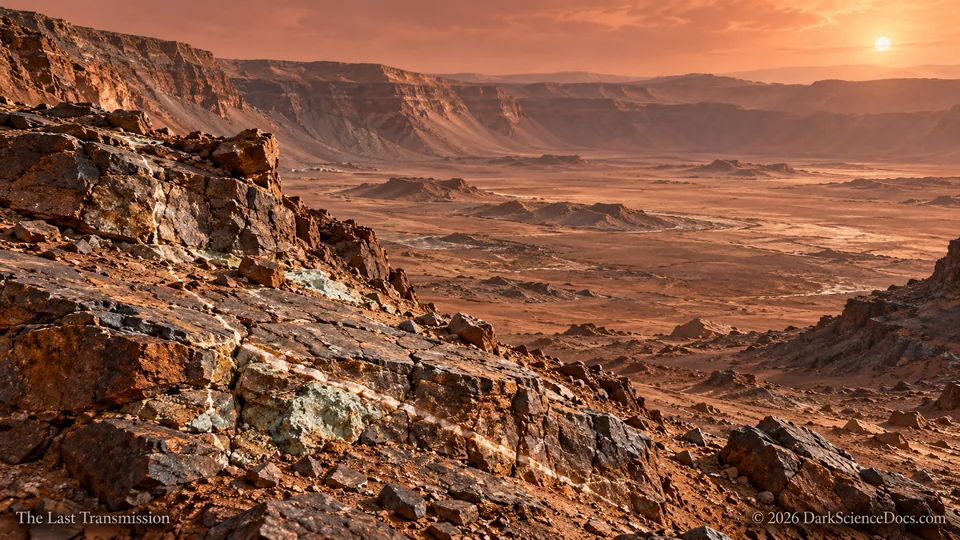
This AI-generated view imagines the geology at human scale. It is not rover footage, a sample photograph, or a detection of Martian life.
© 2026 DarkScienceDocs.com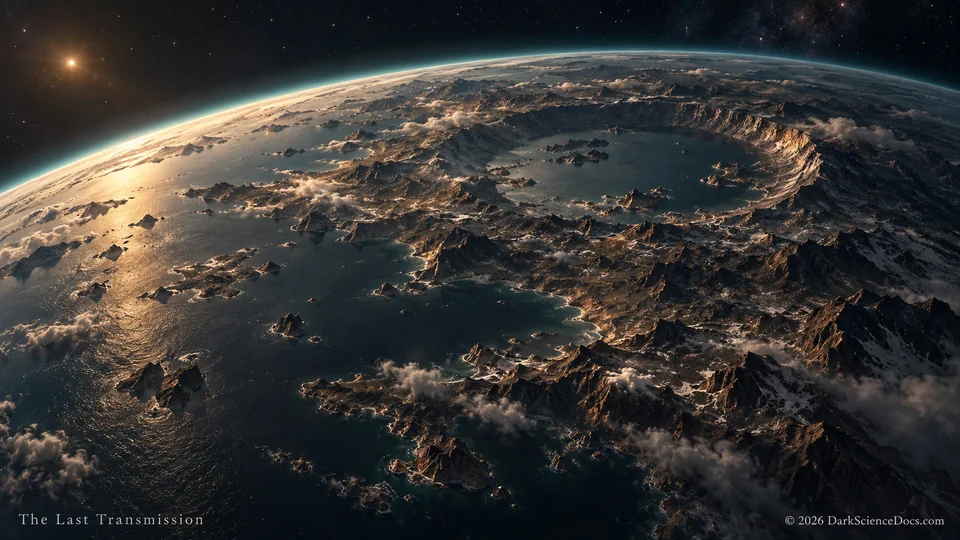
This planet and its surface are invented. No such world has been observed here; the possibility of hidden or recovering life is an inference to investigate, not a reported biosignature.
© 2026 DarkScienceDocs.comRELATED INVESTIGATIONS
Another crater, a different record.
Hapcheon’s later lake and Chicxulub’s cooling rocks are distinct environments. Compare how each geological sequence connects an impact to a possible habitat.
Explore the Hapcheon investigation Investigate early-Earth chemical refuges