
EVIDENCE FILE 34 / LUNAR CAVES
What Does the Evidence for Lunar Caves Establish?
Do lunar cave observations establish a place people can safely inhabit?
All Evidence FilesTHE SHORT ANSWER
Orbital radar supports a cave conduit beneath the Mare Tranquillitatis pit, while thermal observations and modeling suggest stable conditions in particular shaded areas. These findings identify places worth investigating; they do not certify a settlement site.
THE EVIDENCE MAP / LUNAR CAVES
From an orbital signal to a habitat claim
Follow the gap between evidence of a passage and proof of a safe home.
- 01Measurement
A radar return and a thermal record
The reported cave evidence comes from a reanalysis of orbital radar observations near the Mare Tranquillitatis pit. The interpretation supports a conduit extending from the pit rather than a complete map of every underground passage. Researchers must connect returned signals with a physical geometry, so the measurement and the inferred shape are related but distinct. A useful next test would constrain the opening and interior more directly, including the parts that orbital observations cannot resolve.
- 02Interpretation
A conduit with a sheltered environment
The temperature result combines orbital observations with computer modeling of the pit environment. Its scope is particular shaded conditions associated with the Mare Tranquillitatis pit, not every lunar cave or the whole lunar surface. A sheltered thermal environment could reduce one engineering challenge. It does not supply an atmosphere, and it does not establish that all locations within a possible passage share the same conditions. A habitat assessment would need location-specific measurements and their uncertainties.
- 03Competing explanation
Different sites and incomplete geometry
NASA selected GIMLI to examine the Marius Hills pit and test whether it leads into a larger underground lava tube. That target must not be merged with the Mare Tranquillitatis radar result as though both records describe the same cavern. A selected investigation is also different from a completed survey. Measurements at Marius Hills could constrain its own underground geometry and geological history; they would not automatically certify either location for settlement.
- 04Open test
Measure access, structure and conditions
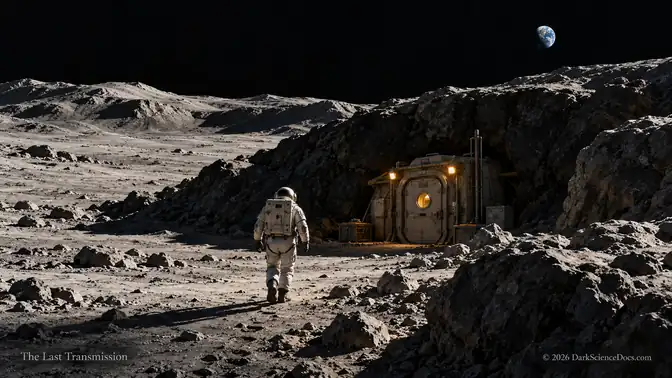
Rock overhead could be useful protection in a suitable location, but a possible cave is not a ready-to-occupy home. Access, roof stability, dust, construction logistics and emergency routes would require investigation. Inhabited modules would still have to retain pressure and maintain air, heat and power. The documentary’s sealed rooms illustrate this engineering distinction. Neither the surrounding rock nor an attractive interior rendering demonstrates that the supporting systems have been built or validated on the Moon.
OBSERVATION / INFERENCE / LIMIT
Read the signal.
A candidate conduit
An orbital signal interpretation supports a passage beneath Mare Tranquillitatis; the full cave is not mapped.
Particular shaded conditions
A modeled sheltered environment is not a global cave temperature or a source of breathable air.
GIMLI at Marius Hills
A separate selected investigation will examine whether that pit connects with a lava tube.
INSIDE THE EVIDENCE
The chain of reasoning.
Each step has a different level of certainty. Follow the measured result into the explanation, then see where the trail ends.
What the radar record can establish
The reported cave evidence comes from a reanalysis of orbital radar observations near the Mare Tranquillitatis pit. The interpretation supports a conduit extending from the pit rather than a complete map of every underground passage. Researchers must connect returned signals with a physical geometry, so the measurement and the inferred shape are related but distinct. A useful next test would constrain the opening and interior more directly, including the parts that orbital observations cannot resolve.
NASA: radar evidence beneath the Mare Tranquillitatis pitWhat the thermal result applies to
The temperature result combines orbital observations with computer modeling of the pit environment. Its scope is particular shaded conditions associated with the Mare Tranquillitatis pit, not every lunar cave or the whole lunar surface. A sheltered thermal environment could reduce one engineering challenge. It does not supply an atmosphere, and it does not establish that all locations within a possible passage share the same conditions. A habitat assessment would need location-specific measurements and their uncertainties.
NASA: orbital observations and thermal modeling of lunar pitsWhy Marius Hills is a separate investigation
NASA selected GIMLI to examine the Marius Hills pit and test whether it leads into a larger underground lava tube. That target must not be merged with the Mare Tranquillitatis radar result as though both records describe the same cavern. A selected investigation is also different from a completed survey. Measurements at Marius Hills could constrain its own underground geometry and geological history; they would not automatically certify either location for settlement.
NASA: GIMLI selection and the Marius Hills investigationNatural shielding is not life support
Rock overhead could be useful protection in a suitable location, but a possible cave is not a ready-to-occupy home. Access, roof stability, dust, construction logistics and emergency routes would require investigation. Inhabited modules would still have to retain pressure and maintain air, heat and power. The documentary’s sealed rooms illustrate this engineering distinction. Neither the surrounding rock nor an attractive interior rendering demonstrates that the supporting systems have been built or validated on the Moon.
NASA: GIMLI selection and the Marius Hills investigationKeep the cave and the ice questions separate
Evidence for an underground void does not identify a water resource inside it. Lunar polar ice measurements concern different terrain and instruments, with their own limits on abundance, depth and accessibility. A plan that needs both shelter and water must establish each requirement independently. The Lunar Ice Prospector game makes that distinction through fictional hydrogen clues and sample assays; its invented terrain and deposits provide no observations about either Marius Hills or Mare Tranquillitatis.
THE EASY MISREADING
The full extent, access conditions and structural stability of candidate caves remain unsettled. Marius Hills and Mare Tranquillitatis are different locations. Neither cave evidence nor a sheltered temperature establishes breathable air, usable local ice or a safe inhabited base.
PRIMARY RESEARCH & MISSION RECORDS
Check the source.
These are the studies and mission records behind this explainer. The illustrated article and related research pages continue the investigation.
FOLLOW THE THREAD
Stay with the question.
Could ancient lunar caves help shelter future explorers, and what would still have to be engineered before anyone could call one home? Follow radar evidence, thermal models and the distinction between a natural shelter and a habitable room.
MORE EVIDENCE FILES
Keep looking.
EVIDENCE FILE 01 / EUROPA
How Do We Know Europa Has an Ocean?
Galileo's magnetic measurements point to a conducting layer beneath Europa's ice. A salty ocean is the leading explanation. Its chemistry and seafloor activity remain open questions.
Read the evidence
EVIDENCE FILE 02 / TITAN & PLUTO
What Is the 5.11-Micrometer Mark on Titan and Pluto?
The 5.11-micrometer absorption is measured on both worlds, but the Pluto feature is broader. A shared wavelength is a clue to investigate, not a chemical identification.
Read the evidence