
A SCIENCE EXPEDITION / 3 CHAPTERS / 8 STOPS
Come Home Younger
Can two travelers reunite after living through different amounts of time?
Make a prediction, fly a return mission, and compare the clocks when the ship comes home. Keep elapsed time, arriving light and a distant assigned “now” separate throughout the journey.
75–120 minutes, across several visits. No deadline; each chapter is a natural place to pause.
Your next step
0 of 8 stops completed
Use “Mark this stop complete & continue” when you are ready to move on. Visiting a page alone never marks it complete.
EXPEDITION COMPLETE
You followed the evidence.
At reunion, which reading tells you how much each traveler aged, which records the Earth light reaching the ship, and which choices in your mission changed the answer?
Your completion marks record your journey, not a qualification or a test score. Revisit any stop below, or choose another expedition.
Choose another expedition →Chapter 1 · Decide which time you mean
- 01
Investigation
Question a universal present
Ready to exploreCompare an assigned distant “now” with the old light an observer actually receives. Explain why changing reference frames does not deliver information faster than light.
- 02
Evidence File
Give the clock to a traveler
Ready to exploreSeparate a light ray’s null path from a material traveler’s proper time. A photon has no rest frame; why does that prevent treating it as a passenger carrying a working clock?
Chapter 2 · Predict, launch, reunite
- 03
Lab guide
Plan the experiment before launch
Ready to exploreRead the quick start, Earth-message readings and model limits. Write a prediction for the reunion clocks and a separate prediction for the cadence of received postcards.
- 04
Interactive lab
Fly your return mission
Ready to exploreUse the Earth-message launch controls or the optional flight deck. Change speed and distance, watch outbound and return legs, then compare Earth and crew elapsed times at reunion. Treat the idealized turnaround separately from a real ship’s acceleration and energy needs.
- 05
Image story
Draw the two histories
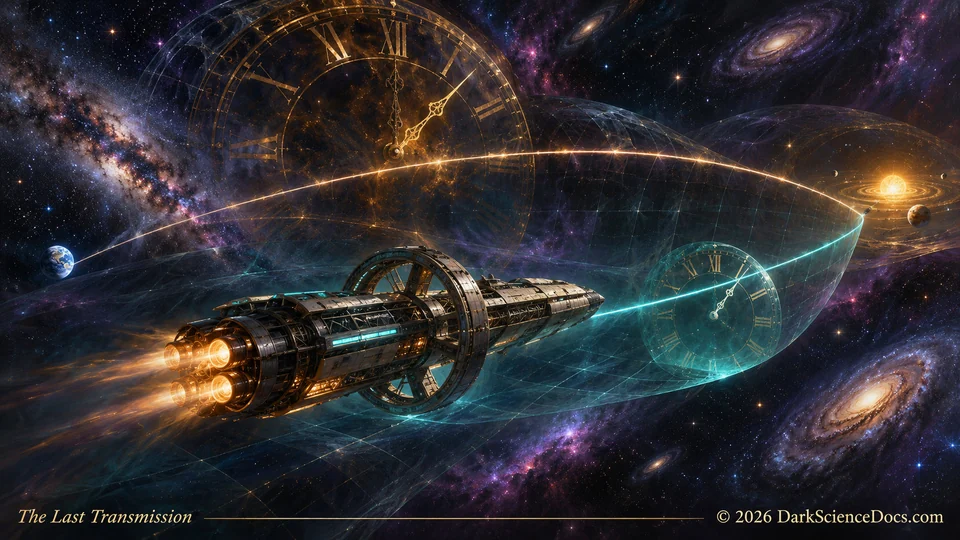
Ready to exploreUse the conceptual worldline artwork as a prompt. Sketch Earth’s path and the crew’s outbound and return path. Label where both clocks meet again; the artwork itself is not measured clock data.
Chapter 3 · Separate the messages from the clocks
- 06
Interactive lab
Put a delay on a light signal
Ready to exploreChoose the signal-travel comparison and vary the distance. Use it to isolate propagation delay, then explain why a stationary-distance calculation alone cannot describe a moving ship’s full reception history.
- 07
Interactive lab
Change the motion, change the received light
Ready to exploreCompare approaching and receding sources in the Doppler teaching model. Relate the shift to a changed reception cadence, while keeping that observation distinct from the reunion clock readings.
- 08
Investigation
Bring the thought experiment back to its limits
Ready to exploreAudit the long-voyage scenario. Separate established relativistic clock relations from imagined visitors, uncertain civilizations and the engineering needed to accelerate, shield and stop a ship.
Manage saved progress
Clear this expedition’s progress in this browser. Your science mystery casebook stays separate.
Clear these completion marks? This cannot be undone.
All stops are available now. Calendar reminders help you return; they do not unlock new content. Progress is saved in this browser when storage is available.