
EXPLORATION GUIDES / FREE PRINTABLE ACTIVITY
Choose a Star's Fate
Follow the core. Check the companion. Explain the ending. A solar mass means the mass of our Sun, but a star's ending also depends on the retained core and a companion. Use four invented cases to explain a possible fate and the information you still need.
4 pages · US Letter, 8.5 × 11 inches · 56 KB
Suggested ages 12+; classrooms, astronomy clubs, and independent readers · 35-45 minutes
YOUR INVESTIGATION
Aim for a claim
you can defend.
Explain a possible stellar endpoint using the core's condition and binary history, while avoiding a rigid rule based only on starting mass.
How to use the packet
Use a pencil and the two learner pages first. The remaining pages hold the answer discussion and sources. You can work alone or compare reasoning in a group. Atlas extensions are optional; a screen is not required.
Print US Letter at actual size, or fit the packet to A4. Color is optional. Print and share the complete guide with attribution and source links intact.
ORIGINAL ANNOTATED DIAGRAM
A route map, with room for uncertainty
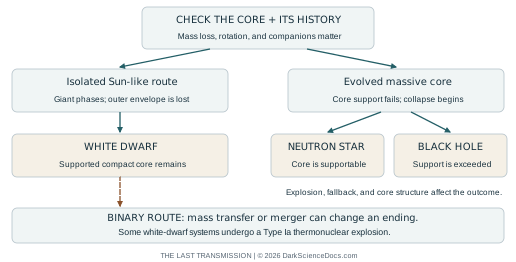
Start here: Underline the part of the star that becomes the remnant. Name one way a companion can change the route.
01 / READ THE CLUES
Follow the case conditions.
These four cases are fictional teaching scenarios with stated conditions. They are not measurements of observed stars.
A quiet ending
An isolated star began with roughly the Sun's mass. It becomes a giant and loses its outer envelope. A carbon-oxygen core remains, supported by electron degeneracy pressure. No companion transfers material to it. [S1] [S2]
Support after collapse
An evolved massive star's core collapses. An explosion ejects much of the envelope. For this case, assume the remaining compact core is within the range supportable as a neutron star and later fallback does not push it beyond that limit. [S2] [S4]
The support limit is exceeded
Another massive core collapses. For this case, assume the retained core and falling-back material exceed the supportable neutron-star limit. A powerful visible explosion is not guaranteed by the information on this card. [S2] [S4]
An ending changed by a companion
A carbon-oxygen white dwarf gains matter from a close companion or takes part in a merger. For this case, conditions trigger runaway nuclear burning that disrupts the white dwarf. Not every accreting white dwarf follows this path. [S3]
02 / WRITE YOUR REASONING
Use the clue. Keep the limit.
S1 / Choose the outcome and defend it
Match cases A-D with white dwarf, neutron star, black hole, or Type Ia thermonuclear explosion. Give a reason from the case card. The cards provide assumed conditions, not additional observations.
S2 / Find the missing information
A star started with 20 solar masses. Can you name its final remnant with certainty? List two additional facts you would want and explain why.
S3 / Separate the explosions
How does core collapse differ from runaway nuclear burning in case D? Does every stellar death produce a bright supernova?
S4 / Test a rule against another system
Rewrite: 'All stars end as black holes, and binary companions only watch.' Use one counterexample and one companion interaction from the activity.
03 / ANSWER DISCUSSION
Compare explanations.
Write your reasoning before opening the discussion. These are defensible explanations, with room for equivalent wording.
S1 / The four cases follow their stated assumptions
A: a white dwarf, because envelope loss leaves a supported carbon-oxygen core. B: a neutron star, because the card explicitly assumes a supportable compact core after collapse. C: a black hole, because the assumed retained mass exceeds neutron-star support. D: a Type Ia thermonuclear explosion, because runaway burning disrupts the white dwarf under the stated conditions. Type Ia is an event here, not a surviving neutron-star remnant. These are fictional teaching cases, not classifications of observed objects.
S2 / Starting mass is only part of the history
A starting mass does not supply the final core structure. Useful additional facts include the pre-collapse core mass and composition, mass lost in winds, rotation, and whether a companion stripped or added material. The explosion and fallback can also change the retained mass. Published model grids do not produce one clean division between neutron stars and black holes at a single initial mass. Accept two relevant facts with an explanation of why they matter.
S3 / Collapse and thermonuclear burning are different routes
In a massive core-collapse event, gravity drives the core inward after it can no longer maintain support; a successful explosion involves energy transport and shock revival. In a Type Ia event, runaway nuclear burning in a white dwarf releases the disruptive energy. An isolated Sun-like star instead loses its envelope and leaves a white dwarf. Some black holes may form without a powerful visible supernova. Brightness alone does not identify a remnant or an explosion mechanism.
S4 / A good revision keeps a counterexample
One defensible revision is: 'Stars can leave white dwarfs, neutron stars, or black holes, depending on their evolution and retained core. A close companion can exchange mass or merge, and some white-dwarf binaries can undergo a Type Ia explosion.' Case A challenges the claim that every star becomes a black hole; case D shows that a companion can change an ending. A complete answer names both the counterexample and the mechanism, rather than replacing one absolute slogan with another.
FOR TEACHERS & ASTRONOMY CLUBS
Make the reasoning visible.
Give learners pages 1-2 first. Spend about 10 minutes on the route map, 20 minutes matching and defending the case cards, and 10 minutes comparing explanations. Discuss why the assumed post-collapse core conditions matter more than guessing a mass threshold. Use page 3 after learners have written their own reasoning.
Optional Atlas extension: compare a single star with a binary in Stellar Fates. Identify the interface's teaching assumptions before describing a result. The animation illustrates a model and does not independently establish a real star's future.
Original activity and diagram by The Last Transmission. Reviewed October 11, 2026. Our explanations synthesize the attributed research; this site did not conduct the underlying observations.
04 / THE SOURCE TRAIL
Check the record.
Primary mission explanations and published research. Source numbers match the downloadable guide.
NASA: Stars ↗
Fusion, gravity, pressure, and the broad stages of a stellar life.
NASA: Types of stars ↗
Giant stars, white dwarfs, neutron stars, and their physical differences.
NASA Roman: Type Ia supernovae ↗
White-dwarf binary progenitors and the distinction from massive core collapse.
Sukhbold et al.: Core-collapse models (2016) ↗
Model-dependent explosion and remnant outcomes across initial masses; a starting mass is not a unique fate.
FOLLOW THE THREAD