
THE LAST TRANSMISSION / FIELD GUIDE 001
Black holes.
The boundary
of return.
Follow light to the place where a message can travel inward and never come back. A field guide to horizons, falling, tidal forces, and the evidence behind the darkness.
Begin at the boundary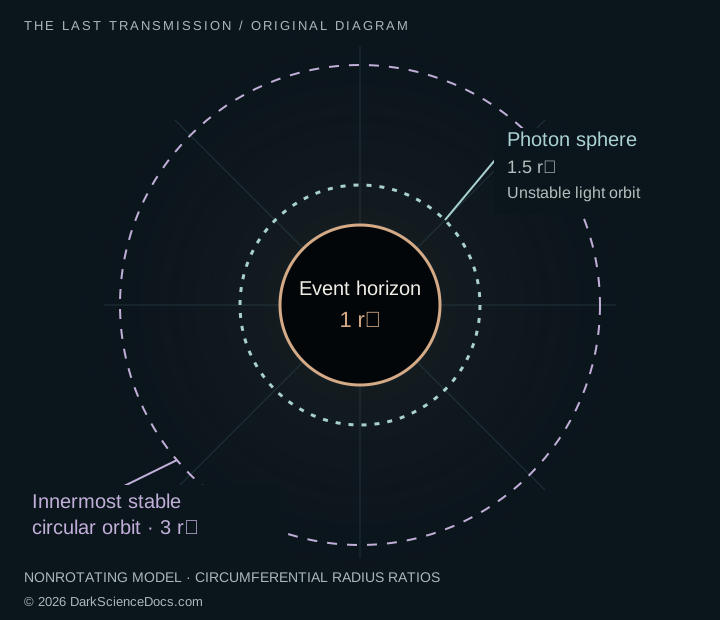
01 / THE BOUNDARY
What is a
black hole?
A black hole is a region of spacetime from which a signal cannot escape to the distant universe. Its defining boundary is the event horizon. A spacecraft can cross that boundary without striking a solid surface, yet every attempt to send a message back faces the same limit: a future-directed route out is no longer available. The darkness is a consequence of how gravity shapes the possible paths of light. [2] [15]
The familiar escape-velocity description is a useful first step, but the deeper account comes from general relativity. Light still moves at its usual local speed. Inside the horizon of the simple nonrotating model used here, decreasing radius becomes unavoidable as time advances. More engine power cannot create an outward path that the geometry does not allow. [15]
From far away, a black hole’s gravity depends on its mass much as another compact object’s gravity does. In the hypothetical replacement of the Sun by an equal-mass black hole, Earth could keep its orbit while losing the sunlight that supports its climate. Our actual Sun lacks the mass needed to become a black hole through ordinary stellar evolution. [1]
02 / READ THE MAP
Three boundaries.
Three different meanings.
Event horizon
At rₛ in this model, the horizon separates the region that can communicate outward from the region that cannot. It is a causal boundary, with no material wall to collide with. [4]
Photon sphere
At 1.5 rₛ, light can follow circular paths that are unstable. A small change sends it inward or outward. This mathematical sphere differs from the bright emission ring reconstructed in a telescope image. [5] [11]
Innermost stable circular orbit
At 3 rₛ, the innermost stable circular orbit marks a limit for freely orbiting massive test particles. Circular paths farther inward are unstable down to the photon sphere. Rotation changes these landmarks. [5]
rₛ = 2GM/c² is the Schwarzschild horizon radius. The diagram uses the circumferential radius and preserves these radius ratios. It is not a map of proper radial distances, an image of the interior, or a ray-traced view. Spin, surrounding matter, and the observer’s position change a real black hole’s appearance. [4] [16]
03 / TWO CLOCKS
What happens
when you fall in?
Your own clock continues to mark your experience. For an ideal freely falling observer, crossing a sufficiently large black hole’s horizon can happen in finite proper time without a special collision at the boundary. In an empty region with mild local tides, the crossing need not announce itself through a sudden physical jolt. The clock you carry does not stop. [5] [7]
A distant observer receives a different sequence of information. Light sent outward before your crossing arrives increasingly delayed and redshifted; the apparent approach slows and the signal fades. The familiar frozen picture is an idealized limiting description. It does not leave a permanently bright astronaut visible at the horizon, and it does not prevent the astronaut from crossing according to their own clock. [6]
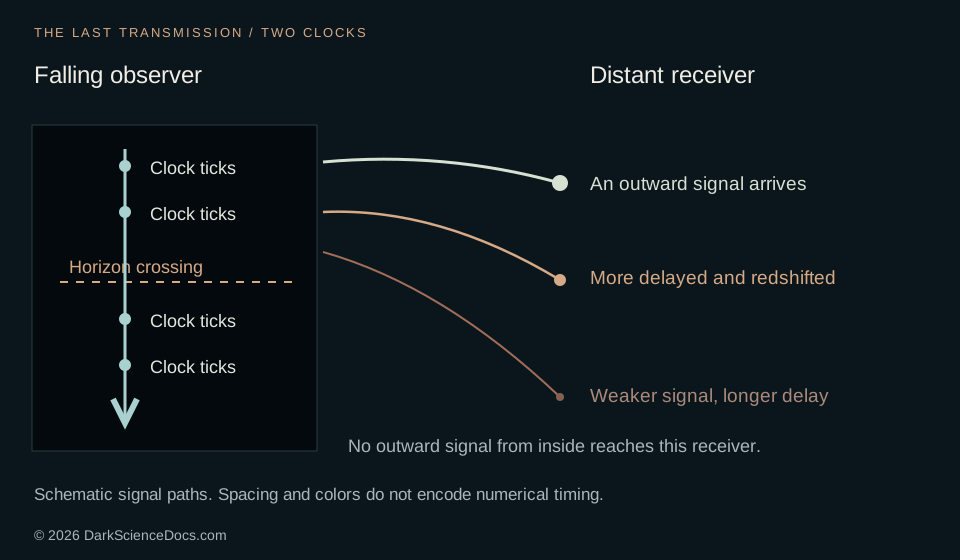
The environment decides whether a visitor survives long enough to experience any of this. Radiation, hot plasma, and tidal stretching can destroy a spacecraft before it reaches the horizon. In the classical Schwarzschild model, continued infall eventually reaches a singularity where the equations cease to provide a complete physical account. The model’s endpoint cannot tell us what a quantum theory of gravity would predict. [7] [15]
Try the Atlas’s falling viewpoint04 / TIDAL FORCES
The difference
that tears.
Spaghettification begins with a difference in gravitational acceleration across an object. If you fall feet first, your feet follow a more strongly accelerated path than your head. Radial stretching combines with compression in the sideways directions. A sufficiently large difference overwhelms the forces holding the object together. [16]
A star can encounter destructive tides while remaining outside the event horizon. Astronomers observe tidal disruption events through changes in light as disrupted material evolves, falls inward, and sometimes flows outward. In AT2019qiz, telescopes followed the flare and surrounding outflow, giving researchers evidence of a stellar destruction process that a single dramatic illustration cannot establish. [8]
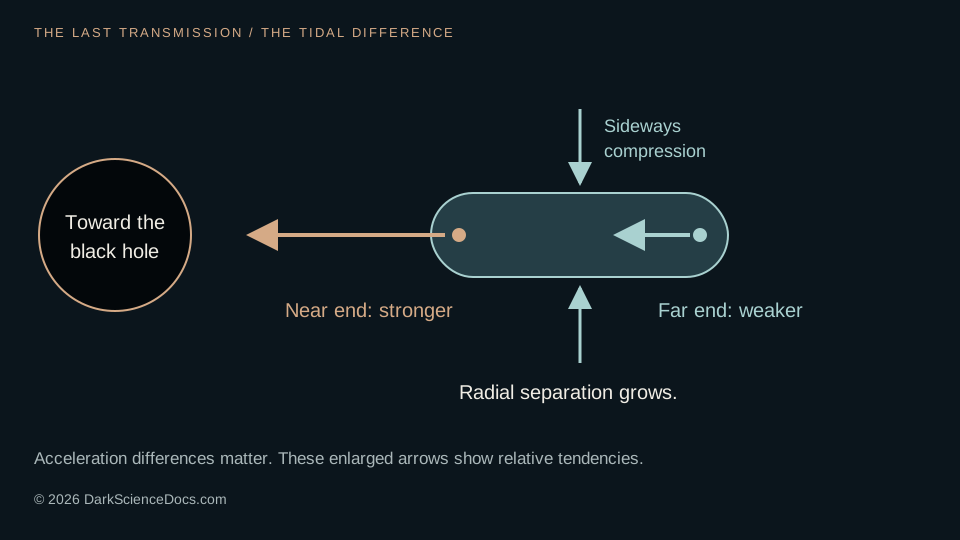
The surprising comparison appears when we stand at the same relative distance from black holes of different masses. A larger mass makes a larger horizon. At that enlarged horizon, the radial tidal difference across the same short object becomes smaller. The interactive model below calculates this relationship; it does not calculate injury, spacecraft survival, gas temperature, or radiation exposure. [4] [5] [7]
05 / CHANGE THE MASS
A larger horizon.
A gentler gradient.
Choose a black hole and move the sampling point from the horizon to three horizon radii. Keep the object’s radial length fixed at two metres, then compare the change in its tidal acceleration.
A stellar remnant
- Horizon radius
- Horizon diameter
- Radial tidal difference across 2 metres
See the equations and assumptions
The horizon radius is rₛ = 2GM/c². The radial acceleration difference across a short separation L in a freely falling Schwarzschild frame is Δa = 2GML/r³. Substituting r = q rₛ gives Δa = c²L/(q³rₛ²), so at fixed q and L it falls as 1/M². These outputs are derived calculations. We use c = 299,792,458 m/s, a nominal solar GM of 1.3271244 × 10²⁰ m³/s², L = 2 m, and Earth’s standard gravity of 9.80665 m/s². [4] [16] [17]
The model assumes no spin or charge, a short radial separation, and no surrounding gas or radiation. Horizon radius is a circumferential coordinate radius. The tidal value is a local acceleration difference, not the acceleration needed to hover, a force on a specified mass, or a human survival threshold. Preset masses are rounded; the ten-Sun example is hypothetical.
The comparison, available without JavaScript
| Example | Mass / Sun | Horizon radius | Tidal difference |
|---|---|---|---|
| A stellar remnant | 10 | 29.5 km | 2.06e+8 m/s² |
| Sagittarius A* | 4,000,000 | 11,800,000 km | 1.29e-3 m/s² |
| M87* | 6,500,000,000 | 19,200,000,000 km | 4.88e-10 m/s² |
Rounded masses: Sagittarius A* [10]; M87* [11]. Scientific notation such as 1.29e-3 means 0.00129. An astronomical unit (AU) is 149,597,870.7 km, approximately the Earth–Sun distance.
06 / THE LIGHT OUTSIDE
Why can darkness
look so bright?
The glow associated with a feeding black hole comes from matter outside its event horizon. Gas carrying angular momentum can form an accretion flow. As material interacts and moves inward, energy becomes heat and radiation. Magnetic fields and plasma processes help shape an environment that may include a hot corona, an outflow, or powerful jets. An isolated black hole with little material around it can be much harder to find. [3]
Gravitational lensing changes the image reaching us. Light from the far side of a disk can arrive along bent paths, while motion changes the apparent brightness of different regions. The dark shadow arises from light capture and the geometry of those paths. Its apparent size is larger than the horizon’s projected scale, and the reconstructed bright ring does not paint the event horizon itself. Jets likewise originate in the surrounding system; they are not matter escaping from inside the horizon. [3] [11]
Follow TON 618 into the quasar story07 / HOW WE KNOW
The darkness leaves
more than one record.
Follow what returns.
Positions and spectra let researchers reconstruct stars’ motion around an unseen central mass. S2’s repeated passages around Sagittarius A* constrained that mass, and its turning orbit supplied a further test of general relativity. Measurements over many years matter more than a single evocative frame. [9]
Read the S301 Evidence File ↗Reconstruct the ring.
The Event Horizon Telescope combines observations from distant radio dishes into an Earth-scale interferometer. Its M87* and Sagittarius A* images reconstruct emission around a dim central region. Researchers compare those records with simulations and other mass constraints; the images do not show the interior. [10] [11]
Compare the illustrated Atlas view ↗Measure spacetime moving.
GW150914 was detected on September 14, 2015, when two LIGO instruments recorded a signal consistent with merging black holes. The measured waveform carries information about the inspiral, merger, and remnant. This is a different physical record from surrounding gas glowing in a telescope image. [12]
Inspect the detection record ↗Ask what a record measures before deciding what its image means. A stellar orbit measures motion, a radio image reconstructs emission, and an interferometer measures a changing strain. Their interpretation requires physical models with assumptions that can be checked.
08 / FAMILIES
One boundary.
Many histories.
Stellar-mass black holes can form from the collapse of massive stellar cores. Intermediate-mass objects occupy an approximate range between stellar remnants and the supermassive black holes found in galactic centers. The category boundaries are conventions rather than separate laws of nature, and confirming intermediate-mass candidates remains an active observational challenge. [13]
Supermassive black holes can grow through accretion and mergers, while the origins of their earliest seeds remain uncertain. Primordial black holes belong to a different proposed history: formation from very early cosmic conditions rather than stars. They remain hypothetical. A possible formation route should not be given the same status as a measured black-hole population. [13]
Explore how stellar remnants begin09 / OPEN QUESTIONS
The guide has
an unfinished edge.
What replaces the singularity?
The classical equations reach a limit where a complete physical description is missing. A diagram cannot supply the absent quantum theory of gravity, and an imagined interior cannot serve as observational evidence. [15]
How did the earliest giants grow?
Seed masses, gas supply, growth rates, and mergers compete in explanations of early supermassive black holes. The existence of a bright distant source is a starting point; its inferred mass and history require further analysis. [13]
Can evaporation be observed?
Hawking radiation is a quantum prediction. For the astrophysical black holes discussed here, its expected emission is extremely weak. The luminous gas seen by telescopes is a different process and does not establish a measurement of Hawking radiation. [14]
10 / QUICK ANSWERS
Questions to keep
beside the picture.
Is the bright ring the event horizon?
The ring is reconstructed emission from the surrounding region, shaped by gravity and plasma. The horizon itself cannot send outward light. The shadow and horizon describe different things. [10] [11]
Can something orbit a black hole?
Yes. Stars and gas can orbit outside it. In the nonrotating test-particle model, stable circular orbits extend inward to three horizon radii. This boundary changes with spin and says nothing by itself about surviving radiation or collisions. [16]
Will every black hole instantly pull you in?
No. At a sufficient distance, mass and your trajectory determine whether you orbit, pass by, or fall inward. A black hole does not have an additional vacuum-cleaner force extending through space. [1]
Would crossing the horizon stop your clock?
Your proper time continues through the crossing. The distant observer receives an increasingly delayed and redshifted signal. Those two accounts use different information and different clocks. [6]
Are black holes proven shortcuts to another universe?
No observation establishes a traversable passage through an astrophysical black hole. Speculative spacetime geometries require their own assumptions and evidence. The horizon and singularity in this guide do not provide a demonstrated travel route. [1]
11 / FOLLOW THE SIGNAL
Take the question
somewhere deeper.
Cross the horizon in a teaching model.
Follow a light path, release a probe, and enter the falling viewpoint. Read the model assumptions alongside the experience.
Enter the dark heart ↗INVESTIGATION / A RETURNING STARCould an orbit reveal spin?
Follow S301 into the proposed observing test, then distinguish an intriguing orbit from a completed measurement.
Open the investigation ↗ILLUSTRATED ARTICLE / STELLAR EXILEWhen a partnership breaks.
Follow the story of a binary encounter and the evidence linking a runaway star to the Galactic Center.
Read on Substack ↗ILLUSTRATED ARTICLE / AN ENCOUNTERA world can lose its Sun.
Explore a hypothetical gravitational encounter that changes an orbit before the event horizon ever becomes relevant.
Read on Substack ↗VISUAL ARCHIVE / QUASAR LIGHTRead the artwork’s evidence trail.
Separate the illustrated cosmic setting from the observations used to interpret an exceptionally bright source.
Open the image story ↗DOCUMENTARY / A SEPARATE QUESTIONWhat could a spacetime shortcut mean?
Explore proposed Krasnikov and Alcubierre geometries. The film examines speculative concepts beyond the black-hole model in this guide.
Watch the documentary ↗Continue across the collection: all Field Guides · Oceans Beyond Earth · How Stars Die.
12 / SOURCES & FURTHER READING
Keep the record
within reach.
Numbered links return to the records behind the explanation. Agency explainers provide context, research papers document analyses, and university teaching pages state the mathematical models. The original diagrams are explanatory drawings; the mass comparison is a calculation under the assumptions shown above.
NASA Science: Black Holes
A starting point for detection methods, distant gravity, and common misconceptions.
Back to source list ↑ESA: Black holes
An agency overview of collapse, extreme gravity, and how black holes affect their surroundings.
Back to source list ↑NASA Science: Anatomy of a Black Hole
Accretion, light bending, the shadow, jets, and the limits of the classical singularity prediction.
Back to source list ↑Andrew Hamilton, JILA: Schwarzschild Geometry
The radius formula and the distinction between coordinate descriptions and local physics.
Back to source list ↑Andrew Hamilton, JILA: Journey into a Schwarzschild black hole
Photon orbits, the innermost stable circular orbit, horizon crossing, and tidal stretching.
Back to source list ↑Andrew Hamilton, JILA: Orbiting the Black Hole
The falling probe’s clock compared with its redshifted appearance to an outside observer.
Back to source list ↑NASA Goddard: A camera journey beyond the brink
A calculated visualization with explicit mass, trajectory, time, and survival assumptions.
Back to source list ↑ESO: Death by Spaghettification (2020)
Observations of the tidal disruption event AT2019qiz and material expelled during the encounter.
Back to source list ↑ESO: S2’s turning orbit (2020)
Long-term stellar observations reveal orbital precession around Sagittarius A*.
Back to source list ↑Event Horizon Telescope: Sagittarius A* (2022)
The Galactic Center image, a rounded four-million-solar-mass value, and the challenge of rapidly changing emission.
Back to source list ↑EHT Collaboration: First M87 Results, Paper I (2019)
The reconstructed emission ring, a dark interior, model comparisons, and the 6.5-billion-solar-mass inference.
Back to source list ↑LIGO Scientific Collaboration: GW150914
The first detection of gravitational waves from a binary black-hole merger.
Back to source list ↑NASA Science: Types of Black Holes
Mass categories, formation routes, intermediate-mass candidates, and hypothetical primordial objects.
Back to source list ↑Andrew Hamilton, JILA: Hawking Radiation
The quantum prediction and why radiation from astrophysical black holes is extremely weak.
Back to source list ↑Markus Pössel, Einstein Online: Changing places
Causal trapping and why a simple drawing of a central point can mislead about the interior.
Back to source list ↑Andrew Hamilton, JILA: Approaching the Black Hole
The M/r³ tidal scaling, idealized boundary markings, and the limit for stable circular orbits.
Back to source list ↑Prša et al.: IAU 2015 Resolution B3 (2016)
The nominal solar conversion constants used for the comparison’s mass parameter.
Back to source list ↑Published and reviewed October 11, 2026. Future revisions should identify a changed measurement or interpretation, update the affected explanation, and preserve this guide’s URL.