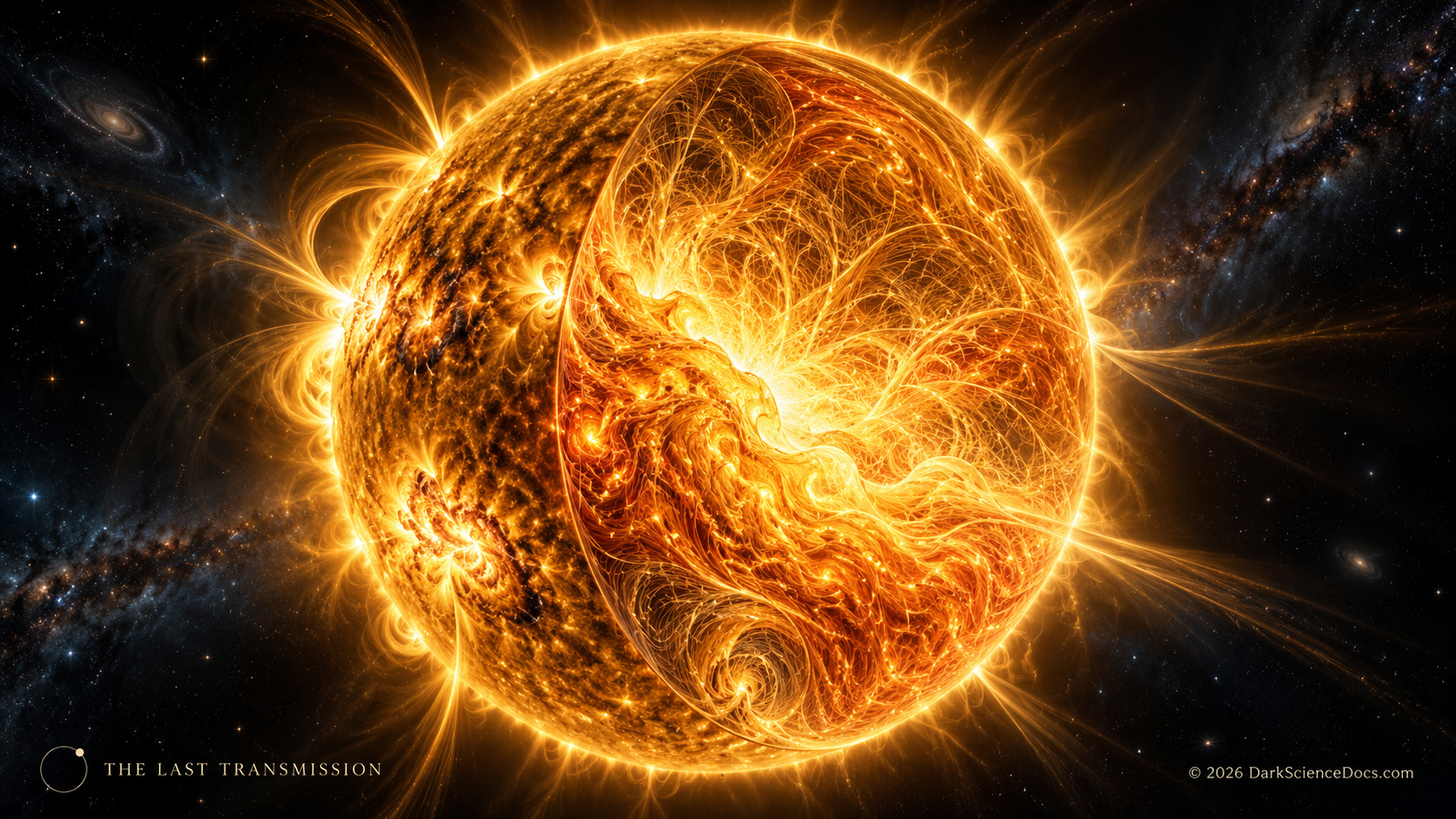
EVIDENCE FILE 12 / STELLAR LIFE CYCLES
How Do We Know the Life Cycle of a Star?
A star can burn for billions of years. How do we reconstruct its history when no observer can follow that entire life?
All Evidence FilesTHE SHORT ANSWER
Astronomers connect many measured snapshots into a tested history. Stellar brightness, temperature, spectra, and motion constrain the picture; clusters and remnants test different parts of it. Models supply the changes between those observations. Starting mass influences the path, while composition, mass loss, and a nearby companion can change the ending.
THE EVIDENCE MAP / STELLAR LIFE CYCLES
From a sky full of stars to a tested life story
Measurements provide snapshots. Evolution models connect them, and independent observations test the connection.
- 01Measurement
Collect the light and motion
Measure brightness, color, spectra, distance, and binary orbits. Compare stellar populations and examine the gas and compact objects left after an ending.
- 02Interpretation
Fit an evolutionary history
Compare those observations with calculations of fuel use, core changes, and mass loss. A cluster's sequence helps test the model's age and predicted stages.
- 03Competing explanation
A different history can shift the picture
Different composition or mixing can change an inferred age. Mass exchange or a merger can produce a star whose route differs from an isolated-star calculation.
- 04Open test
Require several records to agree
Test the models against cluster sequences, measured binary masses, supernova signals, and remnant properties. Refine the route when an independent observation disagrees.
OBSERVATION / INFERENCE / LIMIT
Read the signal.
Light and motion
Brightness, color, spectral lines, distance, and orbital motion constrain a star's present properties. Each measurement has uncertainty.
A history that fits
Evolution calculations must reproduce populations of stars and their remnants. A fitted age depends on the adopted physics and composition.
Mass is one clue
An initial mass alone cannot specify every future remnant. A companion can remove, supply, or merge stellar material before the ending.
INSIDE THE EVIDENCE
The chain of reasoning.
Each step has a different level of certainty. Follow the measured result into the explanation, then see where the trail ends.
The story begins inside a cloud
Stars form when dense regions inside molecular clouds collapse under gravity. The contracting material heats, forming a protostar; sustained hydrogen fusion in the core marks the main-sequence stage. This gives the life story a physical beginning that connects gas to a luminous star. Observations of stellar nurseries reveal many young objects at different stages of that process. The beginning also clarifies the explorer's clock: its years are counted from core hydrogen burning, so the earlier assembly of the star lies outside that age readout.
NASA: molecular clouds, protostars, and core hydrogen burningThe first evidence is the light arriving now
A telescope records the star as it appears at one stage. Distance lets astronomers convert its apparent brightness into luminosity; color and spectra help constrain temperature and composition. Plot luminosity against temperature and the stars gather into recognizable regions: a main sequence, giants, and white dwarfs. Gaia's measurements make those patterns especially clear. This diagram is a population of observed stars. The evolutionary route connecting its regions comes from a model checked against that population. ESA's stellar family portrait also shows why location has several causes: mass, chemical composition, and age all influence where a star appears.
A cluster gives the clock something to answer to
A group of stars formed together offers a useful comparison: many starting masses with approximately shared age and composition. The most massive members spend their fuel faster, so the place where stars leave the main sequence becomes an age clue. Researchers compare the observed cluster sequence with calculated populations of a common age. The age is inferred through that comparison. A study of the cluster NGC 2420 shows how assumptions about mixing near the core affect the appearance of its turnoff region and the fitted age. A successful model must explain the shape of the sequence as well as the location of individual stars.
A Sun-like ending leaves two kinds of evidence
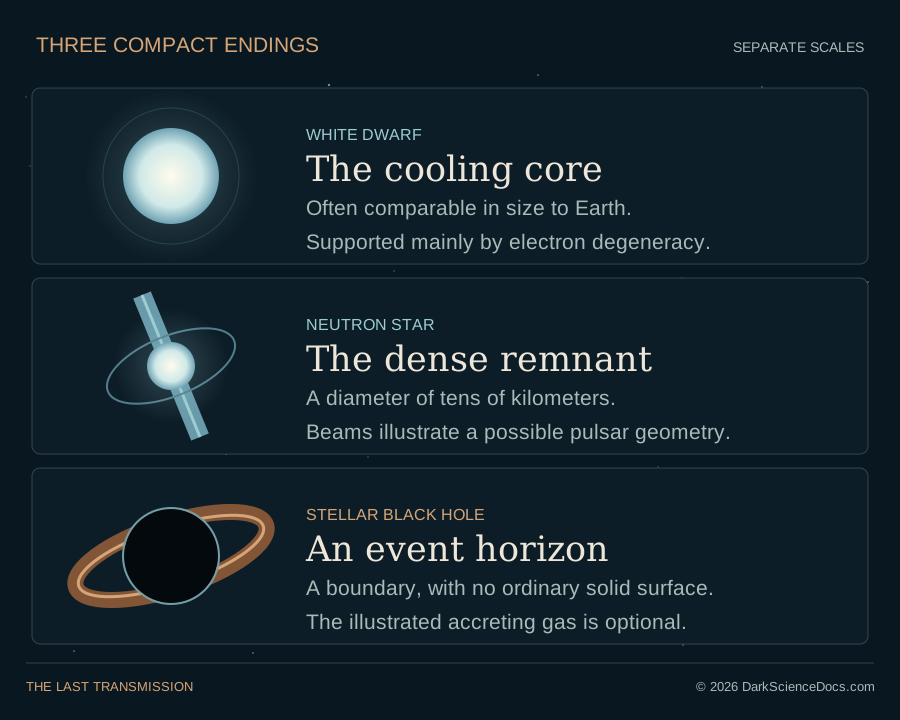
For a Sun-like star, calculations connect core hydrogen exhaustion to an expanding giant, later burning stages, and the loss of its outer layers. A planetary nebula is the expelled material; the white dwarf is the exposed compact core left behind. Their different light and structure let astronomers examine both the material that escaped and the remnant that stayed. White dwarfs then cool over very long intervals. The Sun's future is a prediction tested against other stars and remnants, while the objects we observe occupy particular stages today. The very smallest stars burn so slowly that the universe has not existed long enough for us to observe their full predicted life cycles.
Sometimes the ending reaches us as it happens
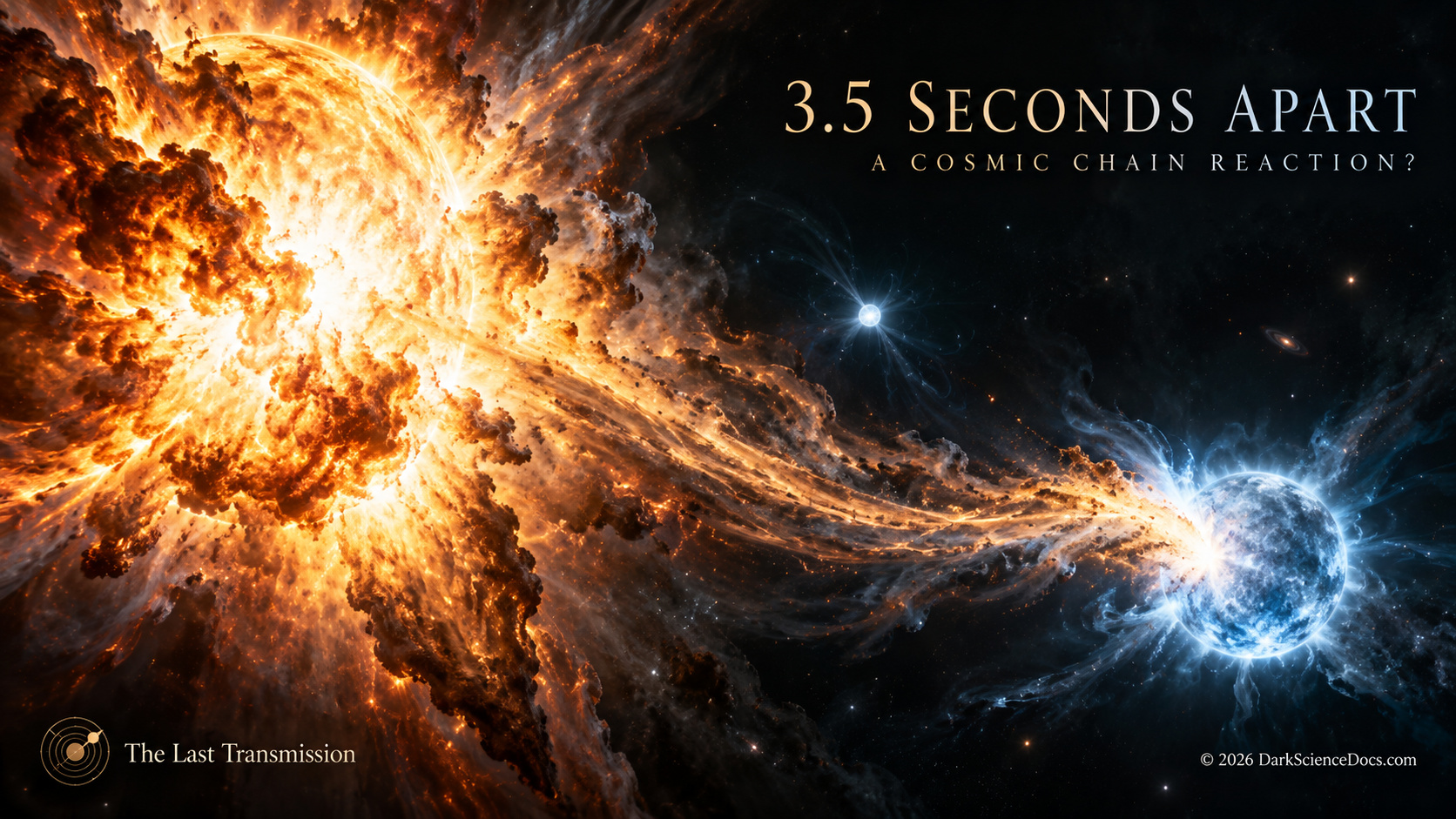
Supernova 1987A supplied a rare sequence of evidence: a brief burst of neutrinos followed by the visible explosion. The neutrinos supported the formation of a compact object during core collapse. Decades later, Webb measured ionized argon near the center of the expanding remnant. Researchers compared possible sources of the energetic radiation needed to produce those spectral features; their analysis found a neutron star the most likely explanation. That conclusion combines several observations with a physical interpretation. Webb measured emission from surrounding material, while the identity of the central object was inferred from the conditions required to illuminate it.
NASA / Webb: evidence for a neutron star in Supernova 1987AAn unseen remnant can reveal itself through an orbit
The binary VFTS 243 contains a bright star and a dark companion. Six years of spectroscopy helped researchers infer an unseen object with at least nine times the Sun's mass, consistent with a stellar-mass black hole. Its quiet X-ray behavior demonstrates another way to find such objects: the companion's measured motion can expose the gravitational mass even without a bright accretion signal. The orbit also suggested that the black hole formed with little kick, possibly through collapse without a powerful explosion. That proposed birth history is reconstructed from the surviving system. Observers did not watch its progenitor vanish. A present-day orbit can test a past event, with alternatives and assumptions still part of the analysis.
ESO: the quiescent black hole in VFTS 243A companion can rewrite the route
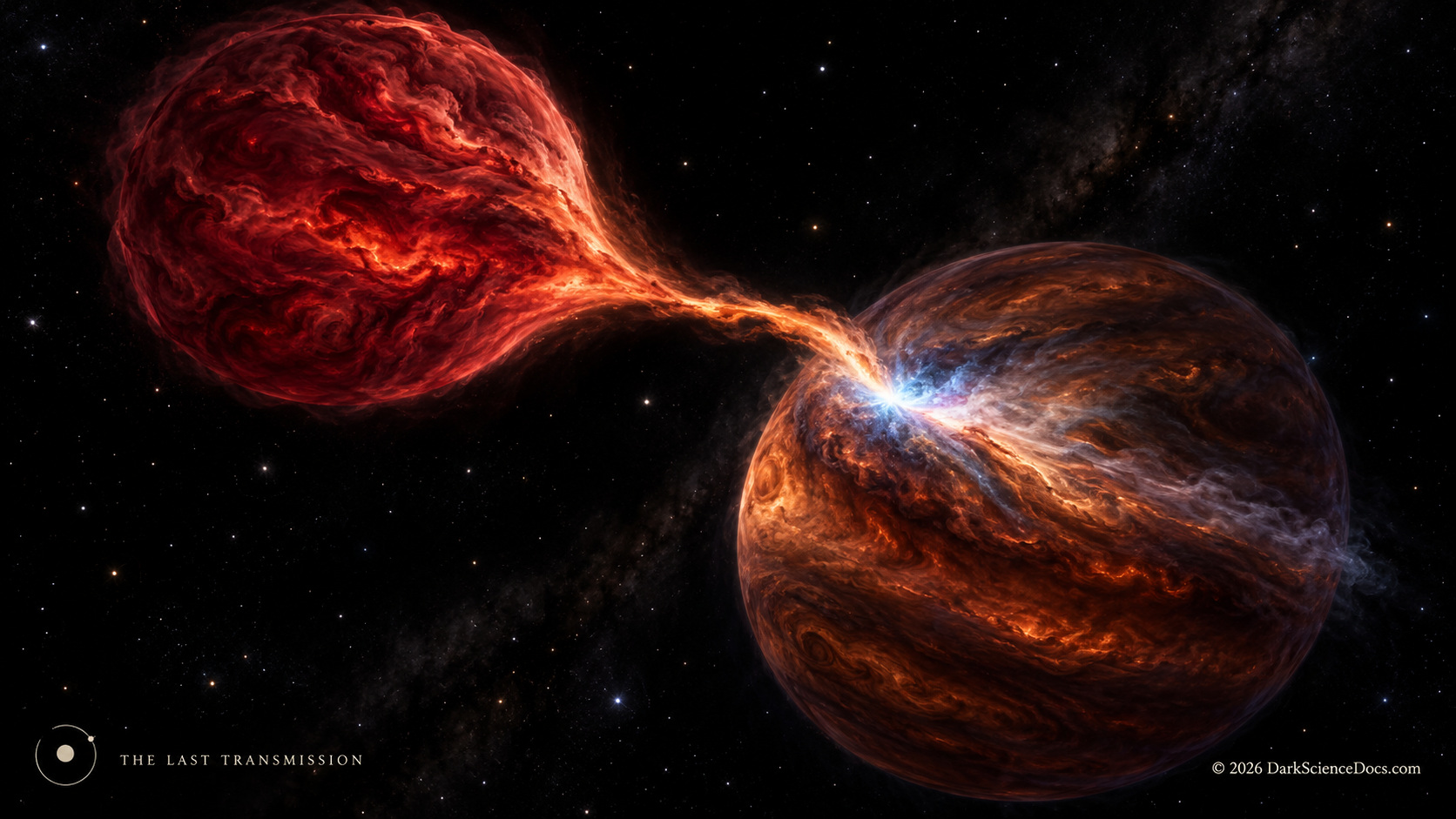
A binary introduces another history to reconstruct. Close companions can exchange mass or merge, changing a star's envelope and the core it eventually leaves. Sana and colleagues used observations of Galactic O-type stars to infer that binary interaction affects many massive stars in their sample. That finding belongs to the studied population; it does not give one universal interaction rate for every kind of star. X-ray binaries provide a visible consequence of the process: gas transferred toward a compact companion heats up and radiates. A star's initial mass, its present mass, and the mass of its remnant therefore answer different questions. The binary stories in Stellar Fates illustrate selected routes through this larger set of possibilities.
The open question lives in the core and the clock
A clean animation needs a chosen route. Research must account for a distribution of outcomes. Mandel and Müller connect compact-remnant masses and birth kicks to the core and shell before collapse, using probabilistic recipes informed by supernova calculations. That approach captures uncertainty a single starting-mass cutoff would hide. More measured binary masses, cluster sequences, and remnant observations can challenge the same models from different directions. When using the explorer, treat its age readout as the approximate timeline for its stated teaching assumptions. The stronger scientific claim is the agreement between independent evidence and a model that survives those checks.
THE EASY MISREADING
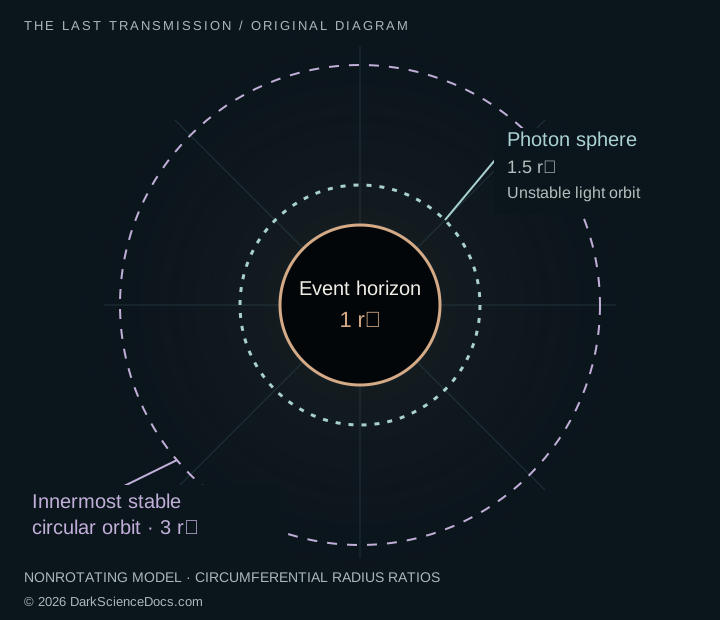
Starting mass is a guide to stellar fate; composition, core structure, mass loss, and companions also matter. A black hole's glowing disk belongs to surrounding gas. Sagittarius A*, explored in the linked map, is a supermassive Galactic Center object with a separate formation and growth history from an individual stellar remnant.
PRIMARY RESEARCH & MISSION RECORDS
Check the source.
These are the studies and mission records behind this explainer. The illustrated article and Field Note continue the investigation.
- Gaia Collaboration (2018): observed stellar populations and cluster sequences
- ESA: Gaia's stellar family portrait
- NGC 2420 research: the turnoff, core mixing, and inferred age
- NASA: star formation, fuel, and stellar lifetimes
- NASA: main-sequence stars and stellar remnants
- NASA / Webb (2024): the compact object in Supernova 1987A
- ESO (2022): VFTS 243 and its inferred quiet collapse
- Sana et al. (2012): interacting massive binaries
- NASA / HEASARC: accretion in X-ray binaries
- Mandel & Müller (2020): probabilistic compact-remnant recipes
- NASA: stellar-mass and supermassive black holes
EXPLORE IN 3D / MAP G-01
Enter a black hole’s gravitational world
Follow the remnant story into the Sagittarius A* explorer. Bend a light signal, follow a star, and release a probe. This map explores our galaxy’s supermassive black hole; its formation and growth are a separate question from the ending of one star.
Open Sagittarius A* mapFOLLOW THE THREAD
Stay with the question.
Energy is made in the Sun's core, but its path through dense interior plasma is nothing like the final eight-minute flight from the solar surface to Earth.
Watch the related documentaryMORE EVIDENCE FILES
Keep looking.
EVIDENCE FILE 01 / EUROPA
How Do We Know Europa Has an Ocean?
Galileo's magnetic measurements point to a conducting layer beneath Europa's ice. A salty ocean is the leading explanation. Its chemistry and seafloor activity remain open questions.
Read the evidence
EVIDENCE FILE 02 / TITAN & PLUTO
What Is the 5.11-Micrometer Mark on Titan and Pluto?
The 5.11-micrometer absorption is measured on both worlds, but the Pluto feature is broader. A shared wavelength is a clue to investigate, not a chemical identification.
Read the evidence