
THE LAST TRANSMISSION / FIELD GUIDE 003
How
Stars Die.
A star’s ending begins deep inside it. Follow the fuel, the shrinking core, and the companion that can turn a quiet remnant into another beginning.
Find the possible endings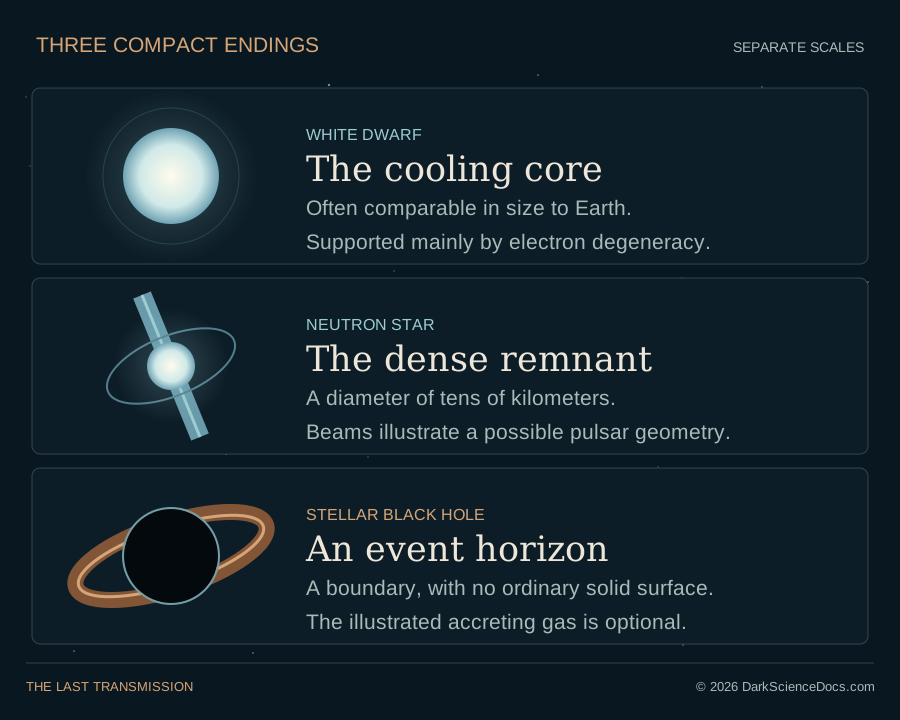
01 / A MAP OF THE ENDINGS
The first question is
what the core can do next.
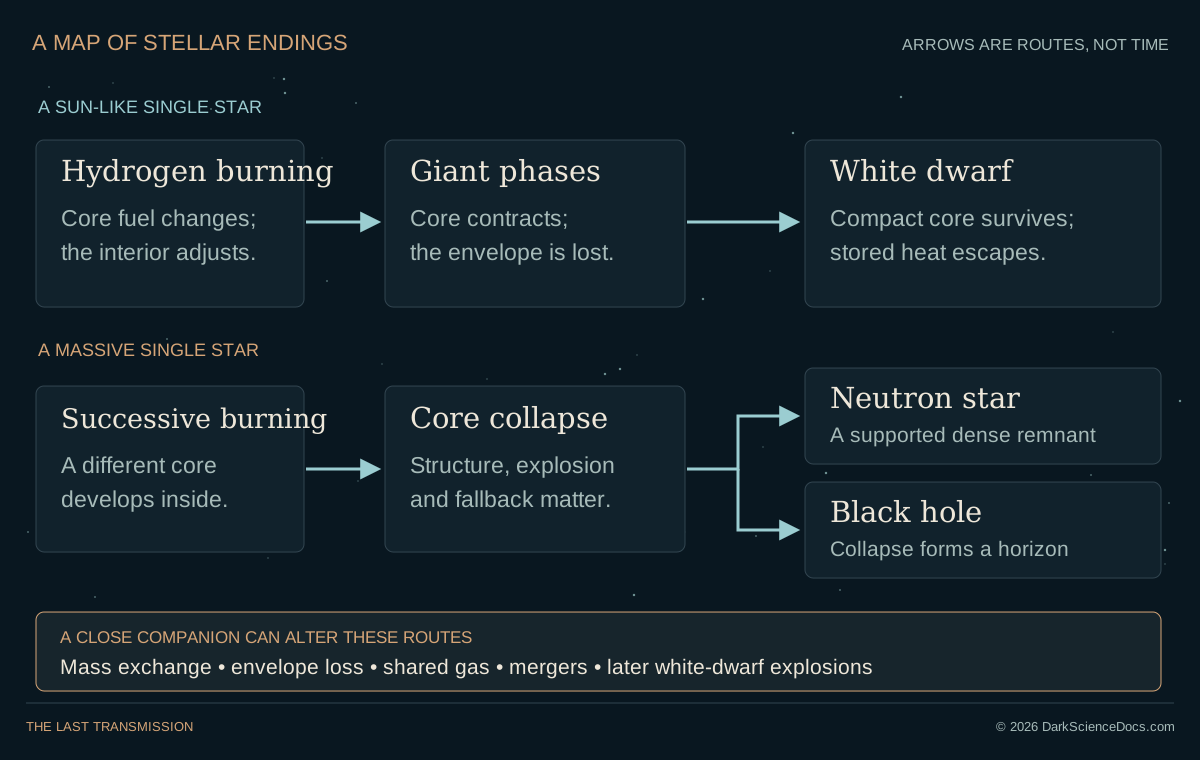
A star spends much of its life balancing inward gravity with outward pressure. Fusion supplies energy that helps maintain that pressure while radiation carries energy away. When the available fuel changes, the interior adjusts. A core can contract and heat while the envelope expands, so a star can become larger even as its center becomes smaller. “Death” describes the end of familiar sustained stellar burning, with several possible remnants and sometimes an explosion. [1]
A core left to cool.
The envelope escapes while a compact remnant survives. A close companion can later disturb this apparently quiet ending.
Follow the cooling core ↗02 / NEUTRON STARMatter at its limit.
A collapsed core can settle into an extraordinarily dense object, with rotation and magnetic fields providing observable clues.
Follow the compact star ↗03 / BLACK HOLEAn event horizon forms.
If collapse cannot settle into a supported remnant, a stellar black hole can form. Its surroundings and companions supply the evidence.
Follow the collapse ↗Three masses that should stay distinct
Starting mass is the whole star when its main stellar life begins. Pre-collapse core mass describes the interior after burning, winds and possible exchange with a companion. Remnant mass is what remains after an explosion, ejection or later fallback. A label such as “eight solar masses” usually refers to a broad starting-mass landmark, while the roughly 1.4-solar-mass white-dwarf limit concerns the remnant itself. Mixing those quantities makes a life-cycle chart misleading. [10] [11] [23]
02 / THE SUN-LIKE ROUTE
Expansion outside.
Contraction within.
The Sun illustrates an ending that does not require a supernova. Once hydrogen is depleted in its central burning region, the helium-rich core contracts. Hydrogen fusion can continue in a surrounding shell. The envelope expands into a red giant, while the core becomes hot enough for a later period of helium fusion. The Sun does not possess the mass needed to carry central burning all the way through the massive-star sequence to a collapsing iron core. [3]
Helium burning produces carbon and oxygen. Later giant phases bring shell burning, pulsations and substantial mass loss. The exposed hot core can illuminate the expanding gas as a planetary nebula, a historical name that does not imply planets created it. After the envelope disperses, the core remains as a white dwarf. Its mass is much smaller than the mass of the original star because so much material has returned to space. [3]
Mass also changes the pace. A more massive main-sequence star has more fuel, but its luminosity rises steeply and it uses that fuel faster. Stellar model grids connect these lifetimes with mass, rotation and composition. A short playback showing all stages at equal speed would disguise this contrast: a long stable phase and a brief final transformation need very different clocks. [20]
The smallest hydrogen-burning red dwarfs live far longer than the universe’s present age. Their complete endings have to be modeled rather than observed as finished histories. They do not simply follow a scaled-down version of the Sun’s giant phases. Likewise, a black dwarf belongs to the predicted far future of remnant cooling. A guide should distinguish the white dwarfs we observe from the endpoints that time has not yet produced. [2] [13]
Before the ending: follow energy out of the Sun ↗03 / WHITE DWARFS
The furnace stops.
The heat remains.
A white dwarf compresses stellar material into an object often comparable in size to Earth. Ordinary thermal pressure is no longer the main reason it holds itself up. Electron degeneracy pressure comes from quantum rules restricting how electrons occupy states. The remnant can therefore remain supported as it loses heat. “Dead” does not mean invisible: the dwarf shines while cooling, and its temperature changes the light we receive. [2] [23]
The Chandrasekhar limit is approximately 1.4 solar masses for an idealized cold, nonrotating white dwarf, with composition affecting the precise value. This is a limit on support by electron degeneracy, not a universal supernova trigger and not the birth mass of a star that leaves a dwarf. The composition and ignition history matter. Carbon–oxygen dwarfs involved in thermonuclear explosions have to be understood through how their fuel becomes unstable. [7] [23]
A companion opens several possibilities. A surface layer of newly supplied hydrogen can undergo a classical nova, after which the dwarf can survive and accumulate fuel again. Runaway burning of a carbon–oxygen white dwarf can instead produce a Type Ia supernova. Proposed routes include growth from another star and interaction or merger with a second white dwarf. The relative contributions of these routes are an observational problem, rather than a choice a simple drawing can resolve. [7]
Some explosion models work below the Chandrasekhar mass. A detonation in an accreted helium shell can send a shock into the carbon–oxygen interior and ignite it, a process called a double detonation. Model spectra and light curves can then be compared with observations. A bright event is not proof that one particular trigger occurred, and two exploding white dwarfs need not have reached identical masses or followed identical binary histories. [8]
There are direct tests of the compact object itself. Hubble isolated Sirius B’s spectrum from its bright companion and measured the gravitational redshift of its light. That shift supplies a mass constraint, while temperature and brightness help constrain radius. Measurements such as these test the relationship between white-dwarf mass and size instead of relying only on a theoretical label. [21]
04 / MASSIVE STARS
The core falls.
The explosion must be earned.
A collapse and a successful explosion are connected events, but the second does not follow automatically from the first.
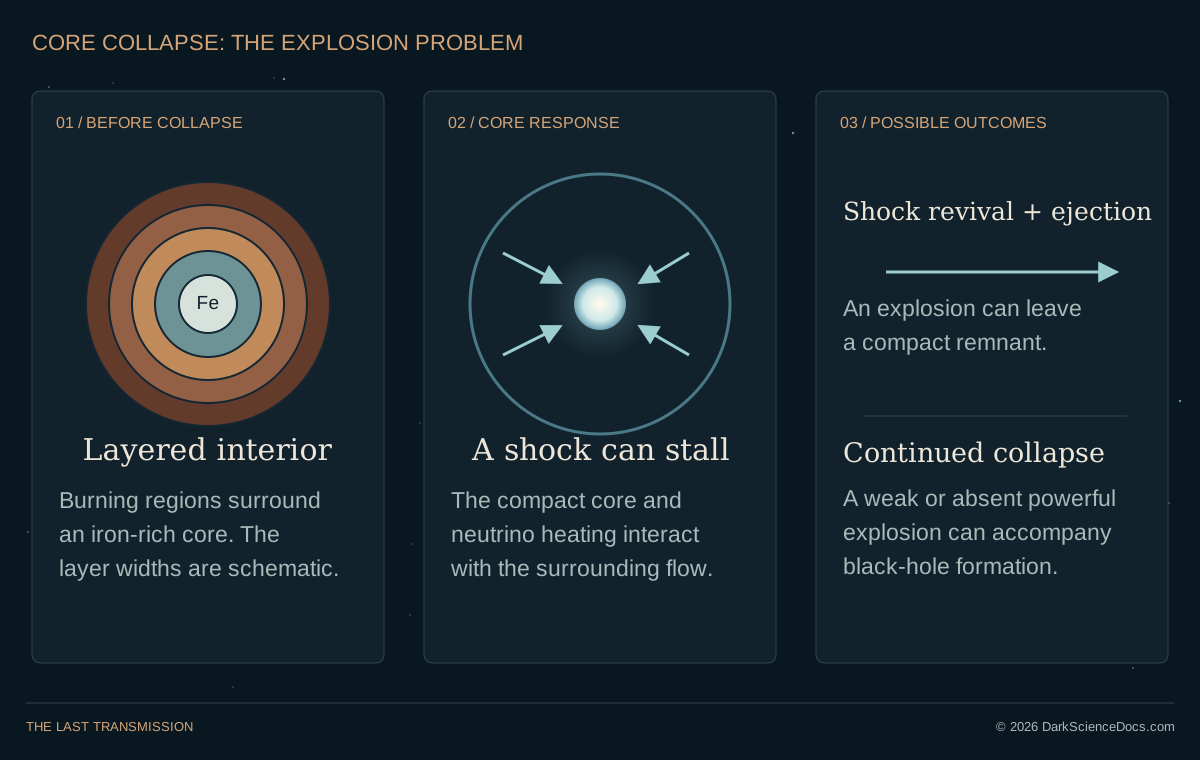
Massive stars can reach successive burning stages, building a layered interior around a growing core rich in iron-group nuclei. Fusion into still heavier nuclei cannot provide the same energy supply. Electron captures and the breakup of heavy nuclei can reduce pressure support and absorb energy. The core then collapses rapidly, while the outer star has not yet had time to respond. The familiar onion drawing captures the ordering of regions without measuring their actual thicknesses. [1] [9]
As the central density rises, nuclear matter resists further compression and a shock develops. The shock can lose energy and stall. Neutrino heating and turbulent, multidimensional motion help determine whether it revives enough to eject the surrounding star. Rotation and magnetic fields can also matter in particular energetic events. The challenge is explaining how a collapsing core transfers sufficient energy into an outgoing explosion. [9]
Different cores can make different demands on that engine. Model surveys find successful explosions interspersed with collapse outcomes across starting mass. Two stars born with nearby masses can develop different internal structures because the burning stages, mixing and mass loss interact. Some material initially pushed outward can later fall back, adding to the compact remnant. A tidy division between all neutron-star progenitors and all black-hole progenitors hides this dependence. [10] [11]
Two different ways to make a supernova
A core-collapse event begins with the loss of support in a massive stellar core. A thermonuclear Type Ia event begins with runaway nuclear burning in a white dwarf. Hydrogen lines help classify observed spectra, but their absence does not by itself identify the underlying engine: stripped massive stars can also explode without a hydrogen-rich envelope. [7] [9] [23]
05 / NEUTRON STARS
A stellar core.
A city’s scale.
A neutron star holds roughly stellar mass within a diameter of only tens of kilometers. Much of its matter is neutron-rich, but it is not a ball of identical neutrons all the way through. A crust, charged particles and uncertain deeper phases belong to the physical problem. Degeneracy and nuclear interactions provide pressure, while general relativity describes the strong gravity that the matter must resist. [12] [15]
Rotation and magnetic fields give observers several routes in. A pulsar sends repeating signals as the star rotates and its emission sweeps through our line of sight. The apparent pulse is a viewing effect; the star need not switch its entire output off between pulses. A companion can also supply gas that produces X-rays as it approaches the surface. These signals reveal the compact star while depending on the surrounding geometry. [12] [5]
Radio timing in a binary can constrain a pulsar’s mass through relativistic effects on the arriving pulses. Measurements of heavy pulsars demonstrate that dense matter can support at least those measured masses. NICER’s X-ray observations constrain mass and radius through models of the changing surface emission. Together, such records test an equation of state, the relationship between pressure and density inside the star. [14] [15]
The maximum stable mass is not a universal three-solar-mass switch that a visitor can apply to every object. It depends on the equation of state and on conditions such as rotation and temperature. A measurement can exclude a model that supports too little mass without uniquely revealing every particle in the center. This is why the guide compares evidence and physical support rather than assigning an exact fate from one number. [15]
Some neutron stars later merge. GW170817 was observed in gravitational waves and across the electromagnetic spectrum, including a kilonova associated with radioactive material synthesized in the ejecta. That linked record connects compact remnants with heavy-element production. It also adds a later chapter to stellar evolution: the death of the original stars did not end the binary’s history. [22]
06 / STELLAR BLACK HOLES
When support
cannot halt collapse.
If a core cannot settle into a supported compact star, continued collapse can form an event horizon. This boundary marks where outward light cannot escape to distant observers. A stellar black hole is not a small hard surface left behind by burning. The light astronomers detect can come from nearby gas, while an orbit can reveal the gravity of an object whose own surface is absent from the view. [16]
Black holes can form after an explosion with substantial fallback, or through collapse without a powerful visible supernova. VFTS 243, a binary in the Large Magellanic Cloud, provides a useful example. The visible star’s motion supports a massive dark companion, and the system’s properties favor a comparatively quiet formation history. That is an inference about an earlier event, not a movie of the star disappearing. [17] [11]
An accretion disk is optional. A black hole with a close gas-supplying companion can shine through the hot material around it, whereas a dormant black hole may reveal itself mainly through a companion’s orbit. The bright ring in an explanatory drawing illustrates a possible environment. It cannot tell us whether a particular remnant is feeding, and an X-ray source needs its own tests before its compact object is identified. [16] [5]
Keep the scale change visible. Sagittarius A*, the black hole at our galaxy’s center, has millions of solar masses. It is an excellent place to explore horizons and gravity, but its origin and growth are a separate problem from the ending of one ordinary massive star. The related Atlas visit below deliberately changes scale, then the Black Holes guide carries the explanation into observations and open questions. [16]
Continue into event horizons, tides and accretion ↗07 / THE COMPANION CHANGES THE STORY
Two stars can rewrite
one another’s endings.
A binary is a shared orbit. A strongly interacting binary is also a shared history of material and angular momentum.
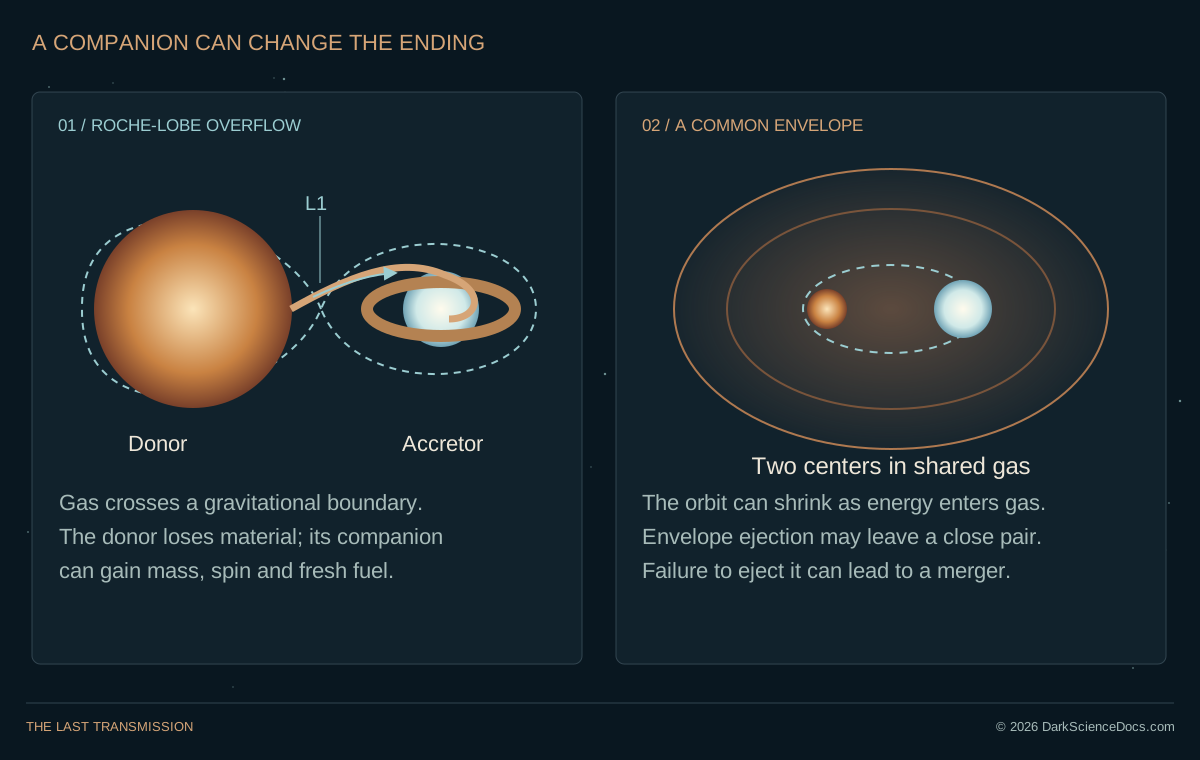
A wide pair can develop largely as two single stars. In a closer system, expansion can bring a star to the boundary of the region gravitationally associated with it in the rotating binary. Gas can then flow through the inner Lagrange point toward its companion. Winds supply another route for transfer without the same surface overflow. The stream changes the stars and can form a hot accretion flow. [5]
The donor can lose an envelope that it would otherwise retain. The receiving star can gain mass, spin and fresh fuel, altering its remaining life. Observations of massive O-star binaries show that interaction is common in that population. This matters when interpreting a supernova’s missing hydrogen envelope or comparing the apparent ages of two companions. It does not mean every pair exchanges mass or that one survey’s fraction applies to every kind of star. [4]
Transfer can become unstable. A companion may orbit within an expanded envelope surrounding both the donor’s core and the companion, creating a common envelope. Orbital energy and other energy sources can help eject the gas as the orbit shrinks. If ejection fails, the objects may merge. Predicting which binaries survive requires understanding energy transport and gas dynamics, an important uncertainty in reconstructing compact binaries. [6]
A surviving compact pair may later produce an accretion event, a white-dwarf explosion or a merger. These are possible branches, not a guaranteed series that every binary visits. The system’s separation, composition, mass ratio and prior mass loss determine which branches are accessible. A second star therefore complicates both the physical ending and the observational reconstruction: we need the history of the system as well as a snapshot of either component. [4] [6] [7]
A bright brown-dwarf binary is a different question
The site’s mass-transfer brown-dwarf Evidence File asks whether accretion light establishes sustained hydrogen fusion. It does not: luminosity from a stream and luminosity from core fusion require different evidence. That case introduces the companion problem without making a brown dwarf into a white dwarf or a confirmed newly ignited star. Follow the binary’s evidence ↗
08 / HOW THE HISTORY IS RECONSTRUCTED
We see the records.
We test the life between them.
No observer has watched a Sun-like star through its entire life. Stellar evolution connects measured populations, short transformations and surviving remnants through physical models. Each record tests a different part of that connection.
Many snapshots, one physical history.
- Measured
- Distances, brightness and color place stars in observed Hertzsprung–Russell diagrams.
- Inferred
- Stellar sequences and cluster populations can be compared with models of age, mass and composition.
- Still open
- Unresolved companions, dust and model assumptions affect where a star lands and how its age is inferred. [19] [20]
SN 1987A’s central radiation.
- Measured
- Webb recorded highly ionized gas near the center of the supernova remnant.
- Inferred
- The required energetic radiation favors a newly born neutron star in the researchers’ models.
- Still open
- The observed gas emission and the inferred buried compact object remain distinct steps in the argument. [18]
A dark companion, a quiet birth.
- Measured
- The visible star in VFTS 243 changes its radial velocity in a binary orbit.
- Inferred
- The companion is identified as a dormant black hole after alternatives are tested; the system favors a quiet collapse history.
- Still open
- The earlier collapse is reconstructed from the surviving system rather than observed directly. [17]
| Ending | What remains? | What resists collapse? | How can we investigate it? |
|---|---|---|---|
| White dwarf | A compact stellar core with an ordinary material surface. | Primarily electron degeneracy pressure. | Cooling light, spectra, mass–radius tests and binary dynamics. [21] [23] |
| Neutron star | An ultradense, neutron-rich compact star with a crust and uncertain deep interior. | Pressure from dense matter, including quantum effects and nuclear interactions. | Pulse timing, surface X-rays, binaries and merger signals. [12] [14] [15] [22] |
| Black hole | An event horizon enclosing the collapsed region. | No supported material surface halts the collapse at the horizon. | Companion orbits, accreting gas and gravitational waves. [16] |
The stellar-life Evidence File follows these measurement chains more closely. The Stellar Fates viewer is an illustration for exploring the branches, with deliberately compressed time and size scales. Replaying it does not add an astronomical observation.
09 / QUICK ANSWERS
Keep the common
questions close.
Will the Sun explode as a supernova?
The Sun’s single-star path ends in a white dwarf after giant phases and the loss of its outer layers. It lacks the mass to build the collapsing core of a massive-star supernova. Its red-giant transformation is still a major change for the Solar System. [3]
Do all stars become black holes?
No. Many stars leave white dwarfs, while some collapsing massive cores leave neutron stars. Black-hole formation depends on the remaining core and collapse dynamics, with mass loss and binary history influencing the result. [10] [11]
Does eight solar masses mark an exact boundary?
It is a useful approximate starting-mass landmark for broad stellar routes. Composition, mixing, rotation and mass exchange move the boundary. The mass of the original star and the mass of its final core are different quantities. [20] [23]
Is a white dwarf still shining?
Yes. It releases stored heat as it cools even though it has stopped the sustained core fusion of its earlier life. A companion can add accretion light or trigger nuclear activity in newly supplied material. [2] [5]
Is a nova the same as a supernova?
A classical nova ignites accumulated fuel on a white dwarf’s surface and can leave the dwarf able to repeat the event. A Type Ia supernova is a thermonuclear explosion involving the dwarf itself. Core-collapse supernovae begin with a different mechanism in a massive stellar core. [7] [9] [23]
Is every neutron star a pulsar?
A pulsar is detected through repeating signals from a rotating neutron star. The magnetic geometry, emission and our viewing direction determine whether we see those pulses. A neutron star can exist without appearing to us as a radio pulsar. [12]
Can a star form a black hole without a bright explosion?
Models permit collapse with a weak or absent powerful supernova. VFTS 243 supplies evidence favoring a quiet formation history, inferred from the surviving binary. That conclusion reconstructs the event; observers did not film the original collapse. [17]
Does a companion always change a star’s fate?
A distant pair can evolve largely independently. Closer systems can exchange material, enter a shared envelope or merge. Separation, mass ratio and the stars’ changing sizes determine whether strong interaction occurs. [4] [6]
Have we found a black dwarf?
A black dwarf is the predicted cooled endpoint of a white dwarf. Cooling to that state takes longer than the universe has existed, so it belongs to a theoretical far future. It is different from a black hole and from a brown dwarf. [13]
10 / FOLLOW THE SIGNAL
Choose your
next passage.
Move through the branches.
Change starting mass and compare single-star and binary teaching routes. The compressed clock and remnant sizes are illustrative.
Open the stellar viewer ↗ EVIDENCE FILE / STELLAR EVOLUTIONRead the measurements behind the life.
Follow stellar populations, cluster ages, binary companions and remnant observations into a tested history.
Examine the evidence ↗ FIELD GUIDE / BLACK HOLESStay with the darkest ending.
Continue from stellar collapse into horizons, falling clocks, tidal forces and the evidence for black holes.
Open the Black Holes guide ↗ 3D ATLAS / A CHANGE OF SCALEExplore a supermassive horizon.
The Galactic Center viewer illustrates gravity around Sagittarius A*. Its millions of solar masses belong to a different origin and growth story.
Open the black-hole viewer ↗ DOCUMENTARY / THE LIVING SUNBegin before the ending.
Follow Eugene Parker and the probe into the Sun’s atmosphere. This film establishes the living-star context rather than documenting a supernova.
Watch the documentary ↗ ILLUSTRATED ARTICLE / AN EXPLOSIVE BINARYWhen one explosion meets a companion.
Read the proposed sequence behind a rapidly linked binary catastrophe, keeping the model and its observational tests in view.
Read on Substack ↗ ILLUSTRATED ARTICLE / BETELGEUSEA giant may have company.
Follow the possible companion and the difficulty of separating a second star from the giant’s surrounding environment.
Read on Substack ↗ EVIDENCE FILE / MASS TRANSFERAsk what the extra light means.
An adjacent case distinguishes accretion from sustained core fusion. Brown dwarfs are a different class from the remnants compared here.
Examine the binary evidence ↗ INVESTIGATION / ENERGY TRANSPORTFollow the light before it escapes.
Understand how a living star moves energy from its interior to its surface, then return to what changes when its fuel runs out.
Read the investigation ↗Continue across the collection: all Field Guides · Oceans Beyond Earth.
11 / SOURCES & FURTHER READING
Keep the evidence
within reach.
Agency records introduce the phenomena and instruments. Research papers document measurements, model assumptions and competing routes. Numbered links identify the source behind each passage. The original diagrams are explanatory schematics, with invented colors, proportions and distances. They contain no additional measurements or numerical fate predictions.
NASA: Stars, from birth to death ↗
The balance between gravity and pressure, fusion fuel, and the broad stages of a stellar life.
Back to source list ↑NASA: Types of stars ↗
Giants, white dwarfs, neutron stars, and the exceptionally long lives of red dwarfs.
Back to source list ↑NASA: White dwarfs ↗
The Sun-like route through giant phases, envelope loss, and a surviving compact core.
Back to source list ↑Sana et al.: Massive binary interaction (2012) ↗
Measurements of massive O-star binaries support frequent mass exchange and mergers. This sample is not a census of all stars.
Back to source list ↑NASA / HEASARC: X-ray binaries ↗
Accretion from winds or through Roche-lobe overflow, and the radiation from material approaching a compact companion.
Back to source list ↑Ivanova et al.: Common-envelope evolution (2013) ↗
A detailed review of shared envelopes, energy transfer, ejection, and the uncertainties in binary survival.
Back to source list ↑Maoz, Mannucci & Nelemans: Type Ia progenitors (2014) ↗
Observational tests of the systems that ignite thermonuclear explosions in carbon–oxygen white dwarfs.
Back to source list ↑Polin, Nugent & Kasen: Sub-Chandrasekhar explosions (2019) ↗
Models show how a helium-shell detonation can trigger a white-dwarf explosion below the familiar mass limit.
Back to source list ↑Janka: Core-collapse explosion mechanisms (2012) ↗
Neutrino transport, stalled shocks, multidimensional flows, and the physical difficulty of launching an explosion.
Back to source list ↑Sukhbold et al.: Collapse from 9 to 120 solar masses (2016) ↗
A modeled population with alternating explosion and collapse outcomes rather than one clean starting-mass division.
Back to source list ↑Mandel & Müller: Compact-remnant recipes (2020) ↗
Probabilistic remnant masses and kicks tied to the pre-collapse core and envelope.
Back to source list ↑NASA: Neutron stars ↗
Compact remnants, rotation, magnetic fields, and why a rotating neutron star can appear as a pulsar.
Back to source list ↑Adams & Laughlin: The long-term stellar future (1997) ↗
Theoretical evolution on timescales far beyond the universe’s present age. Future cooling endpoints are predictions.
Back to source list ↑Fonseca et al.: A high-mass pulsar (2021) ↗
Radio pulse timing constrains the mass of PSR J0740+6620 and tests the matter a neutron star must support.
Back to source list ↑NASA / NICER: Dense matter and its equation of state (2025) ↗
Mass and radius measurements constrain pressure inside neutron stars. The inferred limits depend on the analysis and assumptions.
Back to source list ↑NASA: Types of black holes ↗
The distinction between stellar remnants and supermassive black holes, with binary accretion as an observational route.
Back to source list ↑ESO: VFTS 243 and quiet collapse (2022) ↗
A dark companion inferred from a stellar orbit, and evidence favoring formation without a powerful supernova.
Back to source list ↑NASA / Webb: The compact source in SN 1987A (2024) ↗
Ionized gas at the remnant’s center supports a neutron-star interpretation through its required radiation source.
Back to source list ↑Gaia Collaboration: Observed stellar sequences (2018) ↗
Measured distances and starlight reveal populations in Hertzsprung–Russell diagrams, including white-dwarf sequences.
Back to source list ↑Ekström et al.: Rotating stellar models (2012) ↗
Solar-composition model grids connect mass, rotation, luminosity, and stellar lifetimes under stated assumptions.
Back to source list ↑ESA: Measuring Sirius B (2005) ↗
Gravitational redshift provides a mass test for a white dwarf smaller than Earth.
Back to source list ↑LIGO: The GW170817 observing campaign (2017) ↗
Gravitational waves and electromagnetic observations link a neutron-star merger to a kilonova and newly formed heavy elements.
Back to source list ↑Chandra: Stellar evolution ↗
Observed examples of stellar stages and remnants, and the extra possibilities introduced by a nearby companion.
Back to source list ↑Published and reviewed October 11, 2026. Future revisions should identify the observation or model that changed and preserve this guide’s URL.