
EXPLORATION GUIDES / FREE PRINTABLE ACTIVITY
Investigate an Alien Ocean
Three worlds. Three evidence trails. One careful claim. An ocean can hide beneath ice, beyond a camera's reach. Compare three evidence trails and decide how each supports a claim. Read the clues, mark what was measured, and write a conclusion that includes a limit.
4 pages · US Letter, 8.5 × 11 inches · 57 KB
Suggested ages 12+; classrooms, astronomy clubs, and independent readers · 35-45 minutes
YOUR INVESTIGATION
Aim for a claim
you can defend.
Use a measured clue to support an ocean interpretation while preserving what the observation leaves uncertain.
How to use the packet
Use a pencil and the two learner pages first. The remaining pages hold the answer discussion and sources. You can work alone or compare reasoning in a group. Atlas extensions are optional; a screen is not required.
Print US Letter at actual size, or fit the packet to A4. Color is optional. Print and share the complete guide with attribution and source links intact.
ORIGINAL ANNOTATED DIAGRAM
An interior inferred from an exterior signal
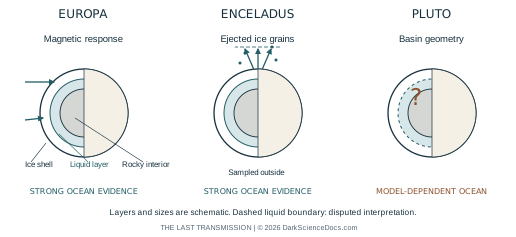
Start here: Circle one interior feature in the diagram that is inferred. Which exterior observation could support it?
01 / READ THE CLUES
Follow the evidence.
A magnetic response
Galileo measured a response as Jupiter's surrounding magnetic field changed. A conducting subsurface layer fits the signal; salty liquid water is the leading interpretation. The signal alone does not give a unique ocean depth or composition. [S1]
A moving shell and sampled grains
Cassini measured the moon's small rotational wobble, supporting an ice shell separated from its interior by a global ocean. Its instruments also detected phosphates in salt-rich ice grains from the E ring, which is fed by the plume. The grains carry chemistry, not a detection of life. [S2] [S3]
A basin with competing explanations
New Horizons mapped Sputnik Planitia and its position relative to Charon. An ocean-uplift model can explain an inferred mass excess; an impactor-remnant model offers an alternative without a substantial ocean. There is no direct gravity map proving the ocean. [S4] [S5]
02 / WRITE YOUR REASONING
Use the clue. Keep the limit.
O1 / Separate the observation from the inference
For each world, write one measured clue, the ocean inference it supports, and one question still open.
O2 / Choose and defend a target
Choose a world for a follow-up ocean investigation. Support your choice with a measured clue and a limit. Different targets can be reasonable.
O3 / Challenge the headline
Rewrite: 'Phosphorus found, so life is confirmed on Enceladus.' Keep the exciting result and remove the unsupported conclusion.
O4 / Design a useful next test
Name a measurement that could narrow an uncertainty. Explain which result would favor one interpretation and what it still would not prove.
03 / ANSWER DISCUSSION
Compare explanations.
Write your reasoning before opening the discussion. These are defensible explanations, with room for equivalent wording.
O1 / Keep each step in its lane
Europa: magnetic response is measured; a conducting layer and salty ocean are inferred; thickness and conductivity remain entangled. Enceladus: shell wobble and grain chemistry are measured; a global ocean and a connection to source water are inferred; grain transport can alter the sample. Pluto: surface shape and basin position are measured; mass excess and interior structure are modeled; competing impact histories remain possible. Accept equivalent wording that preserves these distinctions.
O2 / A defensible target has a bounded claim
Enceladus is a strong choice when the question concerns sampling ocean-related material, because it ejects grains into space. Europa is a strong choice for combining magnetic and geological constraints. Pluto is a valuable target for distinguishing competing interior models. The task is not to declare one universal winner. A good answer explains why a particular observation bears on a particular question and acknowledges the remaining uncertainty.
O3 / Ingredients do not establish inhabitants
One defensible revision is: 'Cassini data revealed phosphate-bearing ice grains linked to Enceladus, strengthening the chemical case for a potentially habitable ocean.' Phosphorus is relevant to Earth life, but its presence does not identify an organism or prove that life arose. The measured chemistry is a substantial result even while the biological question stays open.
O4 / A test should narrow a named uncertainty
An example is to compare magnetic measurements under changing field conditions at Europa while checking the surrounding plasma. That can help constrain a conducting layer and its geometry. Repeated chemical sampling at Enceladus could test whether grain composition varies with location or conditions. A better gravity measurement at Pluto could help constrain interior models, though it would not by itself uniquely identify water. Reward a discriminating prediction and a stated limit.
FOR TEACHERS & ASTRONOMY CLUBS
Make the reasoning visible.
Give learners pages 1-2 first. Allow about 10 minutes to annotate the diagram and clues, 20 minutes for the questions, and 10 minutes to compare claims. Use the discussion on page 3 after learners have committed to an answer. Look for an observation, a justified inference, and a limit rather than an unsupported confidence score.
Optional Atlas extension: choose Europa or Enceladus in the relevant viewer, then identify which details come from spacecraft maps and which are illustrations. Replaying the animation adds no measurement.
Original activity and diagram by The Last Transmission. Reviewed October 11, 2026. Our explanations synthesize the attributed research; this site did not conduct the underlying observations.
04 / THE SOURCE TRAIL
Check the record.
Primary mission explanations and published research. Source numbers match the downloadable guide.
NASA Europa Clipper: Why Europa, evidence for an ocean ↗
Magnetic induction and the reasoning behind a subsurface-ocean interpretation.
NASA: Cassini finds a global ocean (2015) ↗
The measured libration and the inference of a decoupled ice shell.
NASA/JPL: Phosphates in Enceladus ice grains (2023) ↗
E-ring grain chemistry, laboratory interpretation, and the absence of a life detection.
Nimmo et al.: Reorientation of Sputnik Planitia (2016) ↗
Author manuscript of the ocean-uplift interpretation published in Nature in 2016.
University of Bern: How Pluto got its heart (2024) ↗
The research team's impactor-remnant interpretation and its contrast with ocean uplift.
FOLLOW THE THREAD