DESTINATION 01 / SATURN SYSTEM
Saturn
The planet and the final dive
Why did Cassini have to end inside the world it studied?
Cassini spent thirteen years studying the Saturn system. Its final orbits measured the planet and its rings before mission controllers sent the spacecraft into Saturn, keeping it away from potentially habitable moons.
DESTINATION 02 / SATURN SYSTEM
Rings
A structure carved by gravity
What appears when we move closer to the rings?
Cassini’s natural-color panorama reveals a translucent inner C ring, a bright B ring, the darker Cassini Division, the A ring with smaller gaps, and a narrow outer F ring. The division itself still contains ring material. The bands are made of countless individual particles; this map shows their large-scale pattern, not individual ice grains.
DESTINATION 03 / SATURN SYSTEM
Titan
Haze, chemistry, and a coming flight
What can one spectral feature reveal about an alien atmosphere?
Titan has a thick nitrogen atmosphere, organic haze, and lakes of liquid hydrocarbons. A debated feature near 5.11 micrometers offers a way to examine how scientists move from a measured spectrum to a tentative chemical interpretation.
In visible light, Titan’s thick haze hides most surface detail. The optional Cassini view uses a near-infrared brightness map, not natural color.
DESTINATION 04 / SATURN SYSTEM
Enceladus
An ocean escaping into space
What does an icy plume tell us about an ocean below?
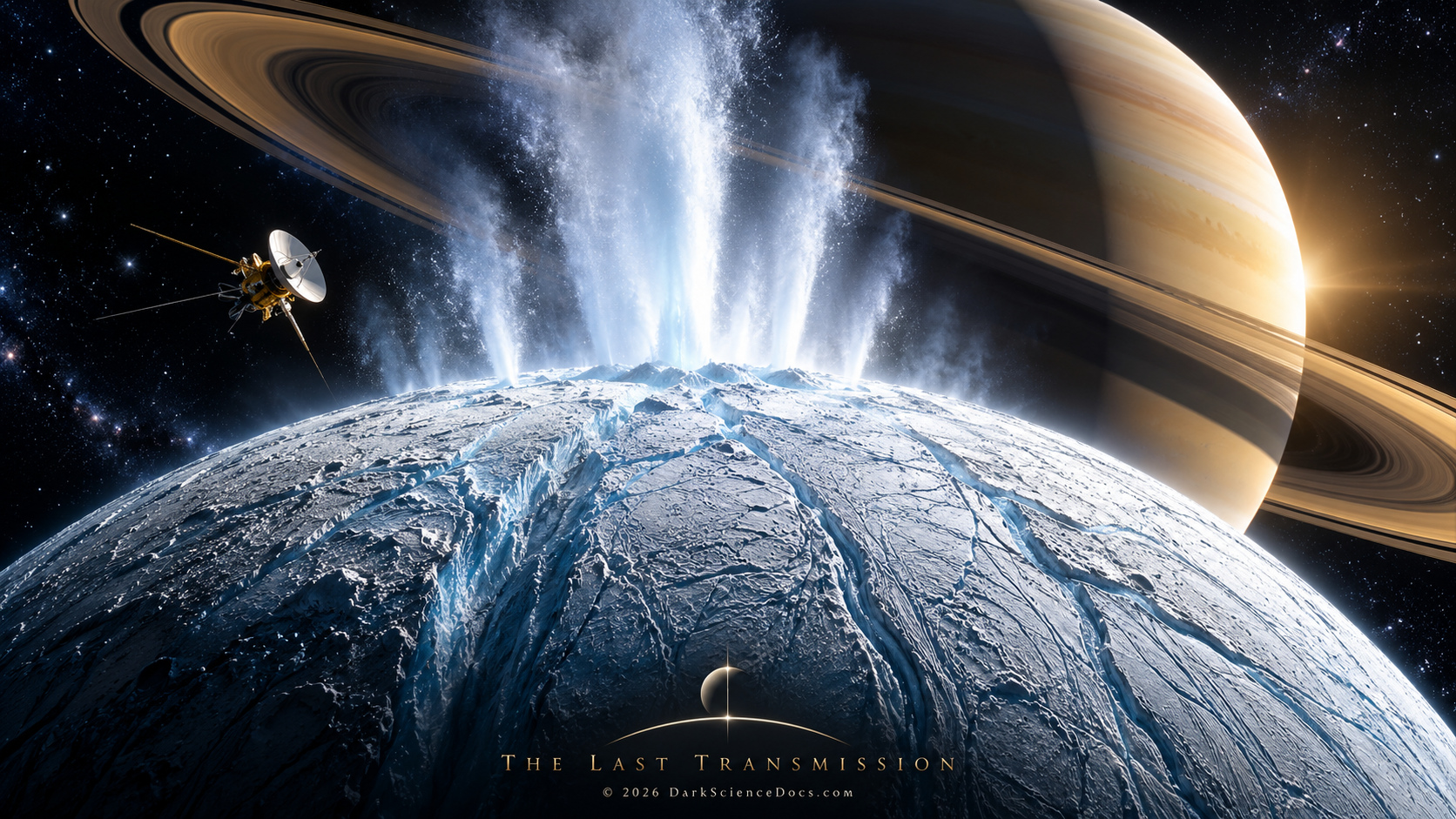
Water vapor and fine ice grains stream into space from fractures near Enceladus’s south pole. Cassini sampled that spray, giving scientists access to material from a hidden ocean and evidence of its chemistry. Choose the south-pole view or fly through the illustrated plume, then follow the documentary into the measurements behind it. The ocean’s habitability remains an open question.
Fine ice grains scatter sunlight. The faint haze makes gas flow visible in this illustration. Vent positions, spray density, grain sizes, and flight speed are chosen for exploration; they are not a reconstruction of one Cassini encounter.