THE LAST TRANSMISSION / FIELD GUIDE 002
Oceans
Beyond Earth.
Ice can hide a world of liquid water. The challenge is learning what lies underneath when every instrument has to read the ocean through something else.
Compare the evidence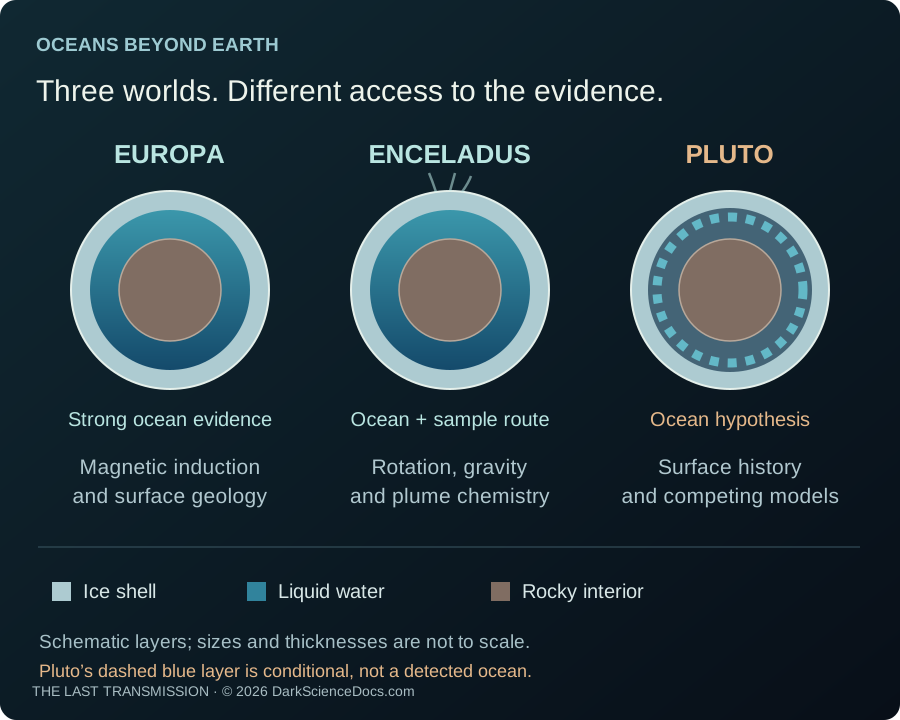
01 / UNDER THE SURFACE
How do we know
an ocean is there?
A hidden ocean is an explanation that must account for measurements made elsewhere: above the surface, within a magnetic field, or inside escaping ice grains. The instruments do not all ask the same question. Some constrain whether liquid is present, others its global extent, and others the chemistry that a connected reservoir can carry into space. Europa and Enceladus have strong ocean cases built from different combinations of evidence. Pluto’s possible ocean depends more heavily on reconstructing an interior from its geological history. [1] [6] [13] [14]
Throughout this guide, a measurement means an instrument’s recorded signal, an interpretation means the physical explanation fitted to that signal, and an open question marks where the explanation remains incomplete. Those distinctions matter most when an ocean becomes a story about life. Establishing water, establishing suitable conditions, and detecting organisms require different evidence. None of these three worlds has a confirmed detection of life. [7] [18] [21]
The coherent journey begins with the comparison below. Follow a world into the detailed explanation, open its Evidence File for the underlying reasoning, then use the linked Atlas view to explore its setting. The diagrams show the ideas behind the evidence; they do not turn an inferred interior into a photograph.
02 / SAME QUESTION, DIFFERENT RECORDS
Compare what
the instruments can reach.
| World | Ocean case | Key evidence | Main gap |
|---|---|---|---|
| Europa | A global salty ocean is strongly supported. | Induced magnetic response, icy surface geology and interior models. [1] [2] | Properties of the ocean, exchange through the ice and current seafloor activity. |
| Enceladus | A global ocean is strongly supported, with an accessible chemical sample route. | Libration, gravity, water-rich plumes and salts in particles. [6] [7] | How plume samples relate to the full ocean and whether any biology is present. |
| Pluto | A plausible ocean hypothesis with competing interior explanations. | Surface extension, thermal calculations and models of Sputnik Planitia. [13] [14] [16] | The present liquid layer is unconfirmed; another mass-anomaly model can fit the basin. |
Explore the evidence records by world. Every card keeps the observation, the proposed explanation and the uncertainty together.
A changing magnetic field
- Measured
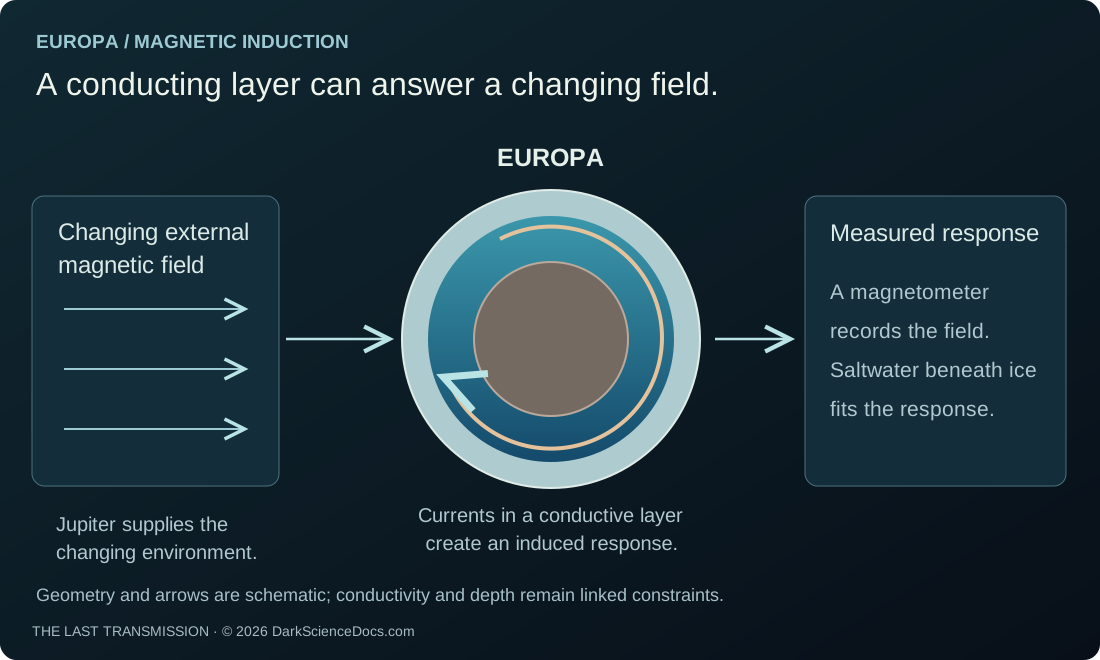
- Galileo measured a magnetic response as the direction of Jupiter’s surrounding field changed.
- Interpretation
- Electrical currents in a conducting subsurface layer fit that response; salty liquid water is the leading material interpretation.
- Still open
- Conductivity, thickness and geometry must be disentangled. This is no camera view of the ocean. [1] [2]
Broken and rearranged ice
- Measured
- Images reveal fractures, ridges and disrupted blocks in regions of the icy surface.
- Interpretation
- A mobile shell and exchange with warmer material help explain the geological record.
- Still open
- A surface feature can involve shallow water or warm ice without marking a direct opening to the global ocean. [1] [3]
Carbon dioxide in young terrain
- Measured
- Webb mapped enhanced carbon dioxide around the disrupted terrain of Tara Regio.
- Interpretation
- The distribution favors an interior source and supports exchange between the surface and subsurface.
- Still open
- The inferred source does not measure the bulk ocean composition or identify organisms. [4]
A shell that wobbles
- Measured
- Cassini images tracked the small back-and-forth motion called physical libration.
- Interpretation
- The observed amplitude supports an ice shell decoupled from the rocky interior by a global ocean.
- Still open
- The detailed ice and ocean thicknesses still depend on interior models. [6]
Salts and phosphates in grains
- Measured
- Cassini recorded chemical signatures in ice particles, including sodium salts and phosphate-bearing compounds.
- Interpretation
- The grains carry a chemical record of liquid reservoirs connected to the plume.
- Still open
- Freezing, vent transport and grain selection can change the sample relative to the source water. [7] [10]
Clues to water meeting rock
- Measured
- Cassini found tiny silica particles and molecular hydrogen in material associated with the moon.
- Interpretation
- Laboratory and chemical models support hydrothermal water–rock reactions as a source.
- Still open
- Neither the vent landscape nor a living ecosystem has been directly imaged or detected. [8] [9]
A basin near the tidal axis
- Measured
- New Horizons mapped Sputnik Planitia, its topography and its location relative to Charon.
- Interpretation
- One model invokes an impact-thinned shell and denser ocean water rising beneath the basin.
- Still open
- The mass anomaly is inferred, not a directly measured gravity map. An impactor-remnant model offers another explanation. [13] [16] [17]
A surface stretched by history
- Measured
- New Horizons revealed faults interpreted as extension of Pluto’s water-ice bedrock.
- Interpretation
- Partial freezing of an internal ocean can expand the body and generate extensional stresses.
- Still open
- Thermal properties and the history of the shell affect the inference; fractures alone do not locate liquid today. [14]
Heat that might survive
03 / EUROPA
An ocean
that answers a field.
Europa sits in a changing magnetic environment around Jupiter. Galileo measured a response whose direction changed in the way expected from currents induced in a conducting shell. A deep layer of salty water provides a natural explanation because dissolved ions allow electrical current to flow. This is the strongest single line of evidence for Europa’s ocean, and it gains force when read alongside an icy surface and geological signs of deformation. [1] [2]
The surface adds a different record. Ridges, fractures and regions of rearranged ice show that the shell has been worked and renewed. Some features may involve liquid or warm ice within the shell, so a chaotic patch does not automatically mark a hole all the way to the ocean. Europa’s overall water inventory may exceed Earth’s combined oceans, but the shell and ocean thicknesses are estimates rather than a borehole measurement. [3]
Webb’s 2023 observations placed enhanced carbon dioxide in Tara Regio, a disrupted and geologically young region. Researchers argued that an interior source better explains this pattern than material delivered from outside. That makes the surface a promising chemical messenger. Transport and irradiation still complicate the task of recovering the composition of water far below it, and tentative plume detections have not established a dependable spray comparable with Enceladus. [4]
Even a convincing ocean does not settle the energy available at its rocky floor. A 2026 mechanical modeling study predicts little active faulting at Europa’s seafloor today. Its result depends on assumptions about stresses and rock strength, and leaves other sources of chemical energy under discussion. It challenges one route to a habitat while leaving the ocean evidence itself intact. [5]
Open Europa’s Evidence File ↗04 / ENCELADUS
The ocean
with a way out.
Enceladus provides an unusually useful connection between the hidden interior and space. Water vapor and ice particles escape through fractures near its south pole, supplying material to Saturn’s E ring. Cassini flew through this environment and recorded its composition. The spacecraft sampled the escaping material rather than dipping an instrument into the ocean, but the plume gives researchers a route that Europa has not yet offered so reliably. [7]
The global-ocean argument does not rest on chemistry alone. Cassini tracked the moon’s small physical libration, a periodic wobble in its rotation. The measured motion is too large for the outer shell to be tightly locked to a completely solid interior in the tested models. A liquid layer separating shell from rock accounts for that motion, complementing gravity and plume evidence. These independent records support the ocean’s global extent. [6]
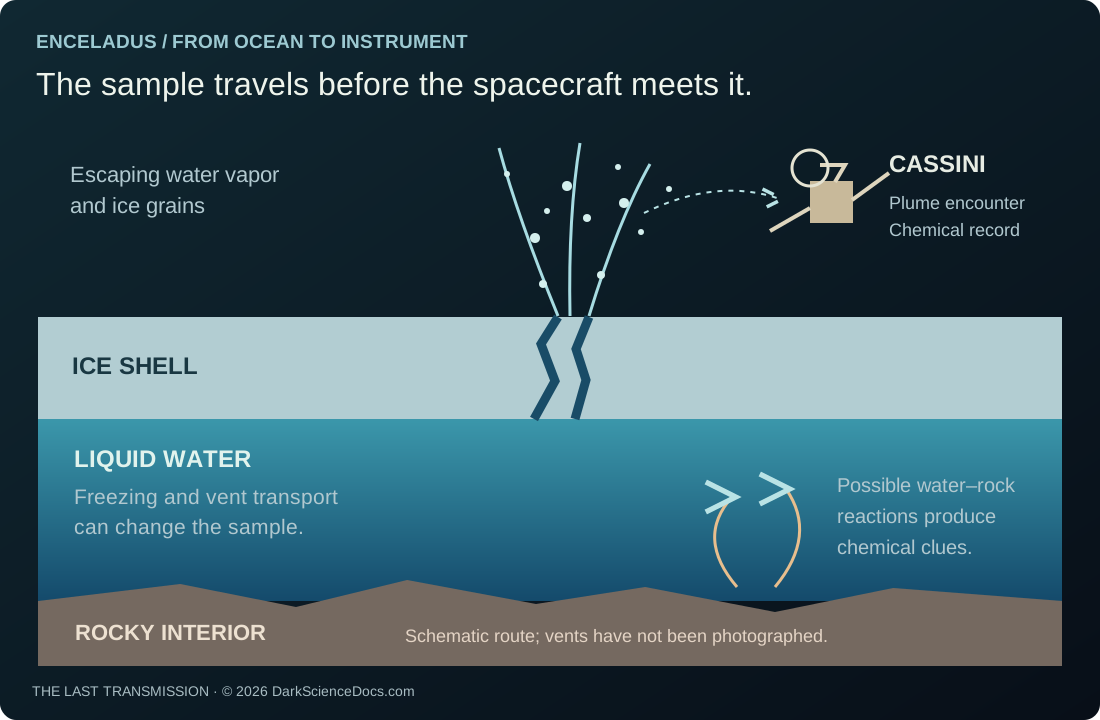
Tiny silica particles point toward water interacting with rock under conditions reproduced in laboratory studies. Molecular hydrogen supplies a second clue: water–rock chemistry can generate hydrogen, which could feed energy-yielding reactions if appropriate reactants and organisms existed. These observations motivate hydrothermal interpretations without establishing that Enceladus has Earth’s exact vent structures or microbial communities. [8] [9]
Phosphates identified in salt-rich grains in 2023 extended the inventory of biologically relevant ingredients. A 2025 reanalysis then found additional organic compounds in fresh particles from Cassini’s E5 flyby. Organic chemistry can arise through nonbiological processes, and the grain population sampled by a spacecraft can differ from the bulk ocean after freezing and transport. The result is a richer case for investigating a possible habitat, with the life question still unanswered. [10] [11] [12]
Open the Enceladus chemistry Evidence File ↗05 / PLUTO
A hidden ocean
with another explanation.
Pluto makes the comparison more interesting because its evidence has a different reach. New Horizons mapped a world whose water ice can form bedrock and mountains while nitrogen ice covers prominent plains. A deep water ocean would be beneath the solid exterior, far removed from a familiar open sea. The 2015 flyby gave detailed geology, but no ocean sample and no global orbital gravity survey capable of uniquely determining its interior. [18] [13]
One ocean argument begins at Sputnik Planitia, the great basin near the axis joining Pluto and Charon. Its position can be explained if the region has an excess of mass. In the ocean-uplift model, an impact thins the ice shell and lets denser liquid water rise beneath the basin; subsequent nitrogen deposition contributes additional weight. The mass anomaly and the reorientation history are parts of this inferred explanation, rather than a gravity map measured by New Horizons. [13]
Surface extension supplies another clue. Water expands as it freezes into ordinary ice, so the partial freezing of an ocean can stretch the overlying shell. Thermal models connect Pluto’s faults to this process and ask whether the remaining liquid could survive. An insulating gas-hydrate layer is one proposed way to reduce heat loss. Its usefulness in a model does not mean that either the layer or the ocean has been detected. [14] [15]
There is a serious alternative. Impact simulations published in 2024 produce a local mass excess from rocky material left by the impactor, permitting the basin’s location to be explained without a substantial ocean. This does not prove that Pluto is dry inside. It means that one celebrated ocean argument can be reproduced by a different interior history, so the guide treats a present-day ocean as plausible and unconfirmed. [16] [17]
A 2026 preprint proposes liquid nitrogen flowing from beneath parts of Sputnik Planitia’s glacier. That hypothesis concerns a different substance and a different depth from a global water ocean inside Pluto. A headline about possible liquid nitrogen should therefore lead back to the surface-glacier problem before it is added to the deep-ocean evidence. [19]
Read the Pluto Evidence File and its alternative ↗06 / THE THERMAL ENGINE
Why doesn’t
all the water freeze?
Liquid water needs a balance between energy supplied and energy lost. At Europa and Enceladus, changing tidal stresses flex the interior, and part of that mechanical energy becomes heat. Orbital interactions can help maintain the eccentricity that drives the changing deformation. The heating is distributed according to the world’s structure, so a warm ice shell does not automatically imply a strongly heated rocky seafloor. [3] [7] [5]
Pluto asks more of retained internal heat, including energy released by radioactive decay in its rock, and of the rate at which its shell lets heat escape. Conductive insulation, convection, dissolved substances and possible hydrate layers alter the lifetime of a modeled ocean. These dependencies explain why a cold surface does not settle the interior and why different assumptions can lead to different answers. [14] [15]
Across the comparison, the useful question is how a proposed ocean remains compatible with the world’s thermal and geological history. A layer of blue in a cutaway supplies no energy by itself. Every long-lived liquid layer needs an account of the heat budget and the properties that control melting and freezing. [3] [7] [14]
07 / WATER, HABITABILITY, LIFE
Three questions
that need their own answers.
Is an ocean present?
Magnetic responses, rotation, gravity and geology constrain interior structure. They can establish a strong water case while leaving the chemistry uncertain. [1] [6]
Could life be supported?
Chemical ingredients, usable energy and sustained water–rock interactions matter. The materials must also reach one another in a suitable environment. [9] [10] [20]
Are organisms there?
A biological interpretation must survive comparison with nonbiological sources, sampling effects and contamination. Organic molecules or hydrogen alone do not establish life. [11] [12] [21]
Where should we search first?
Enceladus offers a demonstrated sample route and rich chemical evidence. Europa offers a major ocean target whose properties can be probed in several ways. Pluto tests how far liquid water might persist in a distant interior. The best target depends on the question and the instrument; this guide gives no invented percentage chance of life. [7] [20] [14]
08 / WHAT WOULD CHANGE THE STORY?
Ask for the
next useful measurement.
At Europa, improved magnetic and plasma measurements can separate the interior response from its surrounding environment. Radar can investigate ice structure and search for liquid within the shell where conditions allow signals to penetrate. Composition maps and thermal observations can test where material or heat may reach the surface. Europa Clipper combines these approaches to investigate habitability, with no claim that its payload will directly detect organisms. [20] [21]
At Enceladus, a future dedicated investigation could repeat plume sampling, compare gas and grain populations, and use measurements designed to distinguish biological and nonbiological chemistry. Connecting sample histories to their sources would make the ocean interpretation more precise. Cassini’s continuing reanalyses also show the value of preserving an instrument record so that a method can ask a better question of it. [11] [12]
At Pluto, an orbital gravity record, broader geological coverage and constraints on present heat loss would help distinguish the competing interiors. This is a suggested evidence test, not a report that those measurements have been made or that such a mission is scheduled. Its purpose is to ask which observation would make the ocean and impactor-remnant accounts predict detectably different worlds. [13] [14] [16]
09 / QUICK ANSWERS
Keep the common
questions close.
Which of these worlds has the strongest ocean evidence?
Europa and Enceladus both have strong cases. Enceladus adds a reliable plume sample route to a global-ocean argument from rotation and gravity. Europa’s induced magnetic response is especially compelling. Pluto’s possible ocean remains more dependent on competing geological and interior models. [1] [6] [7] [13] [16]
Has a spacecraft seen the water beneath the ice?
No camera has photographed the ocean beneath these worlds’ shells. Cassini sampled material escaping from Enceladus, while Europa’s ocean and Pluto’s possible ocean are reconstructed through other observations and models. A cutaway is an explanatory image. [1] [7] [18]
Does Europa have more water than Earth?
NASA’s estimates allow Europa’s ocean to contain more than twice the volume of Earth’s oceans. That comparison comes from inferred dimensions, so it should be read as an estimated inventory rather than a precise measured volume. [3]
Are the Enceladus plumes proof of life?
They provide access to water, salts and organic chemistry, with evidence consistent with water–rock reactions. Those ingredients motivate a search for life, but none requires organisms as its only source. [7] [9] [10] [11]
Is Pluto’s heart a frozen water ocean?
Sputnik Planitia is dominated at the surface by nitrogen ice. The proposed water ocean would be much deeper, beneath the water-ice shell. The 2026 liquid-nitrogen hypothesis concerns the glacier rather than that deeper water layer. [18] [19]
10 / FOLLOW THE SIGNAL
Choose your
next passage.
Find the moon in Jupiter’s system.
Explore Europa’s setting, then follow the dossier into the magnetic evidence. The view shows the system rather than a measured interior.
Enter the Jupiter system ↗ 3D ATLAS / ENCELADUSFly through the illustrated spray.
Approach the south pole and enter the plume experience, then compare the teaching scene with Cassini’s actual sample route.
Enter the Saturn system ↗ 3D ATLAS / PLUTO & CHARONTurn the flyby record in your hands.
Explore surface maps built from New Horizons imagery and the coverage limits that accompany them.
Explore Pluto and Charon ↗ 3D ATLAS / EARTH ANALOGUEDescend into Earth’s dark ocean.
Explore a teaching model of deep-ocean environments. Earth provides an analogy for chemical energy without establishing the same ecosystem elsewhere.
Begin the ocean descent ↗ DOCUMENTARY / CASSINIA final flight to protect a possibility.
Follow the mission’s discoveries and the decision to dispose of Cassini in Saturn. Planetary protection preserves the opportunity to investigate a potentially habitable world.
Watch the documentary ↗ INVESTIGATION / EUROPAAn ocean can leave the energy question open.
Read the investigation into a possible quiet seafloor and the assumptions behind its habitability argument.
Open the investigation ↗ ILLUSTRATED ARTICLE / PLUTOFollow the heart into the hidden interior.
Read the longer narrative, keeping the proposed ocean and the alternative explanation alongside one another.
Read on Substack ↗ ILLUSTRATED ARTICLE / ENCELADUSThe spacecraft is gone. Its record continues.
Follow how preserved Cassini measurements still reveal details of ocean chemistry.
Read on Substack ↗ ILLUSTRATED ARTICLE / EUROPARead the silence beneath the ice.
Explore the narrative behind the seafloor question, then return to the evidence and its limits.
Read on Substack ↗Continue across the collection: all Field Guides · Black Holes Field Guide · How Stars Die.
11 / SOURCES & FURTHER READING
Keep the evidence
within reach.
Agency records explain instruments and findings; papers document the models and analyses. Numbered links lead to the source behind each passage. The original diagrams are schematics, and the comparison is a qualitative synthesis rather than a probability calculation.
NASA: Why Europa has an ocean ↗
Magnetic induction and the geological clues beneath the ocean interpretation.
Back to source list ↑Kivelson et al.: Galileo magnetometer measurements (2000) ↗
The changing magnetic response that strengthened the case for a conducting subsurface layer.
Back to source list ↑NASA: Europa facts ↗
The ice shell, tidal heating and estimated water inventory.
Back to source list ↑NASA: Webb finds carbon on Europa (2023) ↗
Surface carbon dioxide, the proposed interior connection, and limits on plume searches.
Back to source list ↑Byrne et al.: Europa’s seafloor today (2026) ↗
A mechanical model predicts little active faulting; it does not observe the seafloor or settle every energy pathway.
Back to source list ↑NASA: Cassini finds a global ocean (2015) ↗
Enceladus’s measured libration and the inference of a shell separated from its interior by liquid.
Back to source list ↑NASA: Enceladus ↗
Plumes, gravity, an internally heated ocean and the source of Saturn’s E ring.
Back to source list ↑NASA/JPL: Possible hydrothermal activity (2015) ↗
Silica nanograins and laboratory constraints on water–rock interactions.
Back to source list ↑NASA/JPL: Hydrogen and ocean worlds (2017) ↗
Molecular hydrogen in the plume and a possible chemical energy source.
Back to source list ↑NASA/JPL: Phosphorus in Enceladus ice grains (2023) ↗
Phosphates detected in salt-rich ice grains and the separate laboratory/model step used to infer ocean abundance.
Back to source list ↑Khawaja et al.: Freshly ejected organic-bearing grains (2025) ↗
A reanalysis of Cassini’s E5 flyby extends the inventory of organic chemistry.
Back to source list ↑NASA: Fresh organics from Enceladus (2025) ↗
Why fresh plume grains provide a different sample from older particles in the E ring.
Back to source list ↑Nimmo et al.: Sputnik Planitia and an ocean (2016) ↗
An ocean-uplift explanation for the basin’s inferred mass excess; author manuscript of the 2016 Nature paper.
Back to source list ↑Hammond et al.: Pluto’s ice shell and tectonics (2016) ↗
Thermal evolution and the connection between water freezing, expansion and surface fractures.
Back to source list ↑Kamata et al.: An insulating hydrate layer (2019) ↗
A modeled mechanism that could prolong a possible ocean; gas hydrates have not been detected there.
Back to source list ↑Ballantyne et al.: An alternative Sputnik Planitia interior (2024) ↗
Impact simulations provide an alternative mass anomaly with no substantial ocean required.
Back to source list ↑University of Bern: How Pluto got its heart (2024) ↗
The research team explains its impactor-remnant interpretation and its difference from ocean uplift.
Back to source list ↑NASA: Pluto facts ↗
Water-ice mountains, nitrogen plains and the distinction between surface ice and a possible interior ocean.
Back to source list ↑Stern et al.: Possible nitrogen basal flow (2026 preprint) ↗
A hypothesis about liquid nitrogen beneath a surface glacier, distinct from a deep water ocean.
Back to source list ↑NASA: Europa Clipper science instruments ↗
Magnetic, plasma, radar, chemical and imaging measurements aimed at habitability.
Back to source list ↑NASA: Europa Clipper mission FAQ ↗
The mission studies possible habitable environments and is not a life-detection mission.
Back to source list ↑Published and reviewed October 11, 2026. Revisions should identify the changed observation or interpretation and preserve this guide’s URL.