
13 / RESEARCH / OBSERVATION & INTERPRETATION
SpaceX, AI and the Infrastructure Behind a Forecast
The article links ambitions for reusable launch, communications and AI demand. Its strongest questions concern the milestones and infrastructure that would be required for the proposed business relationship to work.
Launch, communications and computing have different operating requirements. The supplied article describes a strategy in which increased connectivity demand might help finance space ambitions; that interpretation does not itself demonstrate future revenue or mission performance. Predicted AI demand, rapid vehicle reuse and a profitable network are separate outcomes. A demonstration flight does not establish an operational turnaround rate, and a market forecast cannot substitute for deployed power, cooling or communications capacity.
Reusability requires repeated performance
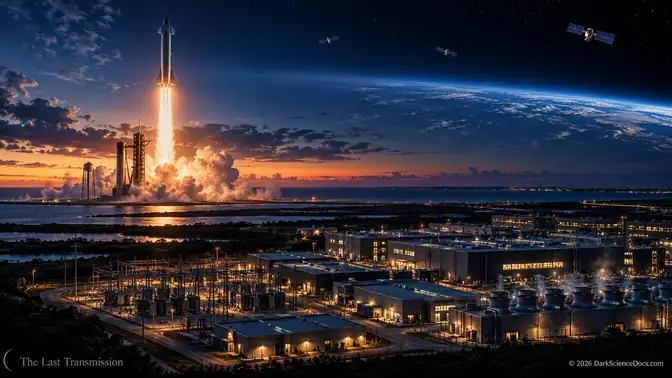
For Flight 15, Musk says SpaceX intends to attempt recovery of both the booster and the upper-stage ship. In the context of the October update, his reference to the following month points to November 2026. It remains an intended attempt, with success explicitly uncertain. Recovering both stages would be a major step toward the fully reusable system SpaceX is pursuing. The more consequential test would come afterward, when engineers inspect the hardware and determine what it takes to fly again. A successful catch cannot, on its own, establish the cost of refurbishment, the useful lifetime of the vehicle, or the time needed between missions.
Computing meets electricity and heat
As the update moves from satellites to computing, Musk emphasizes the infrastructure needed to make AI hardware useful. He describes power, cooling, and electrical equipment as major constraints, and argues that SpaceX’s engineering teams can bring these systems online unusually quickly. His comparisons with competitors remain claims, rather than independently established measures of performance. The physical constraint itself has substantial support beyond Musk’s remarks. The International Energy Agency’s 2026 analysis projects global data-center electricity consumption rising from roughly 485 terawatt-hours in 2025 to about 950 terawatt-hours in 2030. It also identifies bottlenecks involving electricity supply, grid connections, advanced chips, equipment, and financing.
A larger network brings obligations
A constellation approaching the scale Musk describes would raise questions beyond launch capacity. NASA’s orbital-debris research explains why avoiding collisions and managing the expanding population of spacecraft matter for safe operations. Its work on debris remediation also discusses how large constellations can increase exposure to debris and create additional debris risks when spacecraft fail or are poorly disposed of. [3] That does not mean expansion inevitably produces catastrophe. It means the ability to put more hardware into orbit must be accompanied by the ability to operate it responsibly and retire it safely. A launch system’s success cannot be judged solely by how much mass it can deliver when that mass becomes part of a shared operating environment.
Read the illustrated companion article for the full narrative and its source trail. The selected passages above follow that article’s investigation.
Continue reading on SubstackTHE EVIDENCE / THE OPEN QUESTION
What we know.
Launch, communications and computing have different operating requirements. The supplied article describes a strategy in which increased connectivity demand might help finance space ambitions; that interpretation does not itself demonstrate future revenue or mission performance.
What remains open.
Predicted AI demand, rapid vehicle reuse and a profitable network are separate outcomes. A demonstration flight does not establish an operational turnaround rate, and a market forecast cannot substitute for deployed power, cooling or communications capacity.
Why it matters.
Comparing forecasts with measurable milestones makes this a clearer infrastructure story. Reliability, costs, electrical supply and orbital responsibility would determine whether an attractive strategic narrative translates into sustained capability.
COMPARE THE QUESTIONS
Follow what the light reveals.
Follow the relevant evidence and teaching models. Each model explains a mechanism and retains its own stated assumptions and limits.
FOLLOW THE EVIDENCE
Research behind the field note.
EXPLORE IN 3D / MAP 04
Explore the related science model
Comparing forecasts with measurable milestones makes this a clearer infrastructure story. Reliability, costs, electrical supply and orbital responsibility would determine whether an attractive strategic narrative translates into sustained capability.
Open Mars mapVISUAL EVIDENCE
Inside the investigation.
FOLLOW THE THREAD
Related signals.
SpaceX Was Built to Reach Mars. Its Next Great Customer May Be AI.
Elon Musk’s selected update connects reusable rockets, a vastly larger Starlink network, and enormous computing campuses.
The Moon’s Darkest Places Could Decide Whether We Stay
NASA’s next lunar rovers must test whether ancient ice, dangerous terrain, and machines sent ahead of us can support something Apollo never attempted: a lasting human presence.

The First Humans on Mars Will Be Beyond Rescue
We are preparing to send people to another planet. But the greatest danger may arrive when someone calls Earth for help—and discovers that the answer cannot arrive in time.