
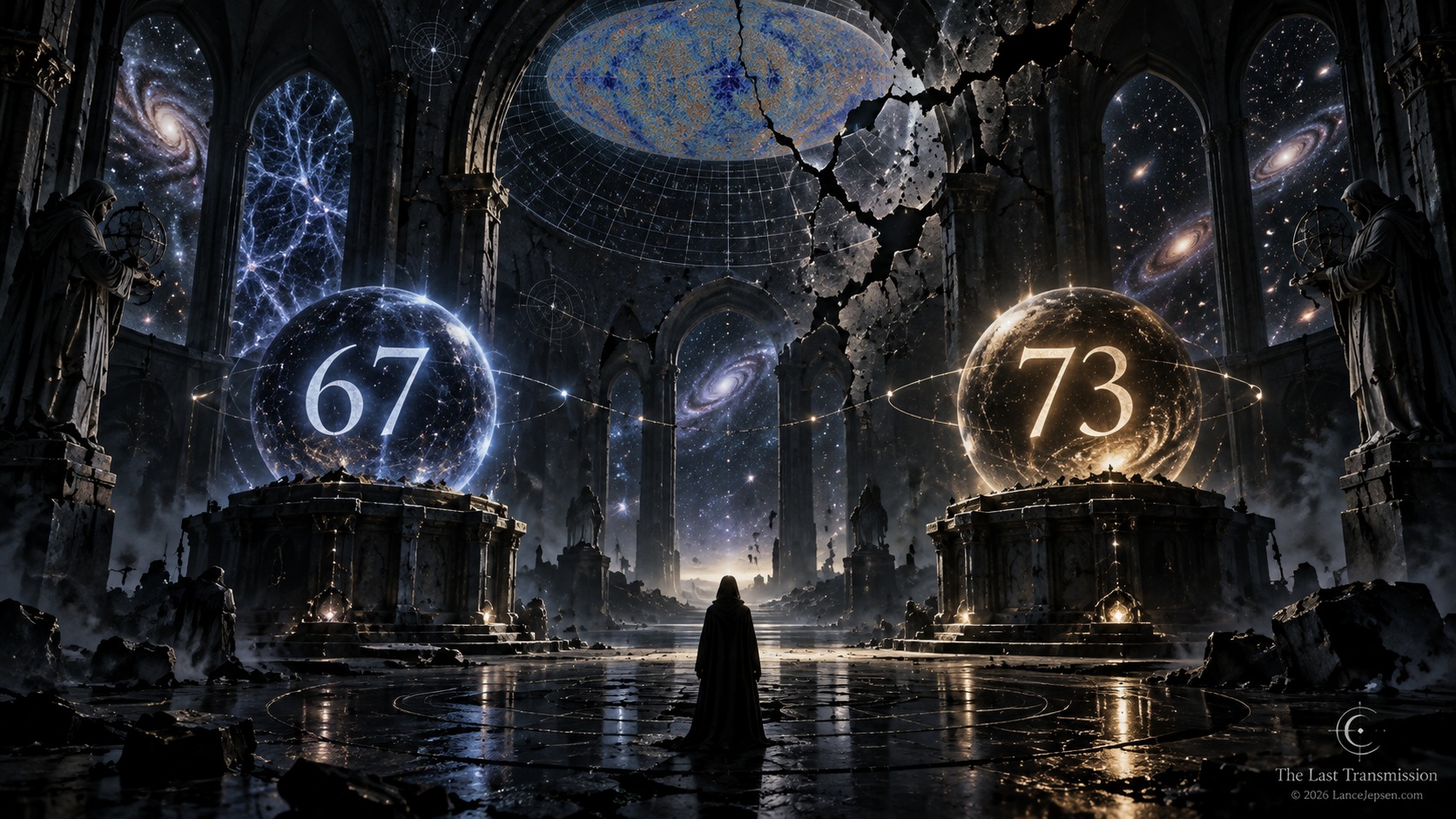
45 / A cosmic disagreement
The Universe Is Beginning to Disagree
Two careful ways of measuring cosmic expansion continue to return answers that do not comfortably meet.
One measurement reaches back toward the early universe; another looks at the nearby cosmos. The difference has endured closer scrutiny. It may point to an overlooked error, a gap in a model, or something we have not yet learned to ask. The tension matters because both paths are built from serious work, and the universe has not yet supplied an easy reconciliation.
The full investigation continues with the evidence, illustrations, and sources at The Last Transmission on Substack.
Continue reading on SubstackTHE EVIDENCE / THE OPEN QUESTION
What we know.
Measurements of the early universe, interpreted through the standard cosmological model, imply an expansion rate near 67 kilometers per second per megaparsec. The local distance ladder uses nearby stars and supernovae to reach a higher answer. The difference has survived many attempts to sharpen the observations.
What remains open.
A persistent disagreement does not automatically reveal physics beyond established models. Hidden systematics in measurements, assumptions in a model, or a genuinely missing ingredient remain live possibilities. Each method has a chain of inference worth examining before a dramatic conclusion can be drawn.
Why it matters.
The two routes connect the young universe to the one we can map around us. If they cannot be reconciled, something in that bridge needs repair. The investigation is a lesson in how science responds when two careful answers refuse to become one.
GO DEEPER / EVIDENCE FILE
Why Do Two Measurements of Cosmic Expansion Disagree?
Planck's early-universe data imply an expansion rate near 67.4 under the standard cosmological model; the SH0ES distance ladder finds about 73.0. The discrepancy is real in those analyses, but its cause is unresolved.
FOLLOW THE EVIDENCE
Research behind the field note.
WATCH THE RELATED DOCUMENTARY
The story in motion.
FOLLOW THE THREAD
Related signals.
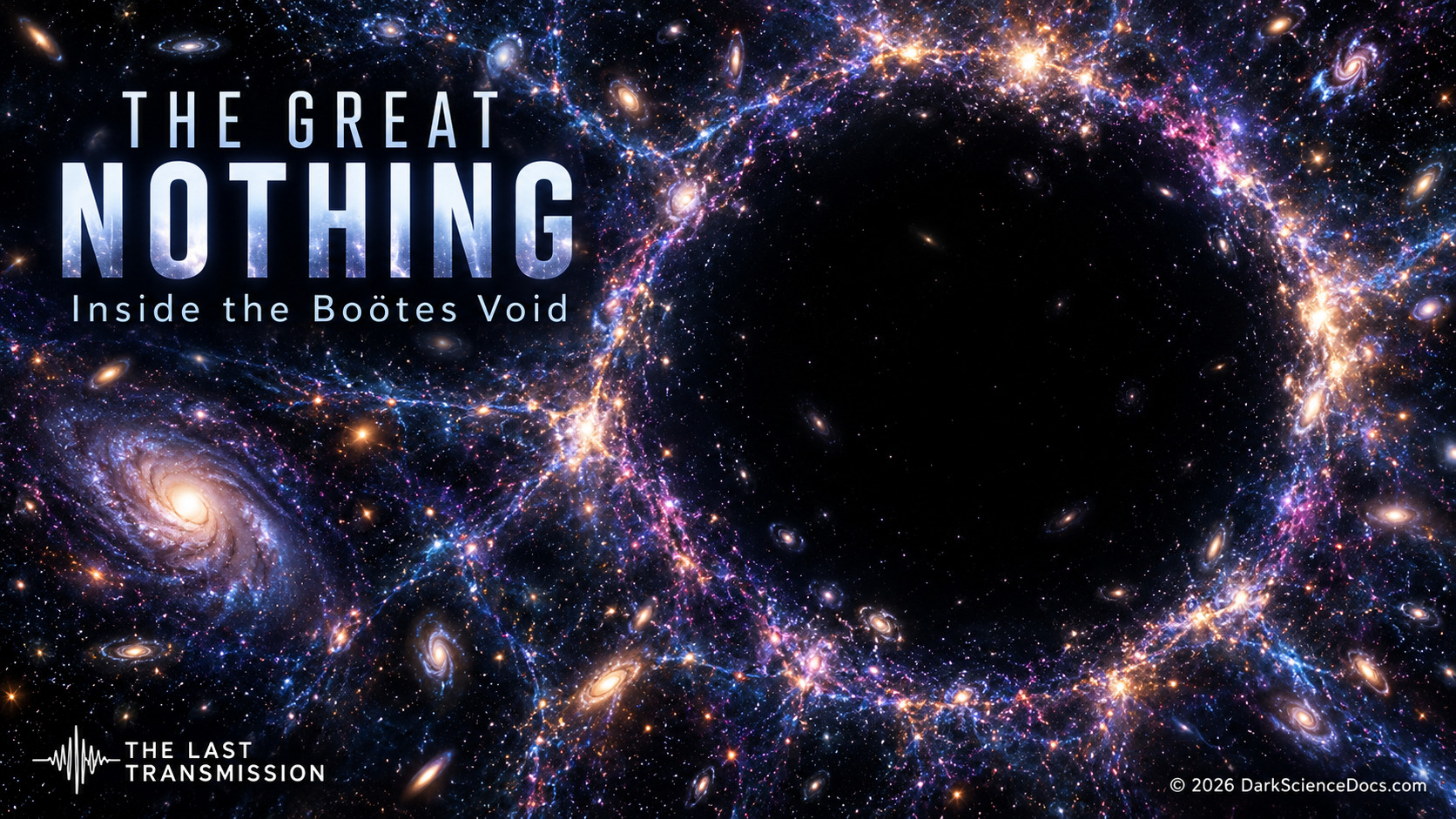
The Great Nothing: What If Your Galaxy Was Trapped Inside 330 Million Light-Years of Emptiness?
An enormous region of the universe contains remarkably few galaxies. The truly unsettling question is what the cosmos would look like if we lived inside it.
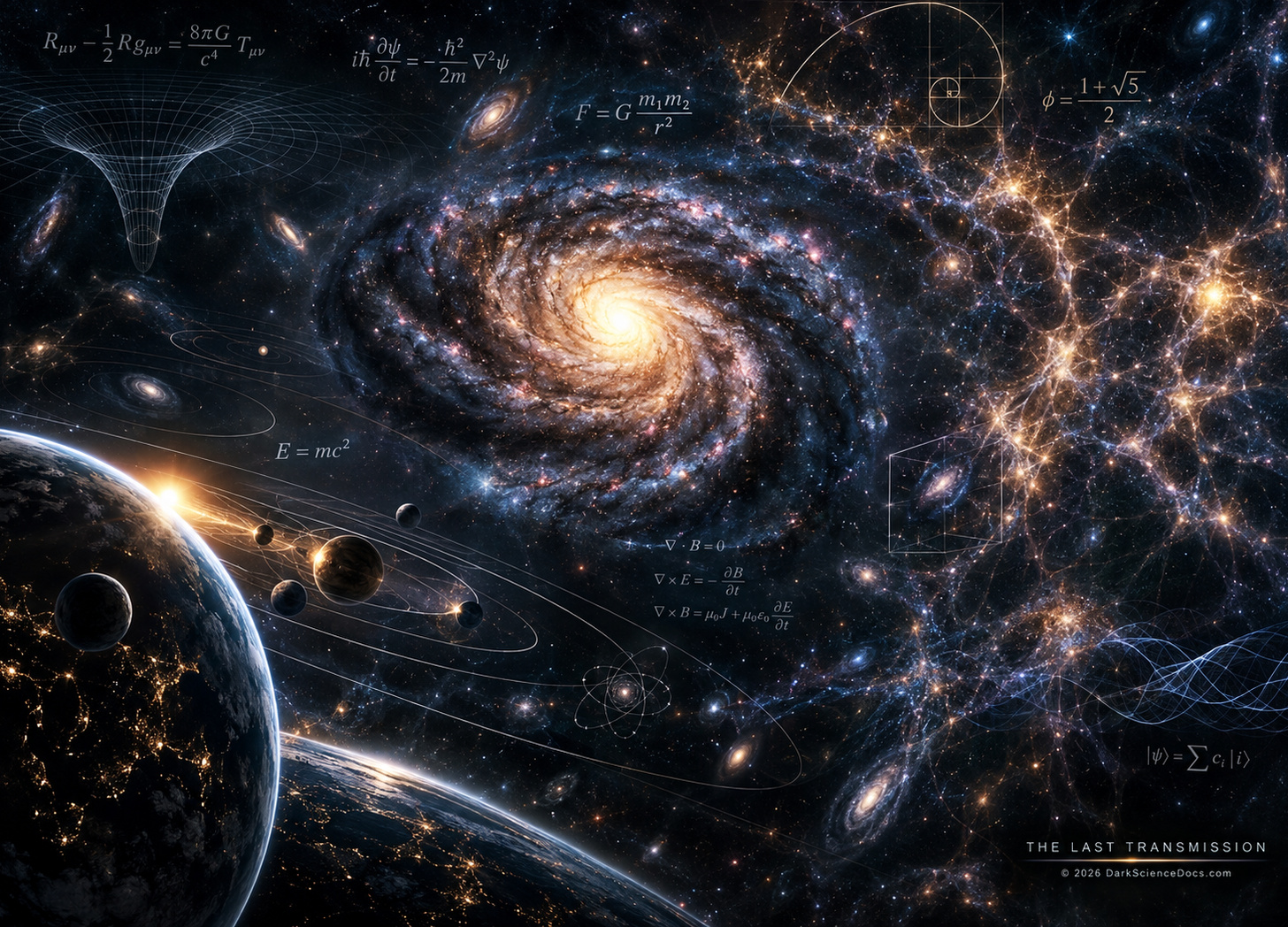
The Universe Looks Written in Mathematics. Physics Still Can’t Explain Why.
The constants are strangely hospitable, equations predict things before we discover them, and the deepest laws of nature refuse to explain where they came from.
A Star Blinked Twice. Whatever Caused It May Be Much Closer to Earth.
Two nearly identical optical disturbances, 4.4 seconds apart, appeared in HD 89389’s light. Follow the unexplained record, a foreground diffraction hypothesis, and the synchronized telescopes proposed to test it.