
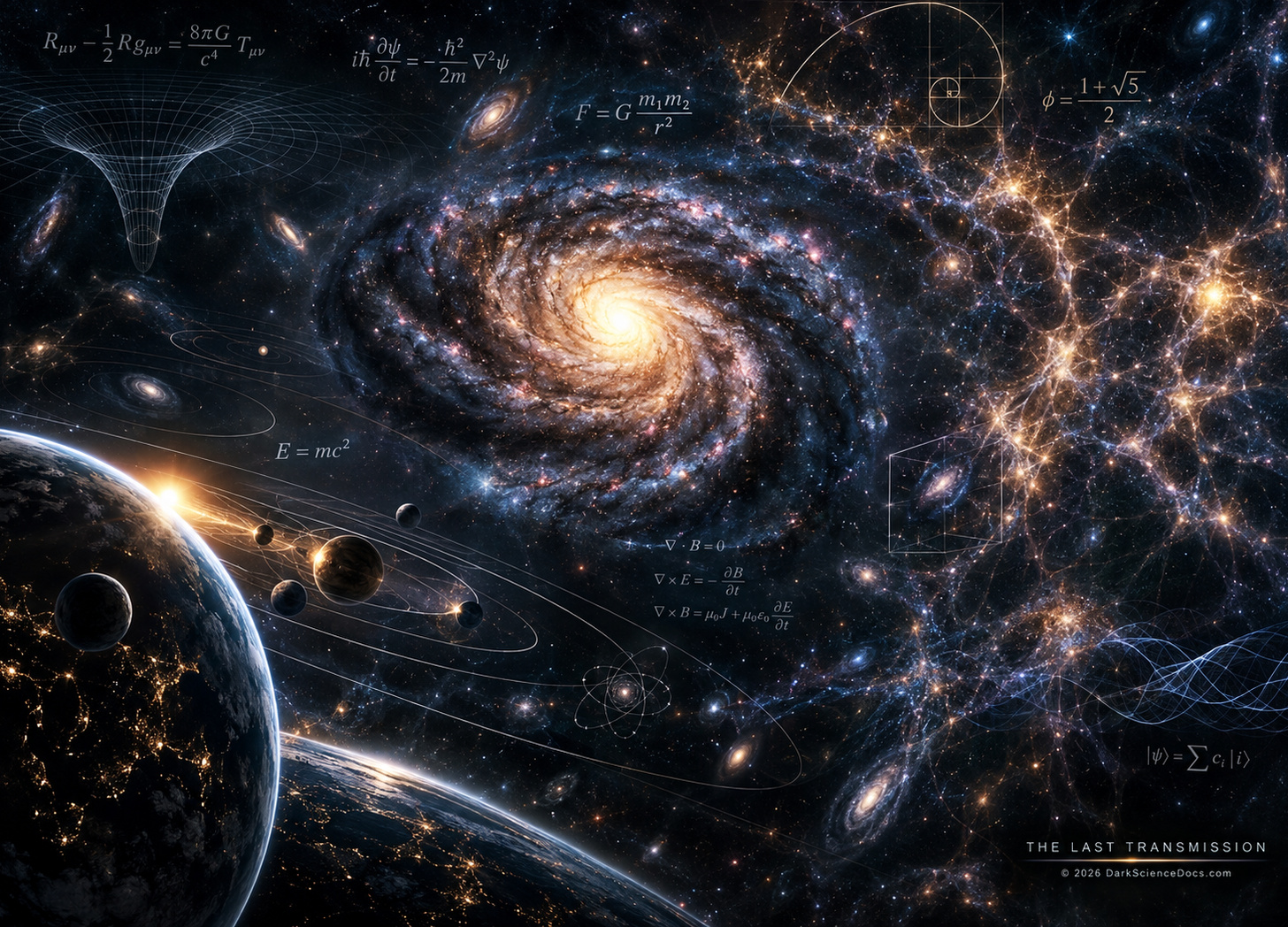
24 / The equations and the world
When an Equation Knows Before We Do
Mathematics can predict an unseen particle and describe a cosmos in which galaxies form. Whether that success explains why the laws have their particular values remains another question.
An equation earns trust when it survives a measurement. Dirac's work helped point physicists toward antimatter before the positron was detected, an extraordinary example of a mathematical structure guiding an experiment. Yet a successful prediction does not tell us why every constant of nature has its measured value. Fine-tuning arguments ask how different parameters might change the possibility of complex structures; the answer depends on which parameters may vary together and what else changes in a hypothetical universe.
The full investigation continues with the evidence, illustrations, and sources at The Last Transmission on Substack.
Continue reading on SubstackTHE EVIDENCE / THE OPEN QUESTION
What we know.
Equations make testable predictions, and measured values such as the small cosmological constant enter models of cosmic expansion and structure. The agreement of a prediction with observation establishes the model's usefulness in its tested domain, not the origin of its assumptions.
What remains open.
We do not know whether the constants could have taken other values, how those values might be distributed, or whether a multiverse is observable. The apparent suitability of our universe for observers is an interpretive problem, not evidence for a chooser or a proof that physics is complete.
Why it matters.
The gap between a law that works and an explanation for that law is where this investigation lives. It is possible to be impressed by the precision of physics while remaining precise about what an equation has actually demonstrated.
FOLLOW THE EVIDENCE
Research behind the field note.
WATCH THE RELATED DOCUMENTARY
The story in motion.
VISUAL EVIDENCE
Inside the investigation.
FOLLOW THE THREAD
Related signals.
A Star Blinked Twice. Whatever Caused It May Be Much Closer to Earth.
Two nearly identical optical disturbances, 4.4 seconds apart, appeared in HD 89389’s light. Follow the unexplained record, a foreground diffraction hypothesis, and the synchronized telescopes proposed to test it.
What If the Universe Is Accelerating Because Stars Die?
For nearly three decades, scientists have struggled to identify the mysterious force accelerating the expansion of the universe. Now a radical theory suggests the answer.
A Star Died 6.5 Billion Years Ago. Its Explosion Is About to Arrive Again.
NASA is watching for a supernova we have already seen. When that light finally reaches Earth, it could help answer one of the most troubling questions in modern cosmology.