
SCIENCE COUNTDOWNS / NASA / ESCAPADE / MARS
ESCAPADE Mars Arrival Countdown
Two arrivals for a two-point experiment
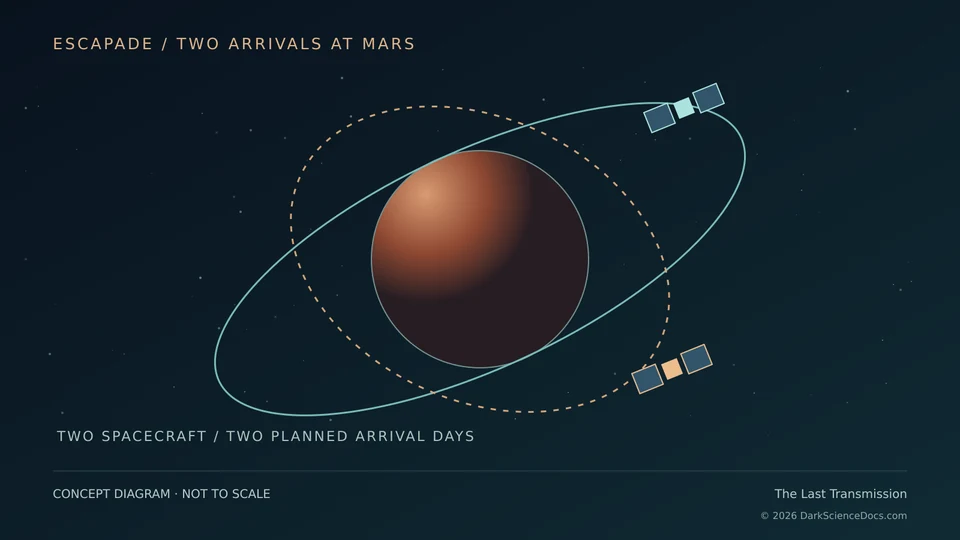
ESCAPADE’s twin spacecraft have separate planned Mars arrivals, opening the way to compare the planet’s plasma environment at two locations.
To the first planned Mars arrival date; no arrival hour has been published here
THE OTHER SPACECRAFT
Second planned Mars arrival · September 9, 2027
Both arrivals are planned. Each clock marks the beginning of its stated UTC date, not a published arrival hour.
To the second planned Mars arrival date; no arrival hour published
WHAT TO FOLLOW
A paired measurement begins with two successful journeys.
NASA’s November 2 update describes two separate Mars arrivals, planned for September 7 and September 9, 2027. They follow the twin spacecraft’s planned November 2026 powered Earth flybys and a roughly ten-month cruise. Keep those two flybys distinct from these later arrival milestones.
ESCAPADE is designed to compare the Martian plasma environment from two locations. That pairing helps researchers ask how conditions change across space rather than attributing every difference to change over time. The arrival reports will be the first things to check, followed by orbit and instrument updates.
This file tracks the plan for both spacecraft. Look for dated agency reports before treating either arrival as complete. An orbit milestone also does not, by itself, establish that a science campaign has begun or that a new result has passed scientific review.
QUESTIONS TO RETURN FOR
Keep the evidence in view.
Why are there two clocks?
NASA gives two planned arrival days. Keeping them separate prevents a successful first arrival from being mistaken for completion of the whole sequence.
What happens after arrival?
Follow the mission’s orbit and instrument status reports. Ask what configuration the spacecraft need before the paired measurements can begin.
What should I return for?
The arrival outcome for each spacecraft, the resulting orbit status and the mission team’s explanation of the next operational step.
CONTINUE THE INVESTIGATION
Follow the thread.
DATE & SCIENCE SOURCES
NASA’s November 2, 2026 update lists the spacecraft’s Mars arrivals for September 7 and September 9, 2027, following the planned Earth flybys. These are planned arrival days, not confirmations or published burn times. Each clock uses 00:00 UTC solely to mark its stated date.
Source and schedule review: . Check the mission or observing source for later changes. A clock reaching zero does not confirm an outcome.Remind me to check the outcome
Choose your calendar
Return for reports on at 9:00 a.m. in your calendar’s time zone, two days after the event day or window ends.
This is a return-for-results reminder, not the event time or an observing alarm. Check the date, time and alert before saving. Reports may take longer.
Saved reminders do not update if the schedule changes. Remove the old reminder and add a new one from this page.
Need another way?
Download the calendar file (.ics) and open it in your calendar. For Outlook on the web, choose Add calendar → Upload from file. For Google Calendar on a computer, choose Settings → Import & export → Import.
This reminder date has passed. Read the event file for the latest status.
No email signup. We don’t receive your calendar details.