
EVIDENCE FILE 55 / OBSERVATION & INFERENCE
What Do Mars’s Rocks and Seismic Waves Reveal About Water?
Trace three separate water investigations on Mars: mineral storage, an InSight crustal inference and the disputed interpretation of a polar radar echo.
THE SHORT ANSWER
What does the evidence support?
Mars’s former wet environments are supported by geological evidence. Minerals record reactions involving water, while seismic models suggest a possible liquid reservoir beneath one region. Radar observations test a different polar feature. These findings provide distinct constraints rather than a single confirmed underground ocean.
MEASUREMENT / INTERPRETATION / LIMIT
Follow the chain of reasoning.
01 / 04
Minerals store a chemical history
Measured or modeled
Rover instruments identify mineral compositions in accessible samples. Curiosity’s CheMin analysis detected siderite in drilled Gale Crater material.
What it suggests
Reactions involving water and atmospheric carbon dioxide can leave carbonates in rock, contributing to a reconstruction of changing surface conditions.
Where the claim stops
A mineral identification does not measure the entire planetary water inventory or show that free liquid remains beside that sample.
NASA: Curiosity’s siderite discovery and the carbonate question02 / 04
Seismic data constrain inaccessible crust
Measured or modeled
InSight recorded ground motion from which researchers constrained properties of the crust beneath its landing region.
What it suggests
A rock physics model favors water saturated fractures in the middle crust as an explanation of those properties.
Where the claim stops
The interpretation depends on composition and crack assumptions; it is regional and does not directly image a water body.
Wright, Morzfeld and Manga (2024): Liquid water in the Martian mid-crust03 / 04
A different radar measurement challenges a lake
Measured or modeled
Enhanced SHARAD observations detected a faint return from the south polar location associated with an earlier bright radar feature.
What it suggests
The observing team found the result more consistent with buried rock and dust than with the proposed liquid lake.
Where the claim stops
The result concerns a particular polar feature. It does not decide whether liquid occurs elsewhere or beneath InSight.
NASA/JPL: enhanced SHARAD observations of the polar feature04 / 04
Inventory models test possible histories
Measured or modeled
Researchers combine geological, atmospheric and isotopic constraints in models of long term Martian drying.
What it suggests
Water incorporated into minerals could account for a substantial fraction of an earlier surface inventory alongside atmospheric escape.
Where the claim stops
The modeled fraction is not a direct census of liquid reservoirs and should not be assigned uniformly to every region.
Scheller et al. (2021): water sequestration in the Martian crustMETHOD / INDEPENDENT TESTS
What would make the case stronger?
Begin with the quantity an instrument measures: mineral structure, ground motion or returned radar power. Then identify the material model connecting that quantity to water. Different instruments can be complementary without observing the same location or phase of water.
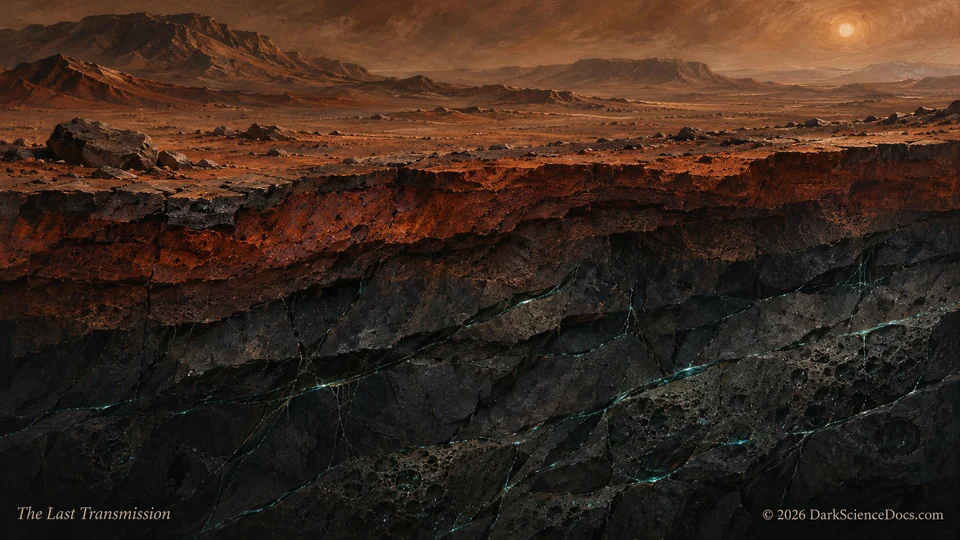
Keep bound water, ice and free liquid separate in an illustration or diagram. A conceptual cutaway should identify its imagined geometry and should never turn a model dependent interpretation into a mapped underground ocean.
Additional seismic constraints, better knowledge of crustal mineral composition and radar observations capable of distinguishing material models could narrow the water interpretations. Biological claims would then require independent evidence tied to a specific environment.
Sources and further reading
- NASA: Curiosity’s siderite discovery and the carbonate question
- Scheller et al. (2021): water sequestration in the Martian crust
- Scripps: the InSight rock physics interpretation
- Wright, Morzfeld and Manga (2024): Liquid water in the Martian mid-crust
- NASA/JPL: enhanced SHARAD observations of the polar feature