SCIENCE COUNTDOWNS / JAXA / MARTIAN MOONS EXPLORATION
MMX approaches Phobos
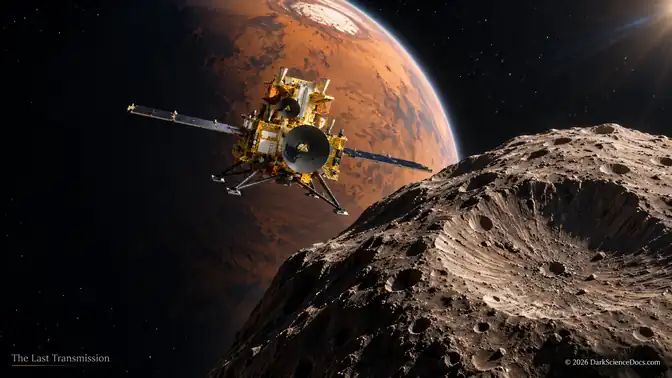
The next threshold is sustained exploration near Mars’s larger moon, before the rover deployment and sample collection.
Until the published September 2027 Phobos window begins
WHERE THE MISSION STANDS
The threshold ahead.
MMX launched from Japan on October 20, 2026 (Japanese local time). The spacecraft is headed toward the Martian system. ESA’s published sequence places entry into Mars orbit in August 2027, followed by operations in a quasi-satellite orbit near Phobos from September. The spacecraft remains primarily in Mars orbit while following the moon closely; this is not an ordinary low orbit dominated by Phobos’s weak gravity.
Arrival begins the survey, not the sample return. ESA’s October 2026 plan places Idefix deployment in early 2029, main-spacecraft sampling in 2030, and return to Earth in 2031. These are separate planned milestones. An expired clock alone cannot confirm that any operation succeeded.
WHY THE SCIENCE MATTERS
Questions worth returning for.
Where did Phobos originate?
Comparing mineral and elemental measurements with competing origin models can test whether the moon assembled from impact debris, captured material, or a more complicated history. Its dark surface alone does not select a unique formation mechanism.
Has the moon collected fragments of Mars?
Impact-transfer models predict that some Martian debris can reach Phobos. Returned grains could test that prediction, but their provenance and surviving geological information must be demonstrated through laboratory measurements.
How do you collect a sample in weak gravity?
Mapping and rover observations will help characterize terrain before the spacecraft approaches the ground. Stable contact, effective collection and preservation are engineering requirements; the target of at least ten grams remains an objective until recovery is confirmed.
CONTINUE THE INVESTIGATION
Follow the thread.
Explore related investigations, Evidence Files, image stories and films.
DATE & SCIENCE SOURCES
ESA lists Mars orbit insertion in August 2027 and operations around Phobos from September 2027. September 1 is only the beginning of the published month, not a confirmed rendezvous day or landing time. Surface operations follow later; schedules may change.
Source review: October 21, 2026. Check the mission agency for later schedule changes.THE NEXT FILES
Keep watching.
Hera returns to the DART impact site
A spacecraft changed a moonlet's orbit. Hera goes back to discover what the collision actually did to the asteroid.
Enter the event fileEuclid opens the next map of the dark universe
The DR1-Foundation release brings survey material into public view. The interesting part is what independent researchers can test with it.
Enter the event fileBepiColombo enters Mercury's orbit
After years of flybys and braking, two science orbiters prepare to investigate a small planet with an outsized interior.
Enter the event file