
SCIENCE COUNTDOWNS / NASA / LUCY / LEUCUS
Lucy Leucus Flyby Countdown
A slow-turning world meets a fast-moving visitor
Lucy’s next Trojan target after Polymele is Leucus, a slow-rotating asteroid whose changing brightness invites a closer look at its shape.
Until Lucy’s planned Leucus closest approach, about 19:32 UTC
WHAT TO FOLLOW
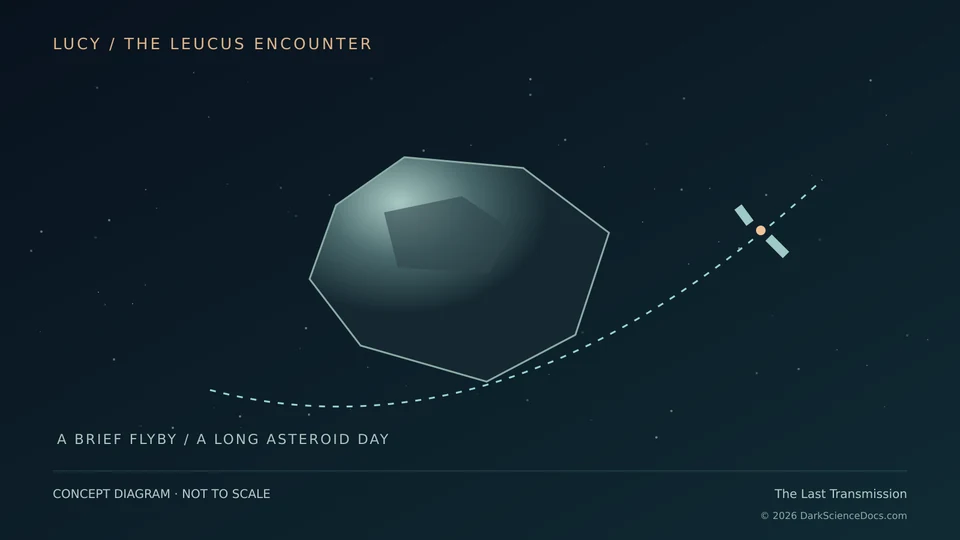
A long asteroid day, sampled during a brief encounter.
The Lucy mission team lists Leucus for April 18, 2028, with closest approach around 19:32 UTC. Its target page gives a planned distance no greater than about 620 miles (1,000 km). These are encounter planning values; later navigation updates can refine them.
Leucus turns unusually slowly. The mission’s tour describes a rotation lasting about 446 hours and a large variation in brightness as viewed from Earth. That variation suggests an elongated shape, but a close encounter can test what the distant light curve leaves uncertain.
Compare the encounter images and team interpretation with what was predicted beforehand. Ask which surface regions were imaged, how the viewing geometry limits a shape model, and whether a newly published picture is an initial view or part of a fuller scientific analysis.
QUESTIONS TO RETURN FOR
Keep the evidence in view.
Why is a slow rotation interesting?
The mission team links Leucus’s long day to stronger day-and-night temperature differences than on more rapidly turning targets. Comparisons with other targets can test how surface materials respond.
Does a light curve reveal the whole shape?
A changing brightness pattern constrains possible shapes and viewing geometries. Resolved encounter images provide a different kind of evidence to compare with it.
What makes this a distinct encounter?
Leucus follows the Eurybates and Polymele encounters. Each target adds a comparison rather than repeating an identical observation of the same asteroid.
CONTINUE THE INVESTIGATION
Follow the thread.
DATE & SCIENCE SOURCES
The Lucy mission team’s Leucus target page lists April 18, 2028 at 19:32 UTC (13:32 MDT). The encounter time is approximate and can change with navigation updates. NASA’s encounter table also lists April 18 in Eastern Time. This is a fast flyby, not a landing or orbital arrival.
Source and schedule review: . Check the mission or observing source for later changes. A clock reaching zero does not confirm an outcome.Remind me to check the outcome
Choose your calendar
Return for reports on at 9:00 a.m. in your calendar’s time zone, two days after the event day or window ends.
This is a return-for-results reminder, not the event time or an observing alarm. Check the date, time and alert before saving. Reports may take longer.
Saved reminders do not update if the schedule changes. Remove the old reminder and add a new one from this page.
Need another way?
Download the calendar file (.ics) and open it in your calendar. For Outlook on the web, choose Add calendar → Upload from file. For Google Calendar on a computer, choose Settings → Import & export → Import.
This reminder date has passed. Read the event file for the latest status.
No email signup. We don’t receive your calendar details.