

98 / ALIEN WORLDS & LIFE / FIELD NOTE
Small Worlds That Keep Their Colors
Follow Hubble and Webb’s observations of tiny Kuiper Belt objects, where familiar color patterns raise questions about how small worlds preserve history.
A distant point can carry a population’s history
Beyond Neptune, small icy objects preserve a record of a Solar System that has been rearranged by planetary migration and collisions. The smallest members are difficult to detect and remain unresolved points of light. Their importance comes from the possibility of comparing them with the larger bodies astronomers have studied more readily.
Coordinated Hubble and Webb observations extend that comparison. Visible and infrared measurements characterize a sample of faint trans-Neptunian objects, including bodies with estimated diameters near 3 miles (5 kilometers). The researchers examine how their brightnesses, colors and inferred sizes relate to the populations from which they came.
Two telescopes examine the same faint bodies
Hubble and Webb contribute sensitivity in different wavelength ranges. Combining their observations provides color information that either telescope alone would leave less complete. These measurements help researchers compare the smallest objects with brighter relatives, while models connect the observed light with properties of the reflecting surfaces.
A color is a useful constraint rather than a complete chemical inventory. Different materials, mixtures and surface histories can influence reflected light. A similar color relationship across sizes therefore motivates an explanation about preserved properties, but it cannot identify every molecule on an unresolved body or guarantee that its surface remained untouched.

Hot and cold describe the orbits
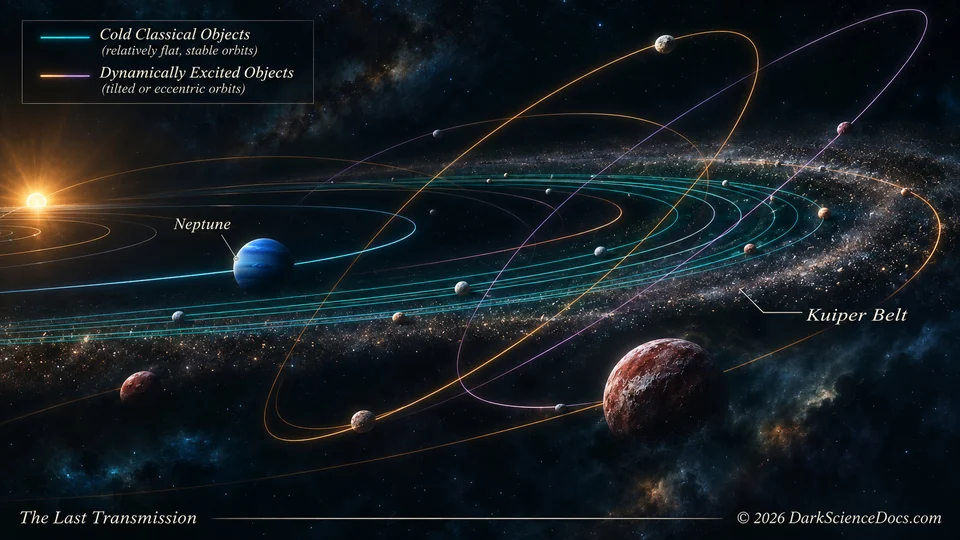
The studies compare dynamically hot and cold populations. These names describe patterns in the objects’ orbits, including their eccentricities and inclinations. They do not describe which surfaces would feel warmer. The orbital distinctions help researchers investigate populations associated with different formation and migration histories.
Small members follow color patterns similar to those of larger bodies in their respective groups. That continuity is intriguing because collisions and exposure of underlying material could have produced a different relationship. The result asks how a population’s recognizable surface signatures can persist through billions of years of evolution.
The number of small bodies is another clue
The observations also constrain the distribution of object sizes. Researchers found fewer very small bodies than some models of planet formation and collisional evolution had led them to expect. The relative numbers of larger and smaller objects therefore provide a second comparison alongside the color measurements.
Neither result supplies a simple complete history. A survey detects a selected part of the underlying population, so sensitivity and modeling remain central to the inference. Collisions, survival and initial formation conditions must be tested together against the number of objects that observations could actually have revealed.
Give the artwork a different job from the data
An illustration can bring an unresolved world into view, showing why such an ancient survivor is worth investigating. Its craters, lighting and terrain are imagined. Keeping that distinction explicit allows the artwork to convey scale and atmosphere while the factual argument stays attached to measured points of light.
Follow the tiny objects back toward the questions that made them valuable: how planetesimals formed, how planetary migration rearranged them and how their surfaces changed afterward. Their colors do not give a complete answer. They provide a test that reaches into a size range where the history of the outer Solar System becomes especially difficult to read.