
SCIENCE COUNTDOWNS / NASA / LUCY / POLYMELE
Lucy Polymele and Moon Flyby Countdown
A small asteroid with a second secret
Lucy’s next Trojan encounter after Eurybates brings a different asteroid and its small companion into close view.
Planned encounter; the mission team publishes an approximate UTC closest-approach time.
Until the mission team’s planned Polymele closest approach, about 03:19 UTC
Remind me to check the outcome
Choose your calendar
Check for results and the latest update on at 9:00 a.m. in your calendar’s time zone, two days after the listed event day.
This is one reminder with a link to this event file. Review the time and notification before saving. Updates may take longer; the reminder does not mean an outcome has been confirmed.
Saved reminders won’t change if the event is rescheduled. Remove the old reminder and add a new one from this page. Add it once; alerts depend on your calendar and device settings.
Need another way?
Download the calendar file (.ics) and open it in your calendar. For Outlook on the web, choose Add calendar → Upload from file. For Google Calendar on a computer, choose Settings → Import & export → Import.
Check that the reminder date above is still in the future before adding it.
This reminder date has passed. Read the latest status in the event file.
No email signup. We don’t receive your calendar details.
WHERE THE SCIENCE STANDS
A separate encounter, a new comparison.
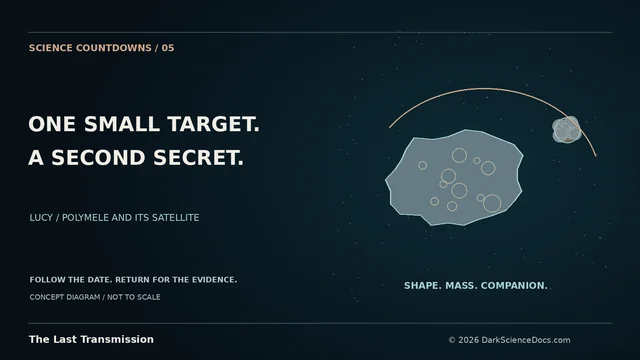
The Lucy mission team lists closest approach to Polymele around 03:19 UTC on September 15, 2027. NASA lists September 14 in Eastern Time; these calendar labels describe the same planned encounter. The mission will also examine Polymele’s small satellite.
This is a different target from Lucy’s Eurybates and Queta encounter, which already has its own event file. Comparing Trojan asteroids allows researchers to test whether similar orbital neighborhoods conceal different shapes, surfaces and histories.
The close passage is a brief opportunity to gather observations, not an instant final explanation. Return for the encounter report, released images and the team’s measurements. Shape and companion-orbit estimates will be more useful when their assumptions and uncertainties are included.
WHY THE SCIENCE MATTERS
Questions worth returning for.
What can a companion reveal?
The motion of a satellite can constrain the gravitational properties of a system when enough observations are available. A single attractive image cannot provide a complete orbit or a secure interior model. Watch how measurements accumulate across the encounter.
Why compare different Trojans?
A mission that observes several objects can test explanations that one isolated target leaves ambiguous. Compare like measurements, including observing geometry and illumination, before treating a difference in appearance as a difference in material.
Which date belongs on your calendar?
The encounter is listed on September 15 in UTC and September 14 in US Eastern Time. Use the stated time standard to convert it. A difference of date across time zones is not evidence that the spacecraft has been rescheduled.
CONTINUE THE INVESTIGATION
Follow the thread.
Explore the science before the milestone, then return to compare what the evidence establishes.
DATE & SCIENCE SOURCES
The mission-team Polymele page lists September 15, 2027, at 03:19 UTC, subject to encounter planning. NASA’s flyby table explicitly uses Eastern Time and lists September 14. This clock uses the mission-team UTC target at minute precision, not midnight. Check the team’s latest schedule before interpreting an expired clock as confirmation.
Source and schedule review: . Published precision retained where no firmer target is verified. Check the primary source for later changes; a clock reaching zero does not confirm an outcome.