THE 3D ATLAS / MARS’S INNER MOON
A world that
barely holds you.
Explore Phobos. Look up at an enormous Mars. Discover what happens when a gentle throw lasts minutes instead of moments.
01 / THE MOON & THE VIEW
Choose your perspective.
Begin with the photograph and gravity experiment, or load the 3D expedition to change your viewpoint.
 AN ARTIST RECONSTRUCTION / NOT LIVE SPACECRAFT IMAGERY
Ready when you are. Orbit mode is an approximate shape with a complete AI artist texture.
All globe texture pixels are an AI artist reconstruction informed by a NASA map; no black gaps represent missing data. The shape is an approximate elongated body, not a measured terrain model. Surface rocks, grooves, lighting and locations are invented. The orbit view uses a Mars radius of approximately 3,390 km (2,106 mi) and a center-to-center distance of 9,378 km (5,827 mi), on the same kilometer scale as Phobos; direction, orientation and phase are illustrative, not a live ephemeris. The Mars-facing view approximates Mars’s 42° angular diameter; its orientation and phase are illustrative. No landing sites are predicted.
One crater, a huge fraction of a moon.
Stickney is roughly nine kilometers (about 29,500 feet) across. Compare the actual orbital image below with the artist globe: the reconstruction cannot supply surveyed crater depths or precise navigation.
Read the mission record ↗02 / THE GRAVITY PLAYGROUND
A gentle throw.
A very long wait.
Use the same launch speed and angle on Phobos, the Moon and Earth. Explore the three magnified views, then compare their actual distances in the shared-scale overview below.
Follow the rock
A moving window, 10 meters wide and 4 meters high. Both axes use the same linear scale. The camera follows the rock; read the rulers for its position from release. The launch speed already includes the thrower’s push.
Three worlds. Three visible paths.
Each panel uses its own magnification so you can see the throw. Compare the written distances, not the apparent size of the arcs. Horizontal and vertical distances share the same scale within each panel. Keep the playback bar in view as you scroll. Select 0.1× slow motion to inspect the brief Earth and Moon flights. Playback uses the same elapsed seconds for all worlds. Earth and Moon land first; Phobos keeps moving until its own flight ends.
Phobos
SEPARATELY MAGNIFIED / PHOBOSMoon
SEPARATELY MAGNIFIED / MOONEarth
SEPARATELY MAGNIFIED / EARTHBig graph / reveal every path
Choose expanded axes to reveal all three paths, or use a linear scale to compare distances directly. All views use the same elapsed-time clock.
Expanded near launch: both axes are nonlinear. Screen length is not proportional to distance; read the rulers.
| World | Gravity | Flight time | Range | Peak height |
|---|---|---|---|---|
| Phobos | 0.0057 m/s² · 0.0187 ft/s² | 248.1 s | 175.4 m · 575 ft 7 in | 43.86 m · 143 ft 10.8 in |
| Moon | 1.62 m/s² · 5.315 ft/s² | 0.873 s | 0.6173 m · 2 ft 0.3 in | 0.1543 m · 0 ft 6.1 in |
| Earth | 9.807 m/s² · 32.17 ft/s² | 0.1442 s | 0.102 m · 0 ft 4 in | 0.02549 m · 0 ft 1 in |
Static example shown. JavaScript enables the controls.
These are idealized teaching calculations: x = v cos(θ)t and y = v sin(θ)t − ½gt². Earth’s air resistance is omitted. The chosen Phobos value, 0.0057 m/s², is a commonly cited representative value; it is not a local measurement at the invented viewpoint. Phobos’s gravity varies with location; curvature, its rotation, Mars’s tides and terrain are omitted. Even these short throws are approximate. This experiment cannot determine escape, orbital paths, a safe astronaut jump, or MMX landing behavior. NASA-hosted study: representative gravity and its limitations ↗
03 / THE OBSERVED MOON
Before the model,
the evidence.
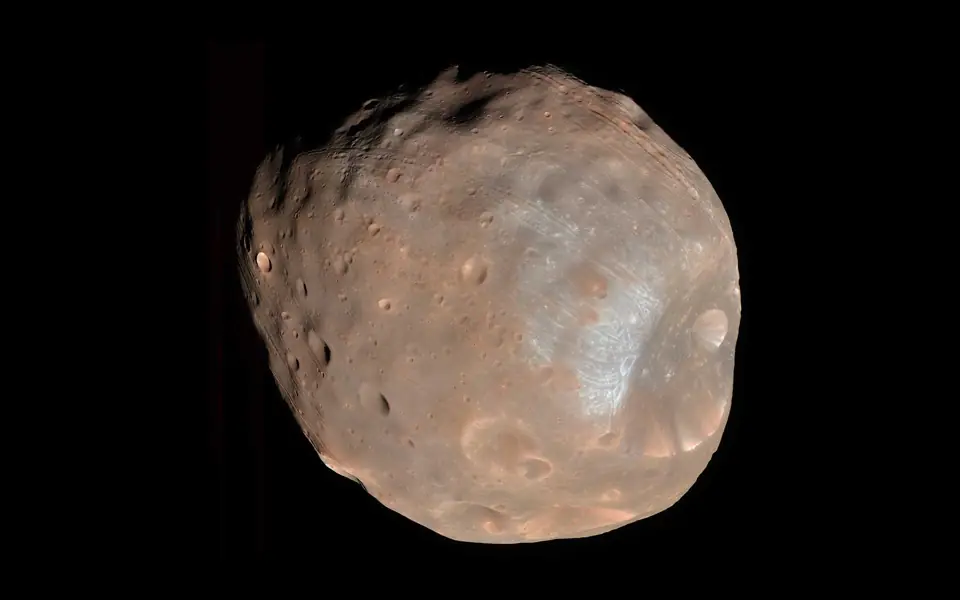
What is measured?
Spacecraft images show an irregular, cratered body with long grooves. The teaching globe follows approximate overall proportions. It does not recover missing topography from a photograph.
NASA: Phobos and Stickney ↗Why is landing difficult?
Idefix will explore ground held under exceptionally weak gravity. Its mission involves terrain, stability and wheel contact that this rock-toss comparison does not simulate.
DLR: the Idefix rover ↗What remains unresolved?
Grooves and dark surface material do not uniquely explain the moon’s history. Competing formation models must be compared with orbital measurements and, if successful, returned samples.
JAXA: the science questions ↗How was the art made?
The globe uses a complete AI-generated artist texture guided by NASA/JPL’s Viking-derived map. Synthesized detail is not a measured mineral, crater depth or georeferenced landing target.
NASA/JPL: texture reference ↗04 / THE TOUCHDOWN CHALLENGE
Attempt a rover touchdown.
Drift over the candidate flat landing zone, slow your descent, and touch down gently. Tiny corrections go a long way in weak gravity.
Press Begin descent. Hold Brake descent to slow your fall; use left and right to line up with the flat zone.
Hold the buttons, or focus this challenge and use ← / → to steer and ↑ or Space to brake. Release to coast. Land with both landing feet fully inside the marked flat zone and vertical and sideways speeds at or below 0.25 m/s (0.82 ft/s). Fuel is limited. All three challenges use the same gravity; drift and landing-zone width change.
An invented thruster-assisted landing game, not an MMX or Idefix landing simulation. The rover artwork is inspired by Idefix’s box-shaped chassis, four wheels and folded solar hardware; its added thruster and visible exhaust are fictional. The real Idefix rover is designed to free-fall, bounce and right itself. The textured ground and candidate zone are artist reconstructions, not a surveyed or mission-selected landing site. Uses representative Phobos gravity of 0.0057 m/s² and 3× simulation time. The flat landing zone, fuel budget and control thrust are game choices. Rotation, tides, bouncing, terrain contact and spacecraft engineering are omitted. No actual landing site or mission performance is predicted.
KEEP EXPLORING / MMX & MARS