
EVIDENCE FILE 46 / EUROPA RADAR
What Does Europa’s Bright Radar Echo Reveal?
Separate Europa’s measured radar echo from ice-scattering models, penetration-depth estimates, and claims about ocean access or life.
THE SHORT ANSWER
The echo tests an ice-scattering explanation.
It adds information about the material that radio waves encounter in Europa’s upper ice. Ocean access, the transport of life’s ingredients and the detection of organisms require further evidence.
Observed
Radar sent from Earth returns with unusual strength and polarization.
Interpreted
Multiple scattering and coherent backscatter explain important features of the echo.
Still open
The shell’s full structure, connections to the ocean and any biological activity.
MEASUREMENT / INTERPRETATION / LIMIT
Keep each claim attached to its measurement.
01 / 05
The echo was measured
Measured or modeled
Researchers sent radar toward Europa and measured the returned power and polarization. The observations involve Earth-based transmitters and receivers, rather than a probe beneath the shell.
What it suggests
The frozen material changes the radio signal in ways that scattering models can test.
Where the claim stops
A strong return is not an image of an ocean, an organism or an artificial transmitter.
Xie et al. (2026): Radar Observations of Europa in 2011–202402 / 05
Coherent backscatter explains a pattern
Measured or modeled
A bright return and its polarization behavior favor a multiple-scattering explanation. Waves taking reciprocal routes can reinforce the return near the backward direction.
What it suggests
Relatively transparent ice with small scattering structures can produce an unusual echo.
Where the claim stops
The mechanism does not map a continuous channel through the shell. The inferred properties depend on the scattering model.
NRAO: Europa radar campaign and coherent backscatter03 / 05
The radar depth is not the shell thickness
Measured or modeled
The campaign at a wavelength of about 1.4 inches (3.5 centimeters) yields a model-dependent upper bound of roughly 105 feet (32 meters) on mean radar penetration depth.
What it suggests
This constrains the part of the material sampled by that wavelength and geometry.
Where the claim stops
It is not a direct measurement of the ocean depth, the complete ice shell or how far Clipper will see.
Xie et al. (2026): Radar Observations of Europa in 2011–202404 / 05
Juno tests a different part of the problem
Measured or modeled
A regional microwave analysis gives about 18 miles (29 kilometers) of cold ice through which heat is conducted under a pure-water-ice model.
What it suggests
Ice temperature, structure and composition can be constrained by observations combined with thermal and material models.
Where the claim stops
The estimate is regional and model dependent. Salts or a warmer convecting layer change the relation to total shell thickness.
NASA: Juno’s regional ice-shell measurement and model assumptions05 / 05
Clipper will bring another test
Measured or modeled
REASON uses longer radio wavelengths to investigate the shell during flybys. Its performance depends on local ice conditions.
What it suggests
Radar, imaging, magnetic and plasma measurements can be compared to sharpen the interior picture.
Where the claim stops
The mission investigates habitability. A radar reflector by itself cannot establish life, and an ocean-boundary detection is not guaranteed.
NASA: the REASON radar instrumentWhat would make the picture clearer?
Compare future sounding and imaging with magnetic, plasma and composition measurements. Test how competing ice structures fit the data. Keep the shallow radar-scattering inference separate from estimates of the whole shell and the ocean beneath it.
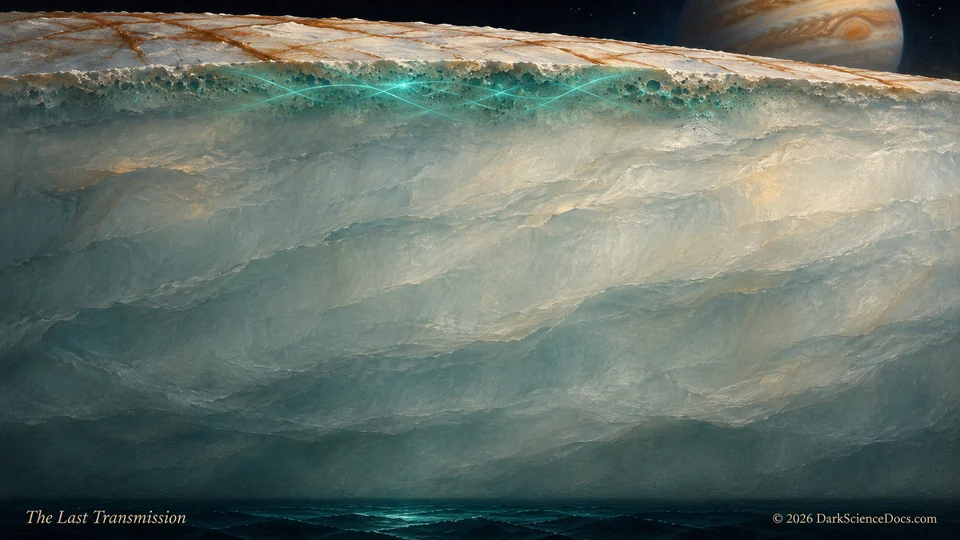
The cutaway is AI-generated conceptual art. Its layers and wave paths are schematic; it does not show a measured route to the ocean.
PRIMARY RESEARCH & MISSION RECORDS
Check the source trail.
- Xie et al. (2026): Radar Observations of Europa in 2011–2024
- NRAO: Europa radar campaign and coherent backscatter
- NASA: Europa facts and ocean evidence
- NASA: Juno’s regional ice-shell measurement and model assumptions
- Nature Astronomy: Juno microwave analysis of Europa’s ice shell
- NASA: the REASON radar instrument
- NASA: Europa Clipper mission timeline
- NASA/JPL: REASON’s Mars rehearsal
- NASA: the ingredients for habitability