
102 / COSMIC MYSTERIES / FIELD NOTE
Where Black Holes Might Meet Again
Explore how gas around an active galactic nucleus could bring smaller black holes together, and what observations could test repeated merger models.
The surroundings can shape a collision
A gravitational wave can reveal two black holes merging while leaving their wider environment difficult to identify. The event reaches us as a brief change in spacetime, carrying information about the compact objects. It does not automatically reveal the gas, stars and orbits that brought them into the same binary.
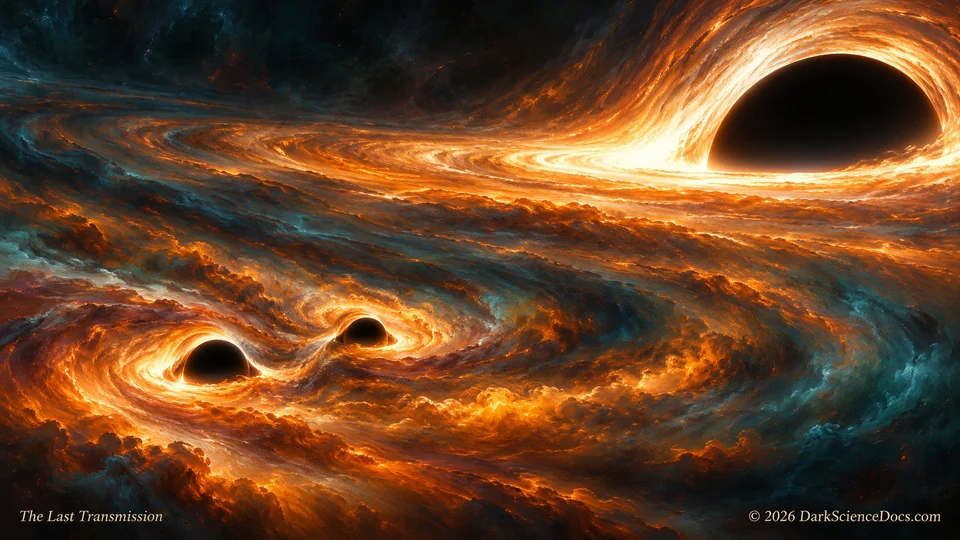
One proposed setting is the accretion disk around an active galactic nucleus. Smaller black holes can move within that gas, whose response changes their orbital evolution. This possibility turns the bright surroundings of a supermassive black hole into a candidate meeting place for remnants of dead stars.
A migration trap is a conditional gathering place
A disk can exert torques that move an embedded object inward or outward. Where the direction changes, researchers describe a migration trap: a region toward which objects may converge. If encounters there produce bound pairs, the disk could help create binaries that later merge and leave heavier remnants.
The conditions matter. Simulations by Vaccaro, Seif and Mapelli examine how pairing changes with central black hole mass, disk viscosity and the treatment of torques. In some regimes traps dominate the pairing locations. In others, differential migration and accumulations away from a formal trap become important. A universal fixed meeting point would conceal that variation.
A remnant could become the next participant
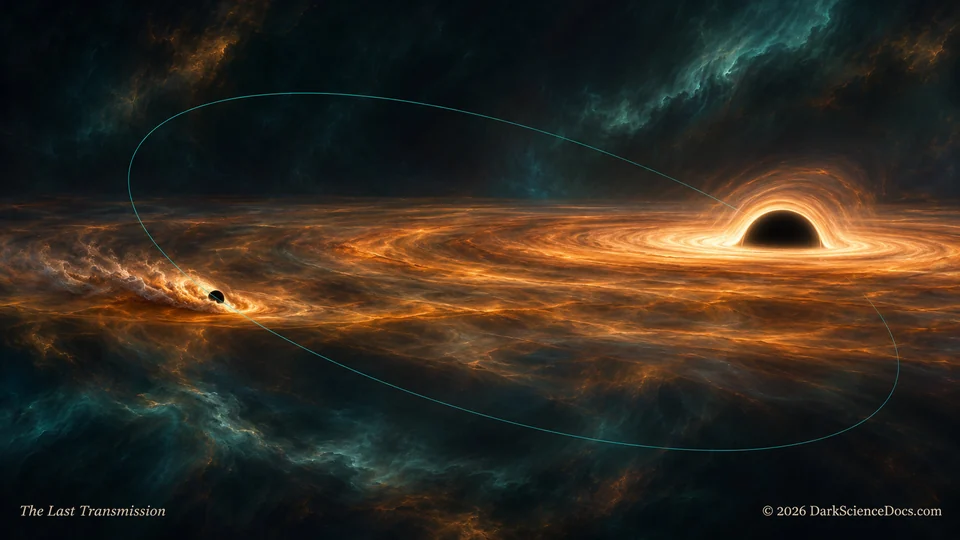
When a merger remnant remains in a suitable environment, it may encounter another black hole. A later binary would then contain an object with an earlier collision in its history. Researchers call this hierarchical assembly. It offers a route to masses that can be difficult to obtain through some models of individual stellar collapse.
Continued assembly has obstacles. Gravitational waves can carry momentum away unevenly, kicking the remnant. Its altered orbit may reduce its chance of another encounter. Growth can also change how the object interacts with the disk. A productive gathering place can therefore evolve as its own occupants gain mass.
A flare could connect the event to its setting
Gas supplies another possible clue. A kicked merger remnant could disturb surrounding material and produce shocks or changes in accretion. Under suitable conditions, that response may generate electromagnetic radiation. Predictions depend on the local density, geometry and the time required for radiation to emerge from the disk.
An optical flare was proposed as a counterpart to a gravitational wave event recorded in May 2019. The association remains a candidate because active galactic nuclei can brighten through other processes. Stronger cases would connect timing, position and behavior with a physical model while also testing ordinary variability.
Follow the channel without declaring the factory found
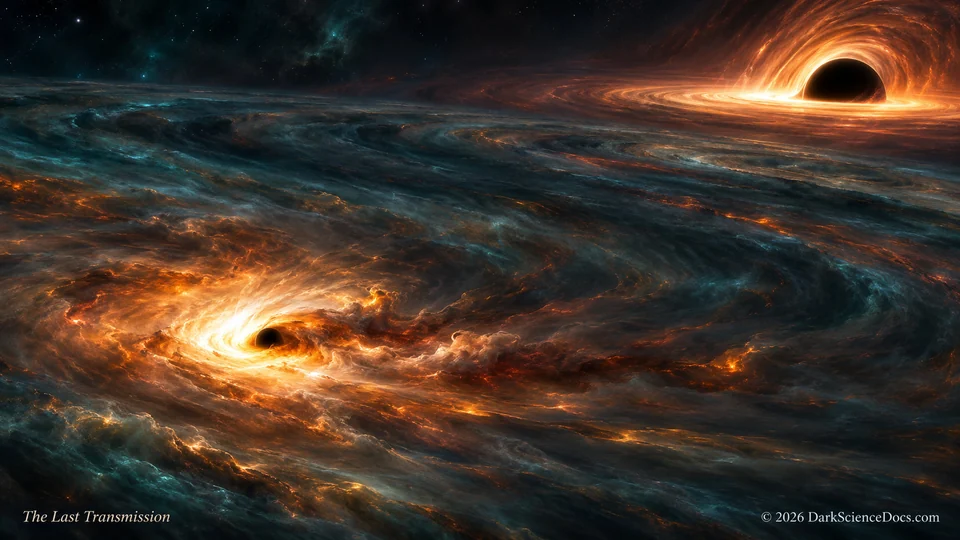
The useful question is how much this environment contributes to the mergers we detect. Dense stellar systems and other pathways can also bring compact objects together. A heavy merger component alone cannot identify its birthplace; masses, spins, event rates and possible light counterparts must be considered together.
Imagine the disk as a set of conditions to test rather than an observed assembly line. Explore a supermassive black hole for scale and context, then return to the measurements that might identify its surroundings. Our own Sagittarius A* is comparatively quiet, so it should not stand in for a luminous active nucleus in the proposed models.
Sources and further reading
- Yang et al. (2019): hierarchical mergers in active galactic nuclei
- Vaccaro, Seif and Mapelli: migration and pairing in AGN disks
- Published migration trap study, A&A 708, A171 (2026)
- Gilbaum et al.: limits on repeated mergers and retention in AGN
- Caltech: the proposed optical counterpart to a black hole merger