
01 / RESEARCH / OBSERVATION & INTERPRETATION
A Universe Inside a Black Hole: Hypothesis and Test
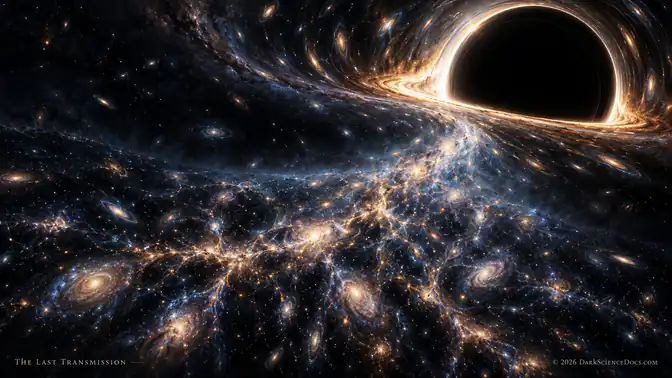
Some speculative gravity models allow a collapsing region to produce an expanding one. Observations of early galaxies and lensing clusters must be evaluated on their own before they can support a claim about cosmic origin.
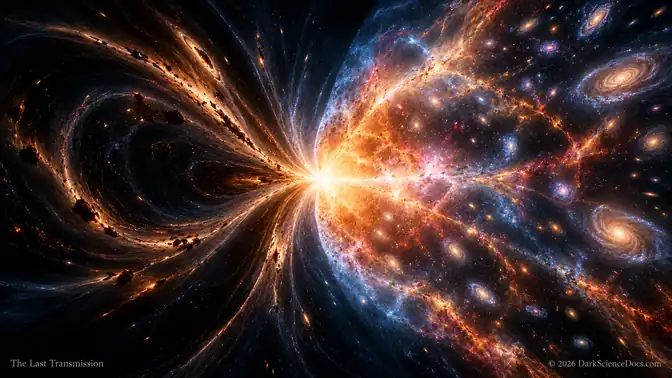
Webb observations reveal luminous galaxies in the early universe, while lensing measures the gravitational effects of intervening matter. These are real research targets with uncertainties in distance, stellar populations, mass modeling and selection. Neither an unexpectedly luminous galaxy nor apparent spiral handedness establishes that the universe formed inside a black hole. A bounce model adds theoretical assumptions, and matching a broad feature is weaker than a distinctive tested prediction.
An early galaxy is an observation
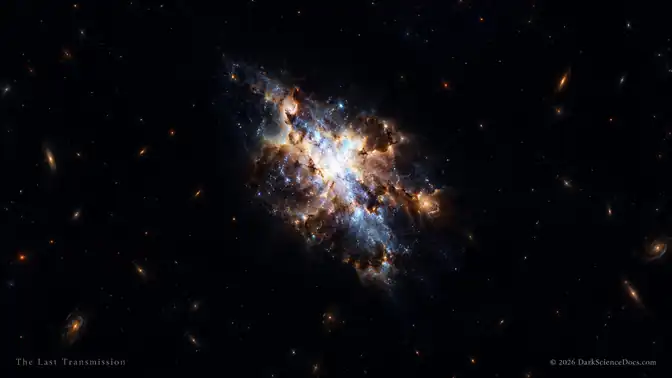
For more than thirteen billion years, a stream of ancient light traveled through expanding space toward a small planet orbiting an ordinary star. At the time, Earth did not exist. Neither did the Sun. The Milky Way had not yet developed into the familiar spiral galaxy we inhabit today. The first generations of stars were transforming primordial hydrogen and helium into heavier elements, and the surrounding universe was still undergoing the long process of reionization. Then, billions of years later, some of those photons reached the instruments of the James Webb Space Telescope. Its name comes from the research program Mirage or Miracle, a fitting description of the uncertainty astronomers encounter when they discover something that appears almost too extraordinary to be real.
A cluster tests a mass model
Approximately 3.3 billion years after the Big Bang, an extraordinary galaxy cluster had already assembled in a distant region of space. Galaxy clusters are among the largest gravitationally bound structures in the universe. They contain galaxies, extremely hot gas, and enormous quantities of dark matter, all influencing one another through gravity. The standard cosmological model predicts that these structures grow hierarchically as smaller concentrations of matter merge and accrete additional material. XLSSC 122 was already remarkably developed when the light we observe today began its journey toward us, approximately 10.4 billion years ago. Earlier observations had revealed an evolved population of galaxies and hot, metal-enriched gas.
A bounce is a theoretical proposal
From outside, that horizon marks the boundary beyond which light cannot escape to distant observers. A black hole can contain enormous quantities of mass while occupying an extraordinarily compact region of space. Einstein’s general relativity describes its gravitational influence with extraordinary success, but the theory encounters profound difficulties when extrapolated toward the classical singularities predicted under certain conditions. We do not yet possess a confirmed quantum theory of gravity that tells us exactly what happens at the most extreme densities. One especially provocative proposal comes from physicist Nikodem Popławski, who has investigated cosmological models based on Einstein–Cartan gravity.
Read the illustrated companion article for the full narrative and its source trail. The selected passages above follow that article’s investigation.
Continue reading on SubstackTHE EVIDENCE / THE OPEN QUESTION
What we know.
Webb observations reveal luminous galaxies in the early universe, while lensing measures the gravitational effects of intervening matter. These are real research targets with uncertainties in distance, stellar populations, mass modeling and selection.
What remains open.
Neither an unexpectedly luminous galaxy nor apparent spiral handedness establishes that the universe formed inside a black hole. A bounce model adds theoretical assumptions, and matching a broad feature is weaker than a distinctive tested prediction.
Why it matters.
Cosmic-origin ideas become scientifically useful when they specify observations that could distinguish them. Separating a mathematical possibility from evidence for its realization protects both the observational discoveries and the question they inspire.
COMPARE THE QUESTIONS
Follow what the light reveals.
Follow the relevant evidence and teaching models. Each model explains a mechanism and retains its own stated assumptions and limits.
FOLLOW THE EVIDENCE
Research behind the field note.
EXPLORE IN 3D / MAP G-01
Explore the related science model
Cosmic-origin ideas become scientifically useful when they specify observations that could distinguish them. Separating a mathematical possibility from evidence for its realization protects both the observational discoveries and the question they inspire.
Open Sagittarius A* mapVISUAL EVIDENCE
Inside the investigation.
FOLLOW THE THREAD
Related signals.
What If Our Universe Was Born Inside a Black Hole?
James Webb is finding galaxies that matured astonishingly early. A controversial study suggests distant galaxies may even share a preferred direction of rotation.
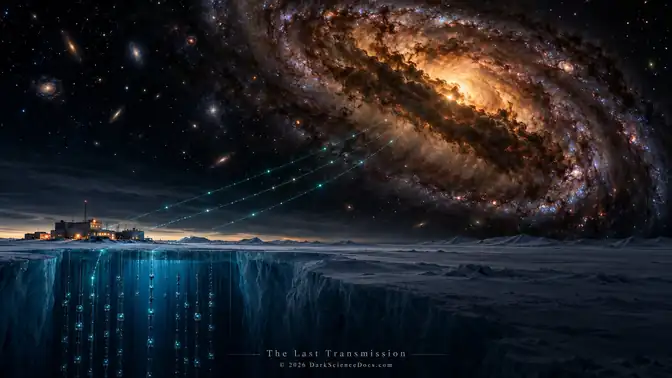
The Black Hole Hid Its Light. The Neutrinos Escaped.
Scientists buried a telescope beneath Antarctica to catch particles from the universe’s most violent places. What they discovered is shocking.
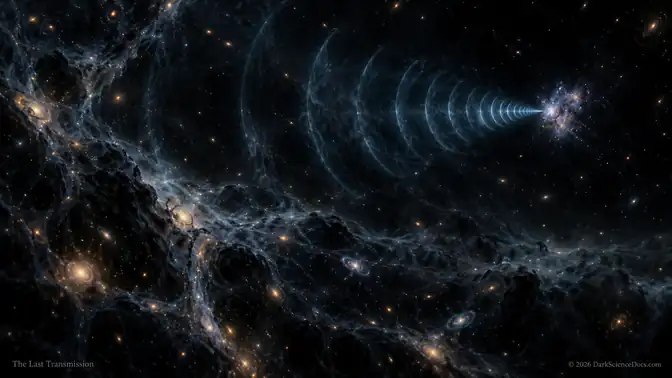
A Signal Crossed 10 Billion Years of Darkness. We Still Don't Know What Sent It.
The James Webb Space Telescope has traced an extraordinarily powerful radio flash to a galaxy so small that Earth's largest telescopes couldn't see it.