
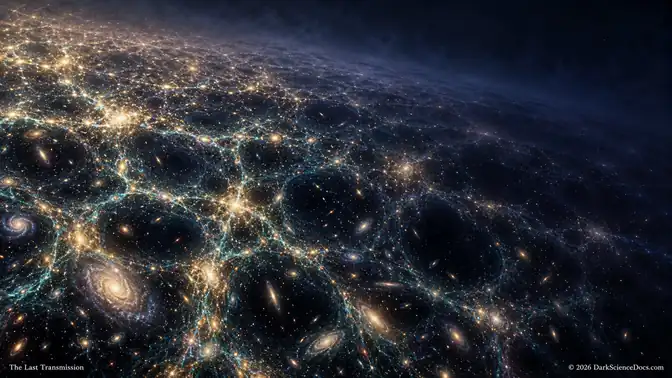
03 / RESEARCH / OBSERVATION & INTERPRETATION
Can Horizon Entropy Explain Cosmic Acceleration?
A thermodynamic extension to cosmology asks whether horizon-related entropy can help describe expansion. Mathematical fit and physical explanation must be judged separately from an appealing idea about a cosmic boundary.
Cosmological horizons describe limits on accessible information or causal communication, depending on the definition. Expansion data can be fitted with models that introduce additional terms, but a horizon is not a physical wall at the edge of all space. A fitted entropy-related correction does not establish that it causes dark energy. Parameter freedom, degeneracies with standard cosmology, priors and independent datasets can change how strongly the extension is supported.
The observation an explanation must address
In the late 1990s, astronomers studying distant Type Ia supernovae discovered something deeply unexpected. The universe was expanding, as Edwin Hubble and earlier observers had helped establish decades before. But those distant stellar explosions indicated that the expansion had begun accelerating. Matter attracts matter through gravity, so astronomers had expected the expansion of the universe to slow as its contents pulled against one another. Instead, the evidence pointed toward an additional influence that could overcome gravity’s tendency to decelerate the expansion on the largest scales. In the standard cosmological model, called ΛCDM, the Greek letter lambda represents the cosmological constant, a form of energy associated with space itself.
A horizon is not an outer wall
A black hole has an event horizon, but cosmologists also work with horizons associated with the expanding universe. The comparison is powerful, although the different kinds of cosmic horizon must be kept separate. The observable universe is limited by the distance light has been able to travel to us since the beginning of cosmic history. This is related to what physicists call the particle horizon. A cosmological event horizon, when one exists, instead concerns which events can ever communicate with us, even if we wait indefinitely. Cosmologists also describe an apparent horizon, a geometric scale associated with the local expansion of the universe.
The warning inside a successful fit
There is a revealing detail in Desre’s published project summary, and it deserves as much attention as the impressive simulation results. Those parameters help control the transition between the earlier and later cosmological behavior. They also give the mathematical framework additional freedom to match observations. Imagine trying to explain an irregular curve with a simple equation. A more complicated equation, containing several extra adjustable values, will often reproduce the curve more closely. But that does not necessarily mean the complicated equation has uncovered a deeper physical truth. Scientists account for this problem using statistical methods that penalize unnecessary complexity. An alternative model must offer enough explanatory or predictive improvement to justify the additional parameters it introduces.
Read the illustrated companion article for the full narrative and its source trail. The selected passages above follow that article’s investigation.
Continue reading on SubstackTHE EVIDENCE / THE OPEN QUESTION
What we know.
Cosmological horizons describe limits on accessible information or causal communication, depending on the definition. Expansion data can be fitted with models that introduce additional terms, but a horizon is not a physical wall at the edge of all space.
What remains open.
A fitted entropy-related correction does not establish that it causes dark energy. Parameter freedom, degeneracies with standard cosmology, priors and independent datasets can change how strongly the extension is supported.
Why it matters.
The useful question is which observations distinguish the extension from a simpler model. A model earns support through predictions that survive independent tests, rather than the number of simulated points or the age of its proposer.
COMPARE THE QUESTIONS
Follow what the light reveals.
Follow the relevant evidence and teaching models. Each model explains a mechanism and retains its own stated assumptions and limits.
FOLLOW THE EVIDENCE
Research behind the field note.
EXPLORE IN 3D / MAP 13
Explore the related science model
The useful question is which observations distinguish the extension from a simpler model. A model earns support through predictions that survive independent tests, rather than the number of simulated points or the age of its proposer.
Open Universe mapVISUAL EVIDENCE
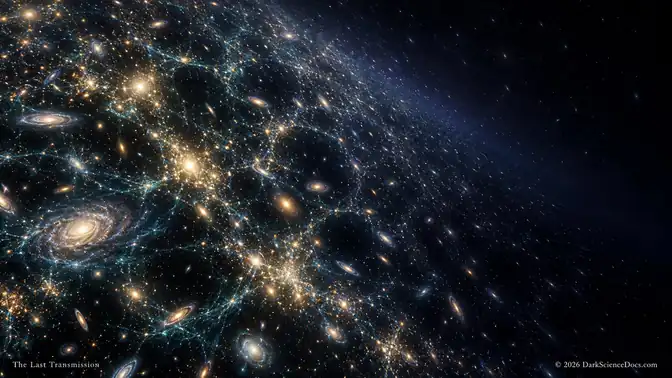
Inside the investigation.
FOLLOW THE THREAD
Related signals.
What If Dark Energy Comes From the Edge of the Universe?
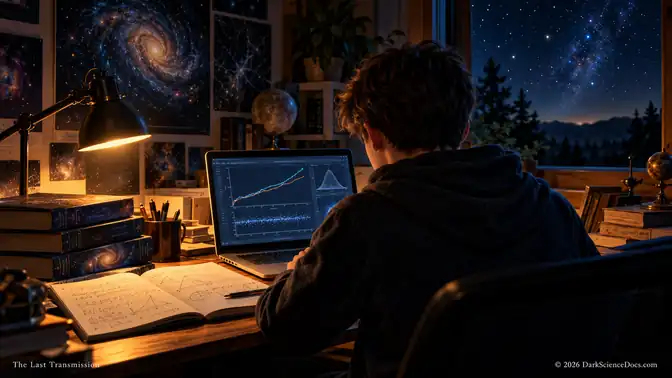
At 14, Liam Desre won an international science prize for exploring a remarkable possibility: perhaps the force accelerating the cosmos is connected to the information we can never see.
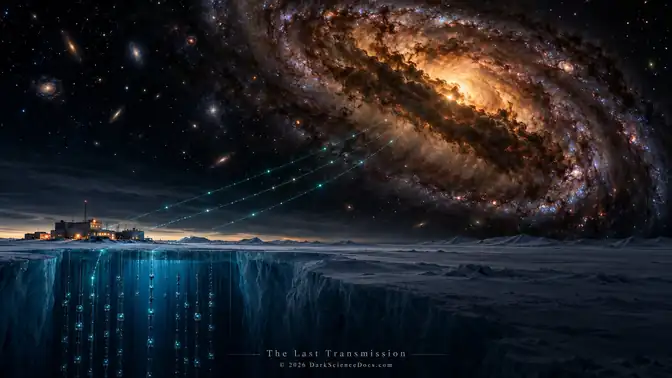
The Black Hole Hid Its Light. The Neutrinos Escaped.
Scientists buried a telescope beneath Antarctica to catch particles from the universe’s most violent places. What they discovered is shocking.
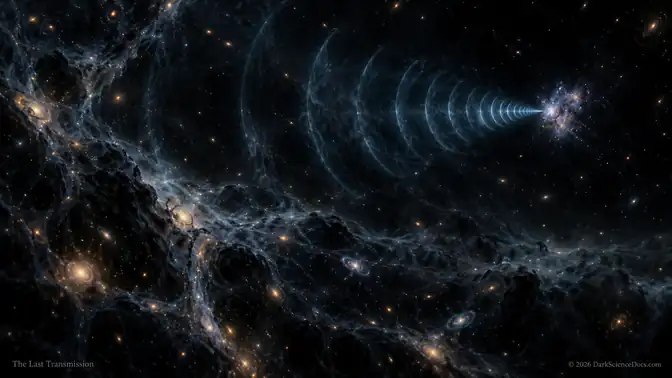
A Signal Crossed 10 Billion Years of Darkness. We Still Don't Know What Sent It.
The James Webb Space Telescope has traced an extraordinarily powerful radio flash to a galaxy so small that Earth's largest telescopes couldn't see it.