
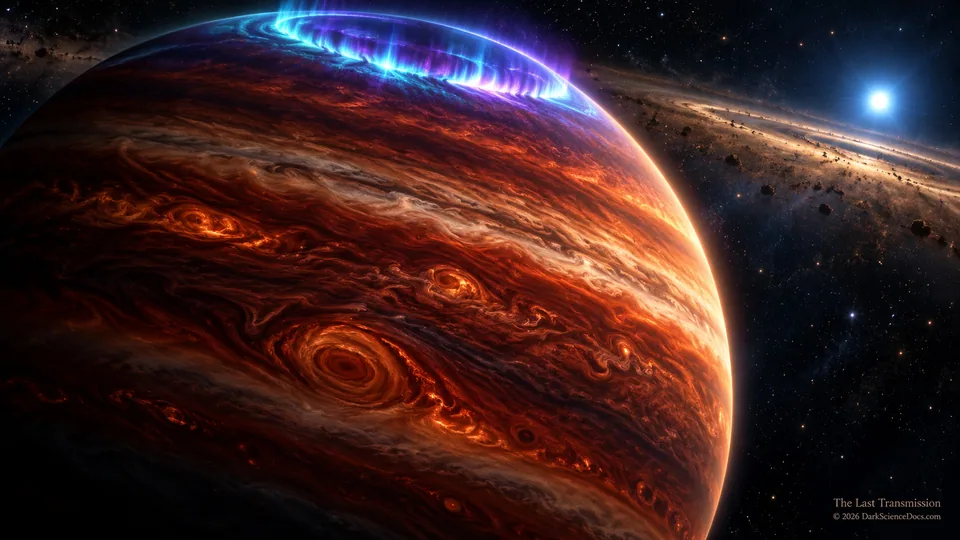
13 / Beta Pictoris b / a signal needs an address
Which World Is Producing the Radio Bursts?
A submitted study attributes highly polarized radio bursts to Beta Pictoris b. The planet is already known, but identifying the source of its reported radio emission requires localization, interference checks and a physical model.
Radio astronomy can expose an environment that visible images barely suggest. Charged particles moving through magnetic fields may produce intense, polarized emission, and Jupiter supplies a nearby example of natural planetary radio activity. The Beta Pictoris analysis combines repeated observing epochs with the source position, polarization and spectral behavior. Each clue addresses a different alternative, from instrumental effects to emission associated with the host star. The scientific claim is therefore a chain of attribution rather than simply the presence of an interesting burst.
The full investigation continues with the evidence, illustrations, and sources at The Last Transmission on Substack.
Continue reading on SubstackTHE EVIDENCE / THE OPEN QUESTION
What we know.
The authors report rapid, strongly circularly polarized bursts across observing frequencies reaching about 3.5 gigahertz and favor a position consistent with the established giant planet. Under a fundamental electron-cyclotron-maser interpretation, the highest frequency implies a local emitting magnetic field of at least about 1,250 gauss. That is a mechanism-dependent lower bound at the emitting region, not a resolved global magnetic map.
What remains open.
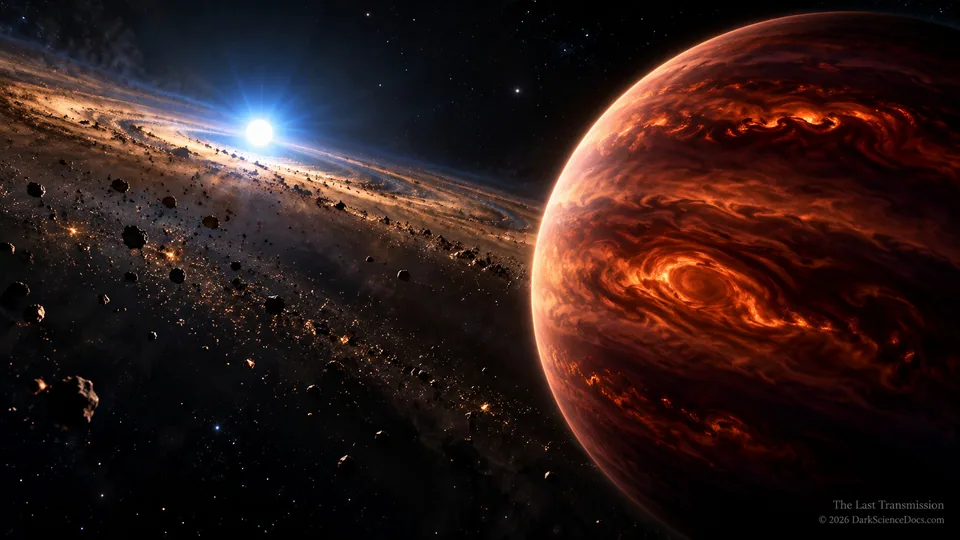
The radio discovery remains a submitted preprint in the checked record. Localization systematics, interference rejection and the emission mechanism remain important to independent confirmation. The origin of the plasma and the detailed energy supply are not fully settled. Natural auroral radio physics does not establish engineered communication, and the artwork does not show a measured auroral landscape.
Why it matters.
An independently confirmed planetary radio source could make magnetic environments accessible at distances where their structures cannot be photographed. Repeat observations can test whether the bursts follow rotation, position and polarization patterns as predicted. The next discovery would be stronger attribution and physical constraints, rather than a shortcut from radio emission to life.
GO DEEPER / EVIDENCE FILE
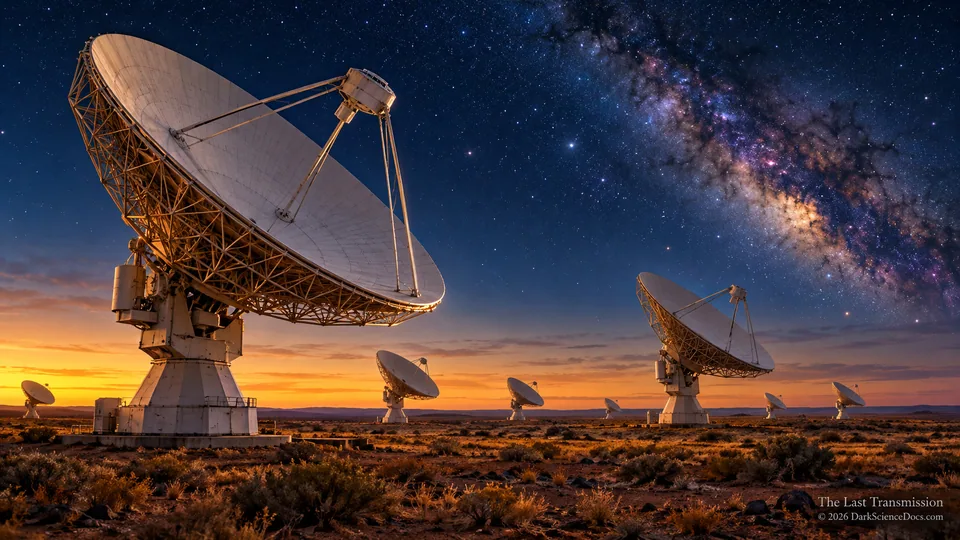
How Are the Reported Radio Bursts Linked to Beta Pictoris b?
Follow radio localization, interference tests and an emission model into a provisional planetary attribution and a conditional local magnetic-field bound.
FOLLOW THE EVIDENCE
Research behind the field note.
EXPLORE IN 3D / MAP 02
Compare a nearby giant planet
Explore Jupiter and its moons as a local comparison. These planetary textures do not depict Beta Pictoris b or Epsilon Indi Ab.
Open Jupiter system mapVISUAL EVIDENCE
Inside the investigation.
FOLLOW THE THREAD
Related signals.
A Star Blinked Twice. Whatever Caused It May Be Much Closer to Earth.
Two nearly identical optical disturbances, 4.4 seconds apart, appeared in HD 89389’s light. Follow the unexplained record, a foreground diffraction hypothesis, and the synchronized telescopes proposed to test it.
What If the Universe Is Accelerating Because Stars Die?
For nearly three decades, scientists have struggled to identify the mysterious force accelerating the expansion of the universe. Now a radical theory suggests the answer.
A Star Died 6.5 Billion Years Ago. Its Explosion Is About to Arrive Again.
NASA is watching for a supernova we have already seen. When that light finally reaches Earth, it could help answer one of the most troubling questions in modern cosmology.