

35 / A cooling interior
The Planet That Lost Its Inner Engine
A star's habitable zone tells us how much light a planet receives. Models of interior heat and outgassing ask whether a rocky world can keep a climate-supporting carbon cycle going over time.
From a telescope, a rocky exoplanet can look promising because its orbit allows temperatures compatible with liquid water under the right atmosphere. That description says little about the deep rock. Radioactive decay contributes to interior heat, and volcanic outgassing can help replenish gases that weathering removes from the air. A model can therefore ask whether some old stagnant-lid planets exhaust that supply while their stars continue to shine. The result is a possibility about planetary evolution, not a census of worlds that have already gone silent.
The full investigation continues with the evidence, illustrations, and sources at The Last Transmission on Substack.
Continue reading on SubstackTHE EVIDENCE / THE OPEN QUESTION
What we know.
Published models connect radiogenic heating, mantle degassing, and planetary age. Earth offers an example of a carbon cycle that links interior and surface, though other planets need not follow exactly the same path.
What remains open.
We cannot currently inspect the mantles of distant rocky planets or assign one observed exoplanet a precise shutdown date. Atmospheres, tectonic style, volatile inventories, and stellar histories can change the outcome in ways a simple habitable-zone label cannot encode.
Why it matters.
The search for life becomes more interesting when a promising orbit is treated as the first filter. A planet's hidden engine may matter as much as the light it receives, and future observations can put models of that engine under pressure.
FOLLOW THE EVIDENCE
Research behind the field note.
EXPLORE IN 3D / MAP 05
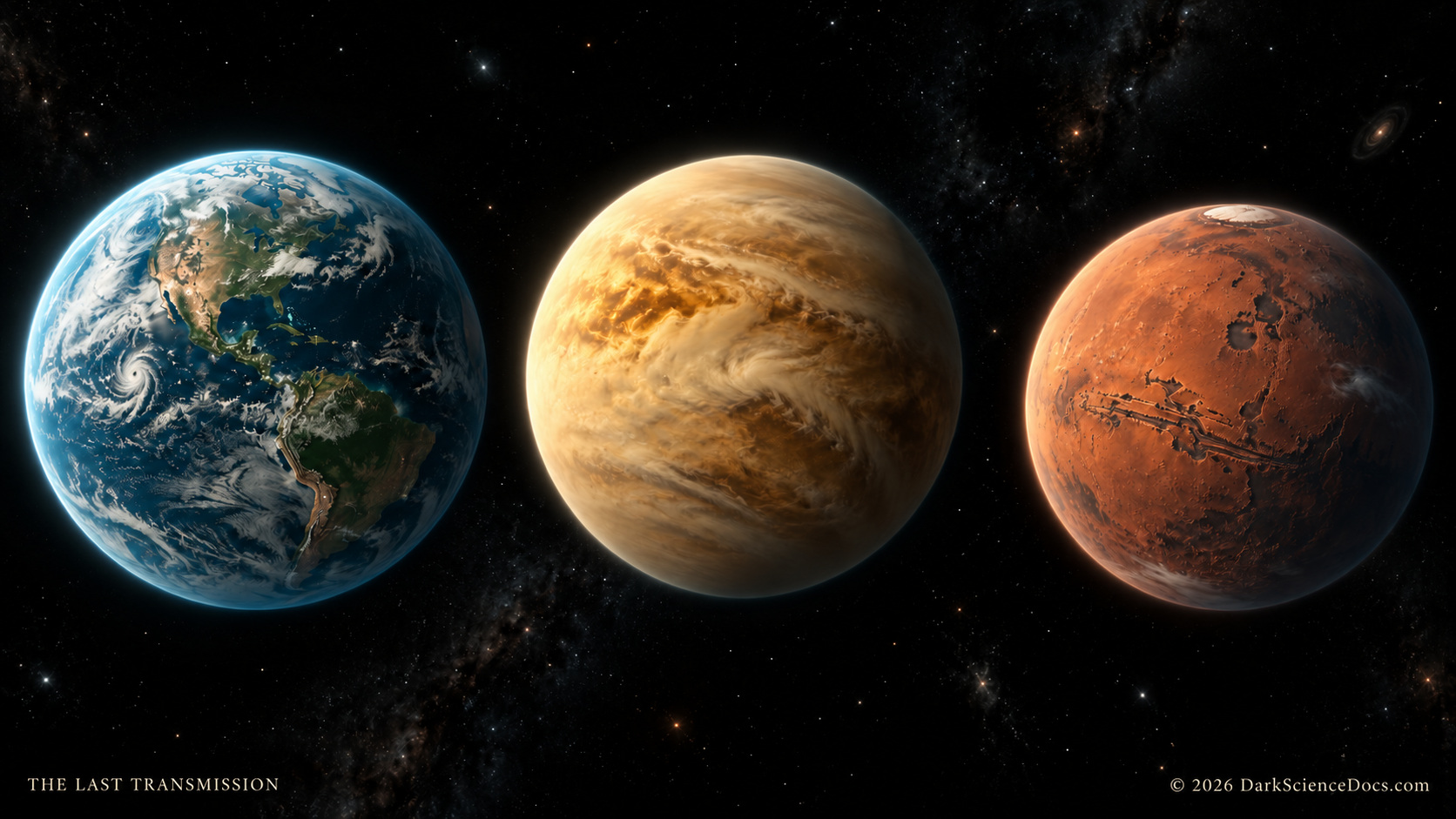
Compare a rocky world’s inner engine
Explore Venus’s radar-mapped surface and volcanoes while considering how interior heat can alter a planet’s fate.
Open Venus mapCOMING MILESTONE / SCIENCE COUNTDOWN
BepiColombo enters Mercury's orbit
After years of flybys and braking, two science orbiters prepare to investigate a small planet with an outsized interior. November 21, 2026, planned orbit insertion.
WATCH THE RELATED DOCUMENTARY
The story in motion.
VISUAL EVIDENCE
Inside the investigation.

FOLLOW THE THREAD
Related signals.
A Star Blinked Twice. Whatever Caused It May Be Much Closer to Earth.
Two nearly identical optical disturbances, 4.4 seconds apart, appeared in HD 89389’s light. Follow the unexplained record, a foreground diffraction hypothesis, and the synchronized telescopes proposed to test it.
What If the Universe Is Accelerating Because Stars Die?
For nearly three decades, scientists have struggled to identify the mysterious force accelerating the expansion of the universe. Now a radical theory suggests the answer.
A Star Died 6.5 Billion Years Ago. Its Explosion Is About to Arrive Again.
NASA is watching for a supernova we have already seen. When that light finally reaches Earth, it could help answer one of the most troubling questions in modern cosmology.