
96 / COSMIC MYSTERIES / FIELD NOTE
One Spectral Line, Several Cosmic Histories
Investigate Webb’s unexplained 1.60-micrometer emission line, its detection across two epochs and the earlier images that leave its source unidentified.
A well studied field can still hide a question
The Hubble Ultra Deep Field has accumulated an extraordinary history of observations. Its images and spectra let astronomers examine faint objects against a rich archive of earlier work. Yet an observing technique can reveal a feature that was not selected by the methods used to build the familiar view.
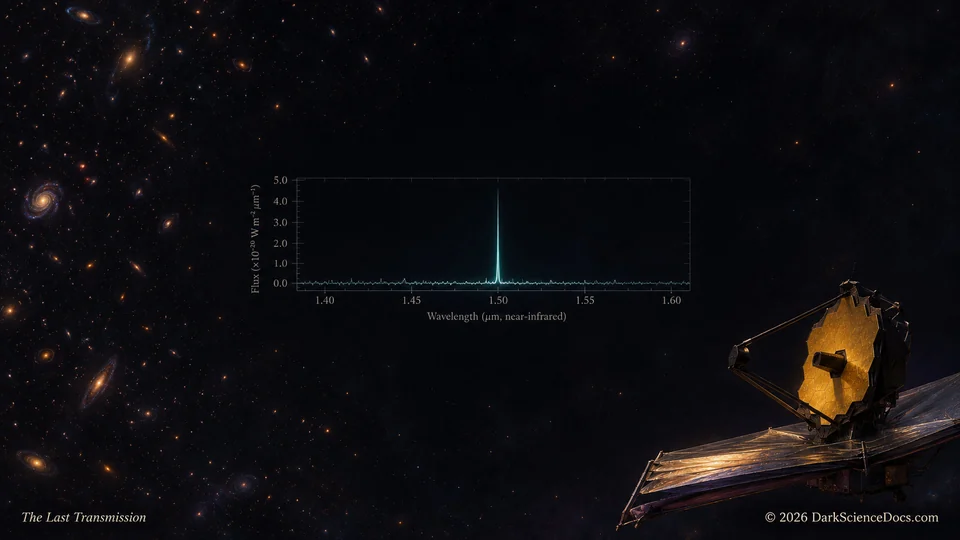
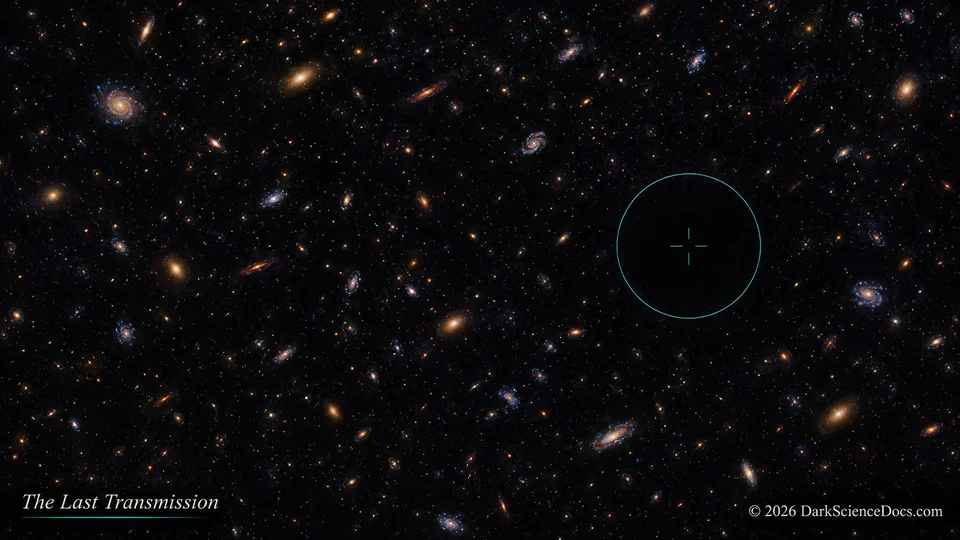
Huberty and colleagues report such a case with Webb’s NIRSpec instrument. They identify a single emission line near 1.60 micrometers without an obvious source in the deep imaging used for comparison. The line is measurable; the physical identity and distance of the object producing it remain unresolved.
Change the search rather than select the expected object
The method, called Multi-Object Coronagraphy for Slitless Spectroscopy, uses NIRSpec’s microshutter array in an unusual configuration. Most shutters are opened, while those positioned over known bright foreground sources are closed. This reduces contamination while allowing a broad search for line emission from objects that were not chosen as conventional individual targets.
The candidate line appears consistently across multiple dither positions and two telescope orientations. Those geometric checks strengthen the argument that the feature belongs to an astronomical signal. They also illustrate why the detection method matters: independent observing configurations can test explanations that would remain plausible after a single isolated exposure.
One wavelength does not fix one distance
An observed line can correspond to different atomic transitions shifted by different amounts as light travels from its source. A reliable identification often comes from a pattern of lines. Here, the absence of clearly detected companions and the unusually strong line relative to the imaging limit make familiar interpretations difficult.
The paper considers possible galaxy, active-nucleus and transient explanations. Each must account for the measured wavelength, strength and profile while respecting the other non-detections. A very distant primordial galaxy is one hypothesis among competing possibilities, rather than an identification supplied automatically by Webb’s ability to observe the early universe.
The dates change the meaning of the missing image
The MOCSS spectroscopy was obtained on August 23 and November 19, 2023, separated by about 88 days. The JADES imaging used for comparison dates to October 8–10, 2022. The earlier image and the spectral detections therefore do not describe the source at the same moment.
That gap leaves room for time-dependent explanations. A transient or a changing active source could differ substantially between the observations, although the consistent line detections across the two later epochs constrain how rapidly the signal could evolve. The timeline is part of the evidence and belongs alongside any statement that imaging showed no counterpart.
An unidentified line can guide the next observation
The useful result is a set of constraints rather than an invitation to choose the most dramatic explanation. Additional lines could establish a redshift. Imaging near the epoch of spectroscopy could test whether a continuum source is present then. Monitoring could distinguish sustained behavior from an evolving event.
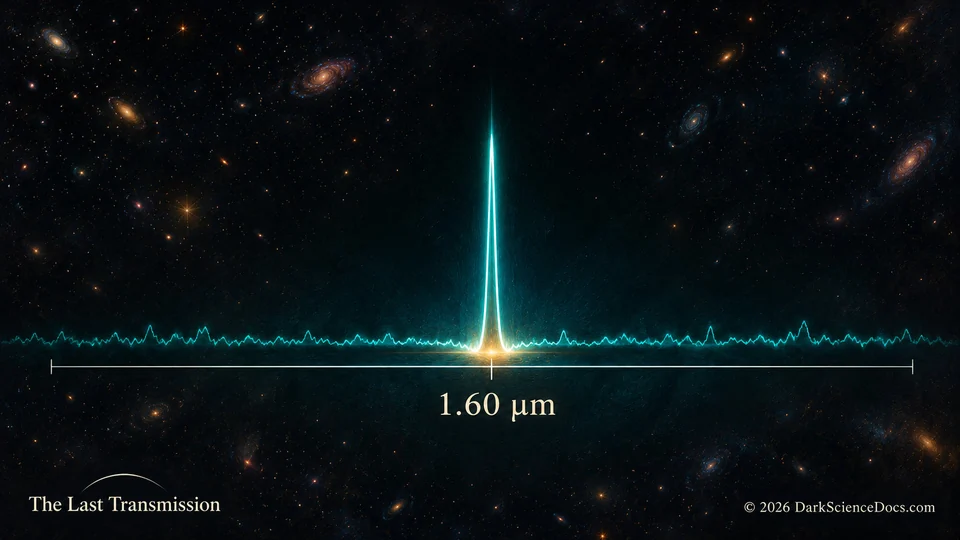
Explore the spectrum with those tests in mind. An illustrated line can communicate the puzzle, provided it is labeled as a conceptual diagram rather than measured data. The real investigation advances when an observation excludes a possible history or connects the feature to a source that can be studied in another way.