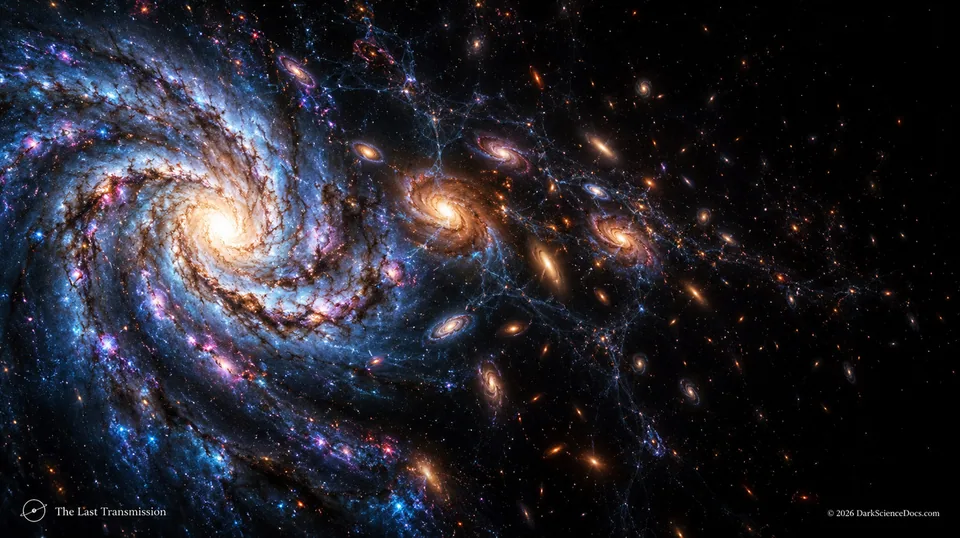
DOCUMENTARIES / THE LAST TRANSMISSION
The Complete Guide to False Vacuum Decay: How the Universe Ends
Physics permits a question stranger than ordinary catastrophe: could the vacuum state underlying our universe change?
If the player is unavailable, watch directly on YouTube ↗
THE QUESTION BEHIND THE FILM
How do physicists distinguish a mathematical possibility from a prediction?
ORIGINAL VIEWING GUIDE
Look closer.
The vacuum has a state
In quantum field theory, empty space is not simply the absence of everything. Models can describe a field resting in a local energy minimum rather than the lowest possible one.
The bubble is a model
Some false-vacuum scenarios involve a transition spreading through space. The details depend on particle physics and assumptions about the fields involved; the scenario is not evidence that such a transition is underway.
Scale changes the feeling
The film follows an extreme possibility to clarify what physical stability means. No telescope has observed a vacuum-decay front, and an imagined cosmic ending should remain distinct from a measured risk.
THE EVIDENCE TRAIL / RESEARCH COMPANION
What the record says.
Vacuum decay begins as a calculation in quantum field theory, where a state can be long-lived without being the lowest possible energy state. It is not an observed wave of destruction.
CHOOSE A CLUE / FOLLOW THE RECORD
These are research waypoints, not video timestamps. Explore them in any order, then return to the film.
The vacuum is a field configuration
Observed or documented
Particle-physics models describe a field’s potential energy and the possibility of more than one minimum. A state trapped near one minimum can be metastable in a given mathematical model.
What it suggests
This gives the phrase “false vacuum” a precise meaning: a local, potentially temporary state of a physical field, not empty space turning into a material substance.
Where the claim stops
Whether our universe has such a state depends on measured parameters and assumptions about physics beyond the current model.
The stability inference uses particle masses
Observed or documented
Research on Standard Model vacuum stability connects the Higgs sector and other measured particle parameters to a calculation of the effective potential at extreme energies.
What it suggests
An inferred metastable region motivates better measurements and theoretical work. The result is sensitive to uncertainties and to what physics beyond established models may appear at very high energies.
Where the claim stops
The calculation cannot be read as an observed countdown. Extrapolating a model to scales no experiment has reached has important limits.
A bubble is a theoretical consequence
Observed or documented
In some false-vacuum models, a transition could nucleate a region of lower-energy vacuum that expands. The scenario follows equations for the assumed fields and their energy landscape.
What it suggests
It provides a striking way to ask what a truly stable cosmic state means and how quantum effects could change a large-scale history.
Where the claim stops
No telescope has detected such a boundary. Details such as nucleation rate or propagation cannot be asserted for our universe from the concept alone.
An accelerator is not a cosmic trigger story
Observed or documented
High-energy collisions occur naturally in cosmic rays, while laboratories study particle interactions under controlled conditions. Stability discussions compare hypothetical processes with physical scales.
What it suggests
A responsible risk claim must quantify rates, energies, and observational constraints instead of treating the word “decay” as evidence of an impending event.
Where the claim stops
An extreme theoretical possibility is not a practical forecast. The documentary’s premise should remain distinct from demonstrated danger.
Which future particle measurements or theoretical result would most change our assessment of the vacuum’s long-term stability?
FOLLOW THE EVIDENCE
Keep the question open.
Watch the documentary, check the research, and continue into the illustrated archive.
MORE DOCUMENTARIES
 What Happens If the Electricity Grid Collapses?
 Everything You Need to Know About the 1977 Wow Signal
 The Dark Forest Theory: The Terrifying Answer to the Fermi Paradox