
22 / Cosmology / a conditional distant future
A Future Observer Could Lose Access to Our Cosmic Evidence
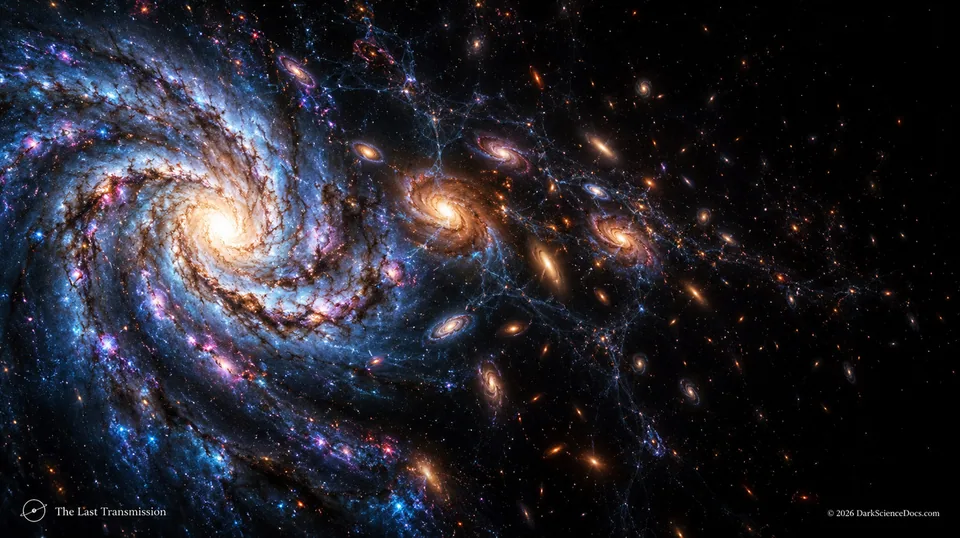
If accelerated expansion continues in the familiar cosmological-constant picture, future observers may have far less evidence available for reconstructing cosmic history. That forecast depends on dark energy and on which observational boundary is being discussed.
Cosmology works because light from different epochs brings independent evidence into the same observing program. Galaxy redshifts, background radiation and the distribution of matter constrain a common history. Continued accelerated expansion can progressively make distant sources harder to detect while shifting the background to longer wavelengths. A future observer in a bound local system might therefore inherit a much poorer record of the wider universe. The argument concerns access to information from a particular place and time, rather than a physical deletion of history everywhere.
The full investigation continues with the evidence, illustrations, and sources at The Last Transmission on Substack.
Continue reading on SubstackTHE EVIDENCE / THE OPEN QUESTION
What we know.
The published future-cosmology calculation develops its argument under continued cosmological-constant-dominated expansion. Current surveys such as DESI test cosmological models through measured structure and expansion history. These observations address the assumptions on which a distant-future extrapolation depends; they do not directly observe that future.
What remains open.
A particle horizon, event horizon and Hubble radius describe different limits and must not be merged into a wall. Old light from a galaxy may remain visible even when some later emissions will never reach us. Large-scale recession does not require local faster-than-light motion. Changes in the behavior of dark energy would alter the extrapolated ending.
Why it matters.
The unsettling possibility is that good science can depend on the epoch in which observers exist. Testing dark-energy models now can refine the conditional forecast, while preserving observations gives future researchers a record their own sky might not reproduce. The case is strongest when the assumptions remain as visible as the imagined empty heavens.
FOLLOW THE EVIDENCE
Research behind the field note.
EXPLORE IN 3D / MAP 13
Explore the larger cosmic setting
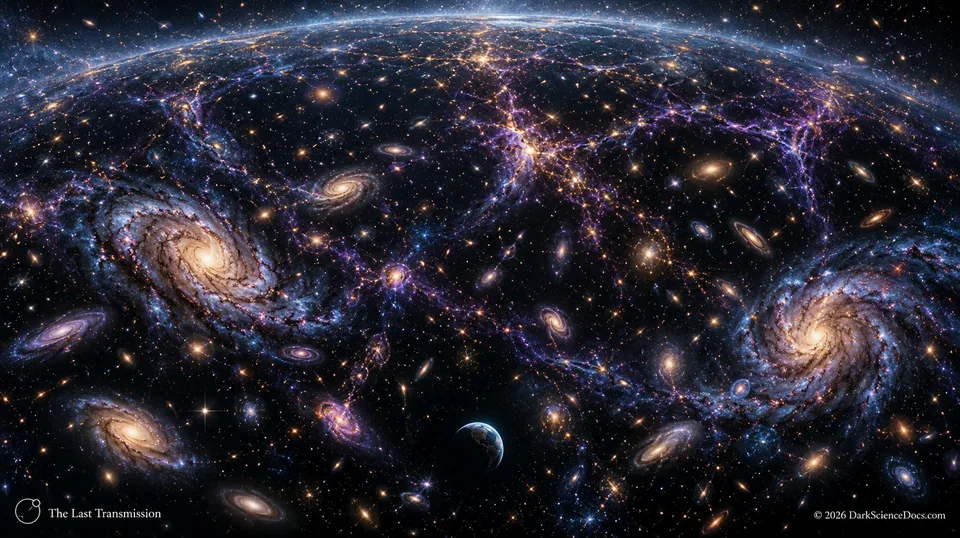
Move through an illustrative cosmic map. Its arrangement does not directly image a black-hole cocoon or predict the future sky.
Open Universe mapVISUAL EVIDENCE
Inside the investigation.
FOLLOW THE THREAD
Related signals.
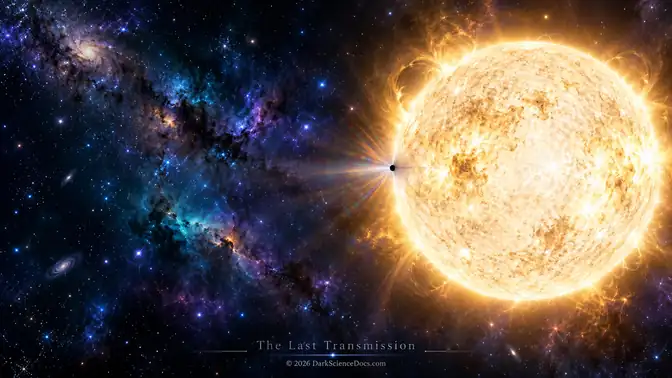
A Star Blinked Twice. Whatever Caused It May Be Much Closer to Earth.
Two nearly identical optical disturbances, 4.4 seconds apart, appeared in HD 89389’s light. Follow the unexplained record, a foreground diffraction hypothesis, and the synchronized telescopes proposed to test it.
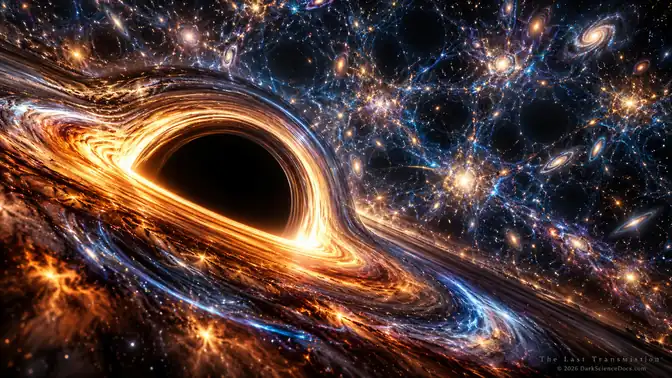
What If the Universe Is Accelerating Because Stars Die?
For nearly three decades, scientists have struggled to identify the mysterious force accelerating the expansion of the universe. Now a radical theory suggests the answer.
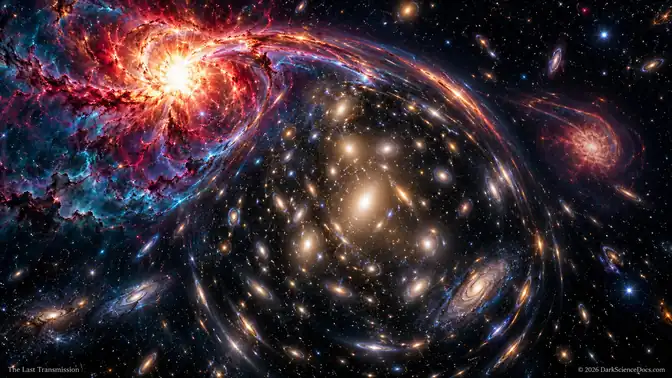
A Star Died 6.5 Billion Years Ago. Its Explosion Is About to Arrive Again.
NASA is watching for a supernova we have already seen. When that light finally reaches Earth, it could help answer one of the most troubling questions in modern cosmology.