
101 / COSMIC MYSTERIES / FIELD NOTE
The Galaxies Behind Our Galaxy
Follow infrared imaging and X-ray observations through the Milky Way’s foreground to see how astronomers investigate hidden galaxies and clusters.
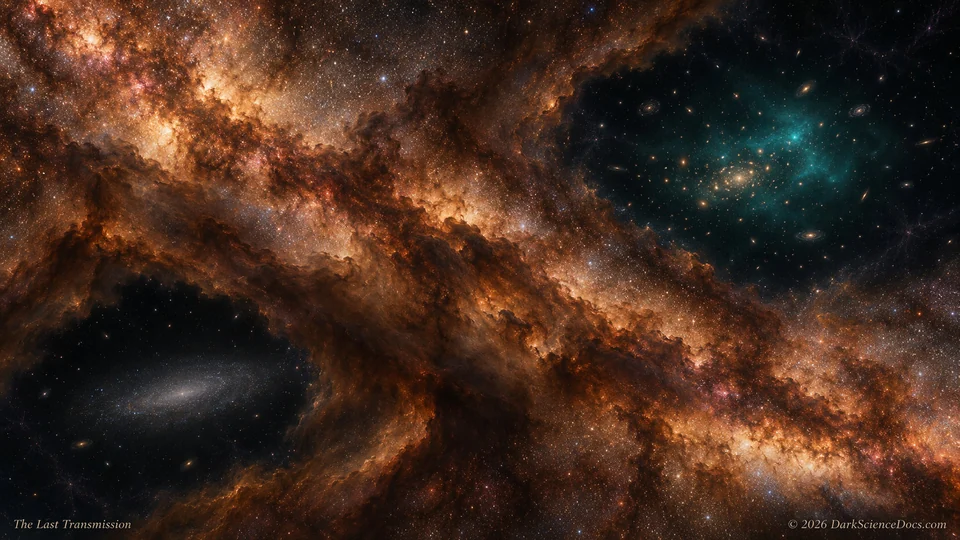
Our own galaxy can obstruct the view
The Milky Way fills the sky with nearby stars, dust and diffuse emission. Those foreground structures can absorb or overwhelm light from more distant systems. The resulting difficulty is called the Zone of Avoidance, a name describing the limits of a survey rather than an empty region of the universe.
Astronomers approach that limit by changing wavelengths and combining observations. Infrared imaging can reduce some of the effects of dust. X-rays can reveal hot gas in a galaxy cluster. Follow-up spectra can test whether apparently neighboring galaxies actually lie at a common distance.
A faint disk emerges from deep images
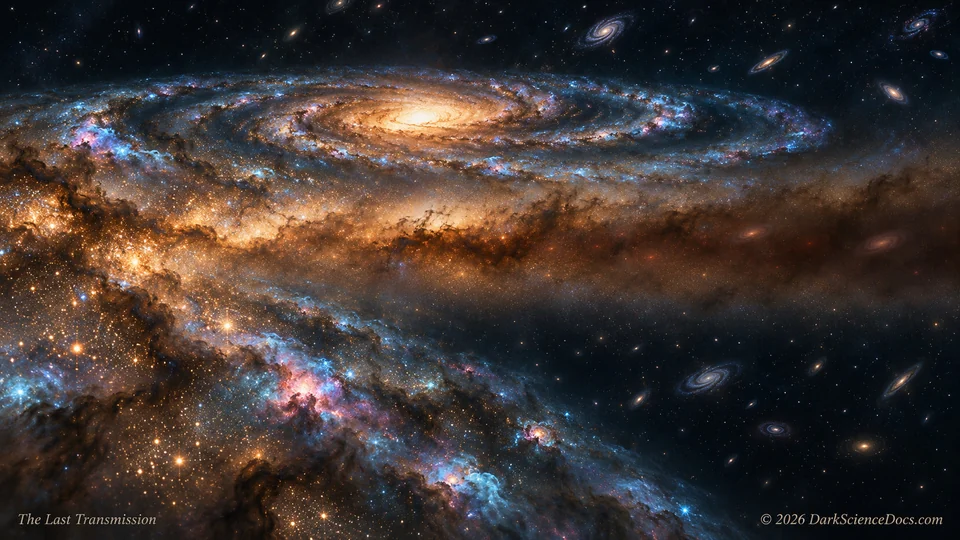
VVVX deep-stack observations identified the diffuse candidate VVVX J080705.96−273823.6 behind the crowded Galactic foreground. The researchers examined its extended light distribution and tested models of its surface brightness. Independent optical material supported the interpretation that the structure belongs to a low surface brightness disk galaxy.
That interpretation should retain its limits. The object lacks a confirmed spectroscopic redshift, so a proposed distance association remains conditional. A measured angular extent can become a physical size only after a distance is adopted. The same image therefore supports a morphological argument more directly than it supports a precise place in three dimensional space.
A separate cluster reveals hot gas and galaxies
Another investigation began with the eROSITA X-ray survey and the object SRGe CL0512.7+3712. Researchers combined radio, optical and infrared information, then used optical and X-ray follow-up to characterize a massive galaxy cluster. Its measured redshift is 0.0745, and the analysis connects the galaxy concentration with a hot intracluster medium.
This is a different object and a different chain of evidence from the diffuse VVVX candidate. Their relationship is the foreground obstacle they share. One investigation follows a faint distribution of starlight; the other combines galaxies and hot gas to establish a system whose gravity gathers much more than its visible stars.
A map is only as complete as its selection
Hidden systems matter because surveys are used to reconstruct the wider distribution of matter. If the Galactic plane makes some objects harder to detect, an apparent gap in a catalog can reflect foreground selection. Understanding that selection helps researchers distinguish a real absence of structures from a place where their instruments struggle to find them.
The cluster preprint suggests that further systems could be uncovered by examining promising regions across several wavelengths. That prediction is a search strategy, not a completed census. Each additional candidate would need its own characterization before it could become a reliable part of the large scale map.
Look through the foreground without inventing the background
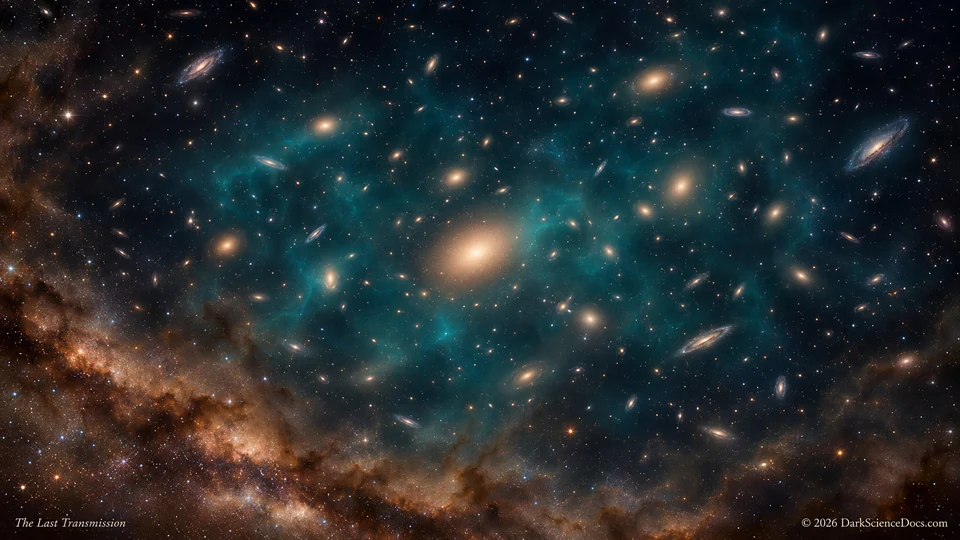
An illustrative cosmic web can make the scale of these relationships tangible. It should not substitute for measured positions or turn a candidate galaxy into a precisely located point. The distinction lets an educational model invite exploration while the evidence remains attached to the actual survey data.
The compelling possibility is that an important structure can already be sending light toward Earth while remaining difficult to recognize. A deeper image or an independent wavelength can change that situation. The discovery then depends on demonstrating what the signal belongs to, how far away it is and how it fits the surrounding environment.