
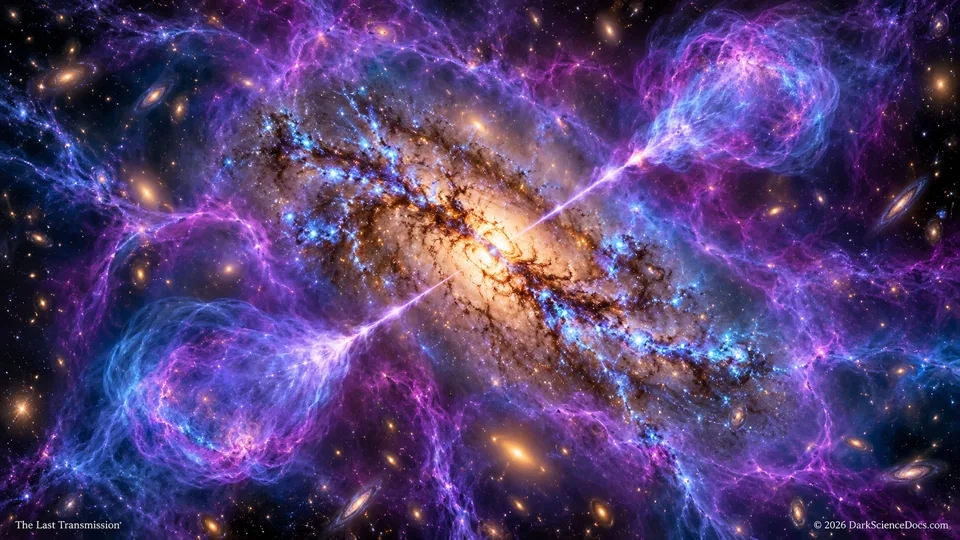
10 / Phoenix Cluster / cooling through the outburst
The Galaxy Where Feedback Still Leaves Room for Stars
The Phoenix Cluster’s central galaxy forms stars amid powerful black-hole feedback. Infrared observations follow gas through an intermediate temperature range, making the competition between heating and condensation more visible.
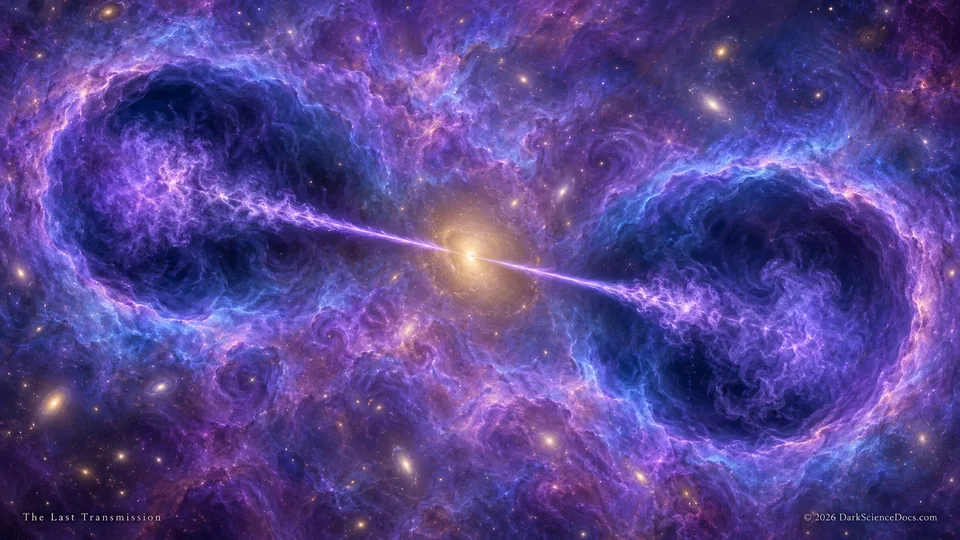
Black-hole feedback is often introduced as a brake: accretion powers outbursts that disturb and heat the surrounding gas, limiting the material that can form stars. Phoenix shows why the real system is more intricate. A galaxy cluster contains hot gas, cooler filaments and cavities associated with energetic activity. Webb observations traced infrared emission from intermediate-temperature gas, connecting phases that are otherwise difficult to follow together. The result supplies evidence about a cooling pathway within an atmosphere that is also being disrupted. It does not mean that every outburst creates stars or that heating has ceased.
The full investigation continues with the evidence, illustrations, and sources at The Last Transmission on Substack.
Continue reading on SubstackTHE EVIDENCE / THE OPEN QUESTION
What we know.
The research follows emission from ionized neon and other tracers into the cluster core. Different analyses estimate star formation over different averaging windows, with rates expressed as solar masses per year. An inferred cooling-flow rate describes gas moving through temperature ranges and is a separate quantity. Spatial relationships among cavities, cooling gas and young stars motivate a physical feedback interpretation.
What remains open.
The observations do not directly replay every parcel’s history or isolate one universally dominant mechanism. Geometry, abundances, time averaging and thermal models affect inferred rates. A black hole can regulate its environment while uplift or disturbance also helps some material condense. Assigning all the star formation to one simple cause would discard that complexity.
Why it matters.
Phoenix turns feedback into a measurable exchange among energy input, cooling and available fuel. Comparisons across temperature tracers and other clusters can test when the balance shifts. The question is how some gas reaches a star-forming state while an active central engine continues changing the conditions around it.
FOLLOW THE EVIDENCE
Research behind the field note.
EXPLORE IN 3D / MAP G-01
Explore a nearby black-hole teaching model
Use Sagittarius A* as a nearby comparison. The model is not a reconstruction of the Phoenix Cluster or a little red dot.
Open Sagittarius A* mapVISUAL EVIDENCE
Inside the investigation.
FOLLOW THE THREAD
Related signals.
A Star Blinked Twice. Whatever Caused It May Be Much Closer to Earth.
Two nearly identical optical disturbances, 4.4 seconds apart, appeared in HD 89389’s light. Follow the unexplained record, a foreground diffraction hypothesis, and the synchronized telescopes proposed to test it.
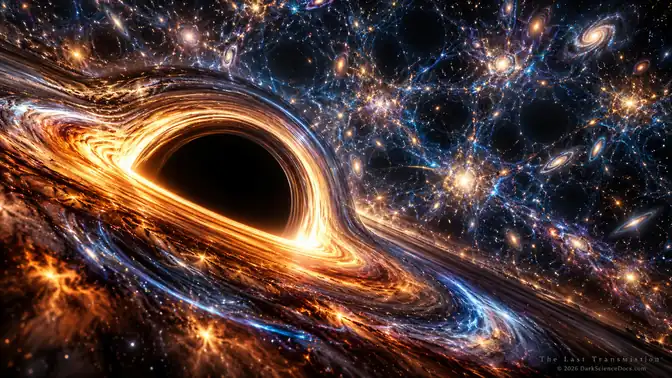
What If the Universe Is Accelerating Because Stars Die?
For nearly three decades, scientists have struggled to identify the mysterious force accelerating the expansion of the universe. Now a radical theory suggests the answer.
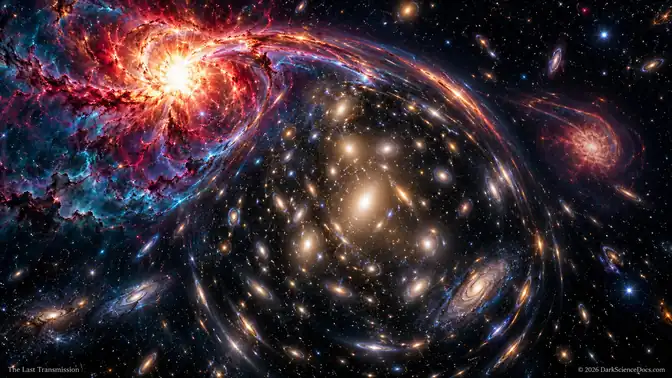
A Star Died 6.5 Billion Years Ago. Its Explosion Is About to Arrive Again.
NASA is watching for a supernova we have already seen. When that light finally reaches Earth, it could help answer one of the most troubling questions in modern cosmology.