
100 / COSMIC MYSTERIES / FIELD NOTE
The Clock a Photon Cannot Carry
Separate a photon’s null path from a traveler’s elapsed time, then follow the clock experiments that make relativity a measurable part of daily life.
Two meanings of a very long journey
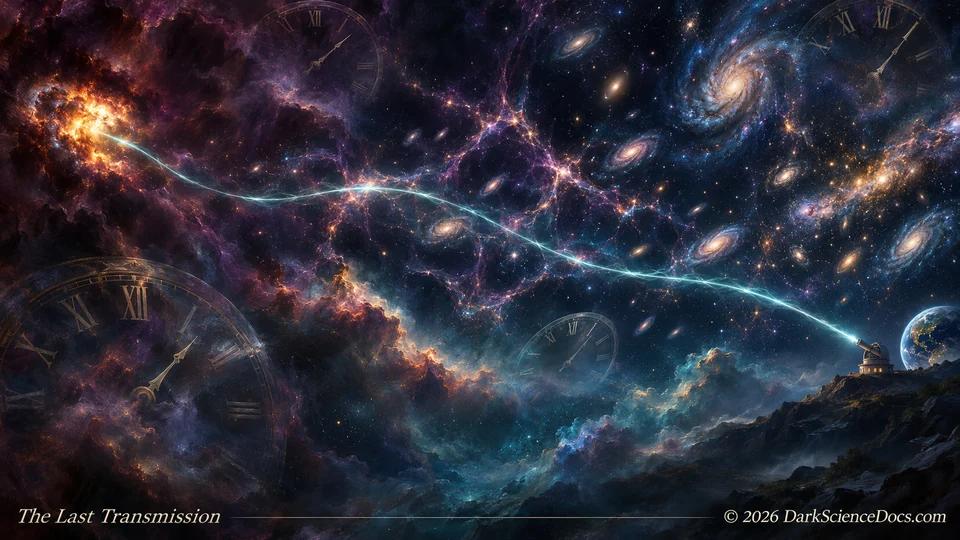
Light from a distant galaxy can reach Earth after billions of years of cosmic history. Astronomers describe that interval using a cosmological model and the evolution of the universe through which the radiation traveled. The journey connects a particular emission event with a particular detection event, even when the source has changed profoundly in between.
Relativity introduces a different question: how much proper time belongs to a path through spacetime? A material clock records proper time along its own worldline. A vacuum light ray follows a null path, whose spacetime interval is zero. These statements concern different quantities and can coexist without erasing the history observed on Earth.
A photon supplies no reference frame
An observer cannot ride alongside a photon at the speed of light and use an ordinary clock to describe its experience. Relativity provides no valid photon rest frame. Statements that light does not age can express the null geometry, provided they do not turn that shorthand into a viewpoint that the theory does not permit.
The distinction matters because a massive traveler never becomes that photon. As a ship approaches light speed, its motion can produce a large difference between its accumulated time and the time assigned by an inertial frame used to describe the trip. Its crew still experiences physical processes and onboard clocks advancing normally.

Reunion lets two histories be compared
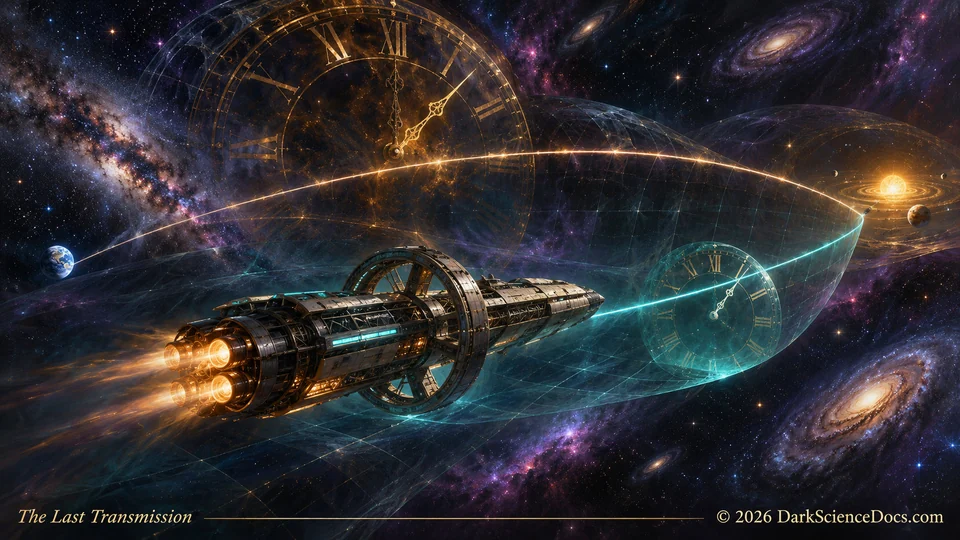
If a traveler leaves Earth and later returns, the two clocks can be placed side by side. They have followed different worldlines between shared events. Their recorded durations can therefore differ. A complete calculation must specify the journey, including the changing motion needed to leave, turn and reunite, rather than compare disconnected snapshots of uniform motion.
The result concerns the traveler’s full physical history. Chemical reactions, instruments and biological aging follow the same local passage of time as the onboard clock. The dramatic difference becomes visible when those histories meet again and their accumulated intervals can be compared directly.
Precision clocks bring the geometry into reach
Atomic clocks make these ideas experimentally accessible. NIST researchers have compared clocks with different motions and at different heights, finding the shifts predicted by relativity. Gravitational potential and velocity enter the comparison in different ways, so an experiment must track both when interpreting the measured difference.
The familiar setting is useful. Relativity applies to clocks near Earth as well as hypothetical starships. Increasing precision allows smaller differences to be detected, creating opportunities to study gravity and improve measurement. Those experiments test relationships between material clocks; they do not place a clock aboard a photon.
Receiving a message is another time question
A starship can receive an Earth signal carrying a timestamp from an earlier moment. The light travel delay changes as the ship moves, and the rate at which signals arrive depends on the relative motion. The timestamp reaching the ship therefore differs from the Earth coordinate time used to describe the mission.
Use the Time Dilation Lab to compare these readings deliberately. Watch each accumulated clock, then watch arriving messages as separate information. The distinction makes the strange result easier to assess: a long light journey, unequal aging at reunion and delayed news from Earth are related parts of relativity, each answering its own question.