
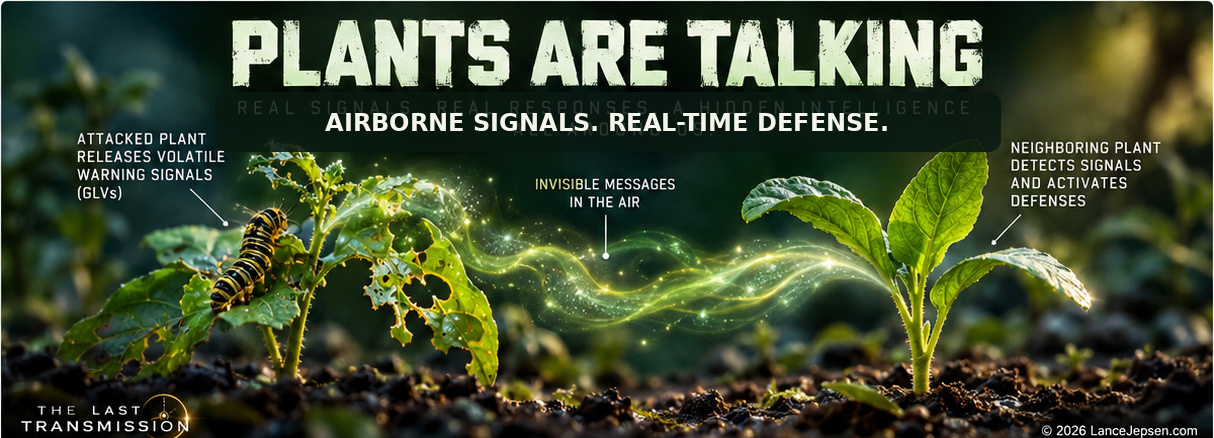
50 / An airborne alarm
How a Neighboring Plant Registers Trouble
Damaged leaves release volatile compounds. In a controlled experiment, nearby plants responded with waves of intracellular calcium, making a chemical warning visible without proving that plants think like animals.
Researchers made plant tissue respond to green-leaf volatiles released by damage and recorded its response with a fluorescence biosensor. The glowing pattern is not the odor itself moving through air; it is a calcium signal inside cells exposed to airborne compounds. Mapping where and when the signal appears gives researchers a route from a wounded leaf to a receiving plant's physiology. A warning is a useful shorthand for this ecological relationship, but intention and understanding are different claims that the experiment was not designed to test.
The full investigation continues with the evidence, illustrations, and sources at The Last Transmission on Substack.
Continue reading on SubstackTHE EVIDENCE / THE OPEN QUESTION
What we know.
The Nature Communications study measured rapid calcium responses in Arabidopsis tissues after exposure to green-leaf volatiles from damaged plants. The researchers used genetically encoded fluorescence imaging to locate the responsive cells and examine the signal's propagation.
What remains open.
The apparatus establishes a cellular response under its tested conditions; it does not show that every plant species uses the same chemical mix or that a receiver consciously recognizes a neighbor. The ecological benefit of a given signal depends on predators, herbivores, and environment.
Why it matters.
An invisible chemical exchange becomes an experimental trace. It shifts the question from whether plants 'talk' to which compounds, receptors, and defense pathways make neighboring damage consequential.
FOLLOW THE EVIDENCE
Research behind the field note.
FOLLOW THE THREAD
Related signals.

They Grew a Human Cortex Inside a Mouse. Then They Tested Its Memory.
Scientists created mice whose cortical tissue was almost entirely derived from human cells. The tissue grew, formed connections, generated electrical activity, and revealed something extraordinary.
They Found Plutonium at the Bottom of the Pacific. The Explosion That Made It May Be Over 95 Million Years Old.
Deep beneath the ocean, scientists discovered radioactive debris from beyond Earth. The most disturbing clue was an element they could not find.

The Blows That Nearly Killed Earth May Have Helped Bring It to Life
A model identifies a window for life’s chemistry 4.33 billion years ago. The unsettling question is whether Earth was the only world to take advantage of it.