Descend from the photosynthetic surface to a vent field on the dark seafloor. At each stop, follow an original investigation, documentary, illustrated article, or cell model into the question it opens.
OCEAN DESCENT VERTICAL DISTANCES NOT TO SCALE
SUNLIT SEA / PHOTOSYNTHESIS
Choose a depth to explore the ocean.
DEPTH FILE 01 / EARTH OCEAN
The Sunlit Sea
Light / plankton / oxygen
How does sunlight enter the ocean food web?
Near the surface, phytoplankton use light to make organic matter, supporting marine food webs and contributing substantially to Earth’s oxygen production. These plankton include photosynthetic eukaryotes with chloroplasts and cyanobacteria, which are prokaryotes. The glowing points here stand for a mixed community, not identifiable organisms or a measured bloom.
Sunlight weakens with depth, eventually becoming too scarce for photosynthesis. Sinking organic particles can carry carbon and nutrients from upper waters to life below. The lights in this compressed column depict drifting material, not a measured flux, fixed depth boundary, or a realistic view of the entire ocean in one place.
How can a food web begin where sunlight never arrives?
At hydrothermal vents, seawater moves through hot rock and returns with dissolved chemicals. As vent fluid mixes with the surrounding ocean, some microbes capture chemical energy and fix carbon, supporting communities without local sunlight. The varied chimneys, mineral outcrops, and diffuse plumes are an illustrated composite, not a map of a real vent field. Other deep-sea life may still depend on food sinking from above.
Mineral surfaces and chemical gradients at some kinds of ancient seafloor vents are investigated as possible settings for early metabolism. Modern vent ecosystems demonstrate that life can use chemical energy, but they do not show how life first emerged. The scene below represents a present-day style of vent, not the first cell or a reconstruction of the early Earth.
The AMOC carries heat through the Atlantic. Follow the documentary into the measurements and open questions, alongside this illustrated descent through ocean habitats.
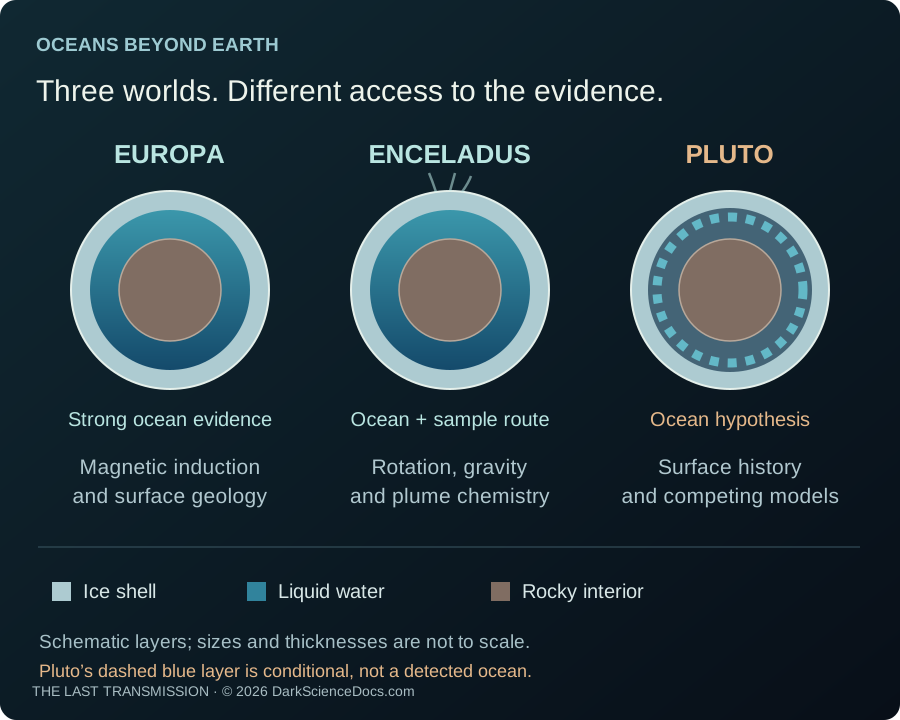
This Earth descent is a model of one environment. Europa and Enceladus have different ice, heat, and evidence histories. These links lead to their own records; no life has been established in either ocean.
01 / JUPITER
Europa
Galileo’s magnetic measurements are one line of evidence for a salty ocean beneath ice. What could its chemistry support?
Explore a modern bacterium as a useful comparison with vent microbes. The animal-type eukaryotic cell is a different modern architecture, not a reconstruction of the first cell or of ocean plankton.
This is a compressed, fictionalized vertical transect of an Earth ocean. The underwater surface texture is generated artwork, while the plankton, sinking particles, chimneys, mineral outcrops, plumes, and chemical markers are illustrated examples rather than a survey of one location or a measured community. Light loss, color, camera travel, seafloor relief, vent chemistry, and relative distances are schematic. A vent’s chemical energy supports organisms today; this model makes no claim that life began at this vent or that ocean worlds beyond Earth contain life.
The spacecraft was destroyed in Saturn’s atmosphere in 2017. Now scientists are finding richer organic chemistry in samples it collected from an alien ocean years before it died.
Compare Europa’s magnetic response, Enceladus’s sampled spray, and Pluto’s competing interior models. Follow the measurements into the hidden-ocean question, the search for habitable conditions, and the Atlas.
A favorable vent environment does not establish life’s birthplace.
The descent links sunlight, deep water, and a vent setting. Such environments can motivate origin-of-life hypotheses, but those hypotheses need chemical and historical evidence. The illustrated vent field is not a sampled site or proof that life began there.
Ask yourself How large are the uncertainties, and which claim would go beyond the data?
THE SIGNAL CONTINUES
Some discoveries stay with you.
Get the illustrated investigations delivered to your inbox. Then follow the questions that refuse to leave.