
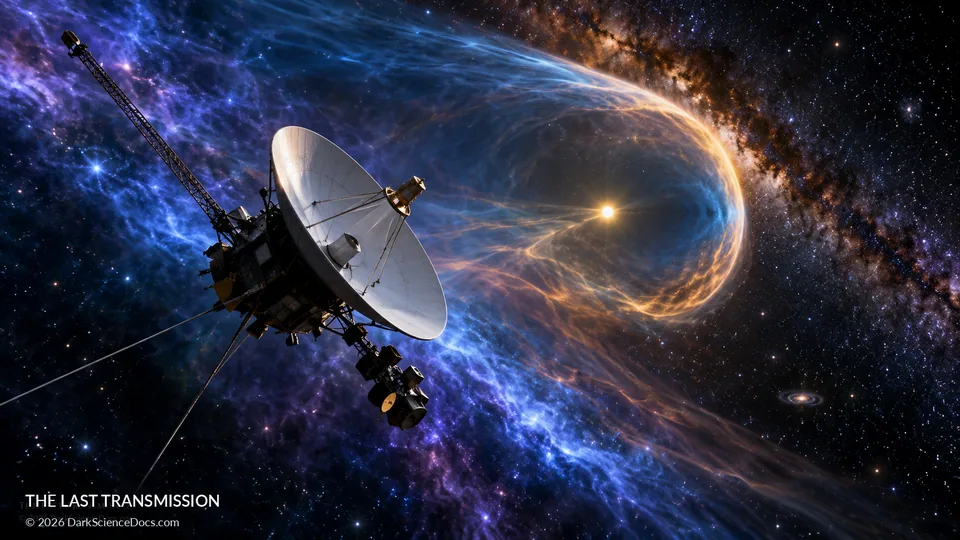
16 / Voyager 1 / instrument survival
The Interstellar Measurement That Depends on Every Watt
Voyager 1 can still probe plasma and magnetic fields beyond the heliopause, but keeping the spacecraft alive requires choices about which measurements survive. Mission longevity and the remaining science inventory are separate outcomes.
Crossing the heliopause in 2012 placed Voyager 1 in an environment dominated by interstellar material, without carrying it beyond every object gravitationally associated with the Sun. Its instruments sample this region where a later mission cannot quickly repeat the trajectory. Plasma-wave measurements reveal electrical oscillations that can constrain the density of the surrounding medium. Converting those data into audible frequencies makes a scientific record easier to perceive; it does not turn the spacecraft into a microphone hearing acoustic sound travel through a vacuum.
The full investigation continues with the evidence, illustrations, and sources at The Last Transmission on Substack.
Continue reading on SubstackTHE EVIDENCE / THE OPEN QUESTION
What we know.
NASA’s April 2026 update records the shutdown of Voyager 1’s Low-energy Charged Particles instrument, leaving plasma-wave and magnetic-field science. The radioisotope power supply loses roughly four watts of electrical output each year. An August update reports a power-saving reconfiguration completed on Voyager 2 while the corresponding Voyager 1 work was still planned in that account.
What remains open.
The cited updates do not establish an exact date for Voyager 1’s final transmission or prove completion of every later engineering plan. Communication delay changes with the spacecraft’s range and should be treated as an approximate, date-dependent comparison. A luminous interstellar boundary in artwork is a metaphor for measured fields and plasma, not a visible wall.
Why it matters.
Every engineering decision preserves some observations while ending others. Reading the mission record requires keeping those trades visible instead of compressing the future into one countdown. The existing documentary and the illustrated article now provide complementary ways to follow the measurement, the spacecraft and the uncertain remaining margin.
WATCH THE DOCUMENTARY
Voyager 1 Is Going Dark: NASA’s 2026 Mission Status
The oldest messages from interstellar space depend on power, distance, and engineers solving problems across a one-way light-time measured in hours.
FOLLOW THE EVIDENCE
Research behind the field note.
EXPLORE IN 3D / MAP 12
Locate the wider Galactic setting
Explore an illustrative Milky Way map. It does not supply a measured source location or live Voyager position.
Open Milky Way mapVISUAL EVIDENCE
Inside the investigation.
FOLLOW THE THREAD
Related signals.
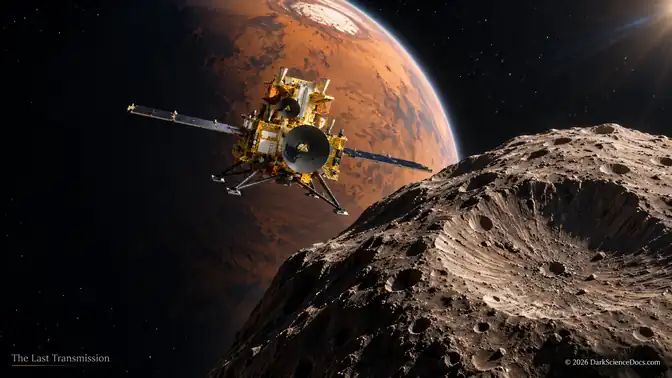
Phobos: The Moon That May Preserve Mars’s Past
MMX will investigate how Phobos formed and whether its dust contains fragments ejected from Mars. Follow the mission, the sample-return plan, and the limits of the evidence.

The People Who Cared for Laika Knew She Would Never Come Home
Before her one-way flight, a doctor brought her home to play with his children. That small kindness leaves us with a harder question about what it means to care.
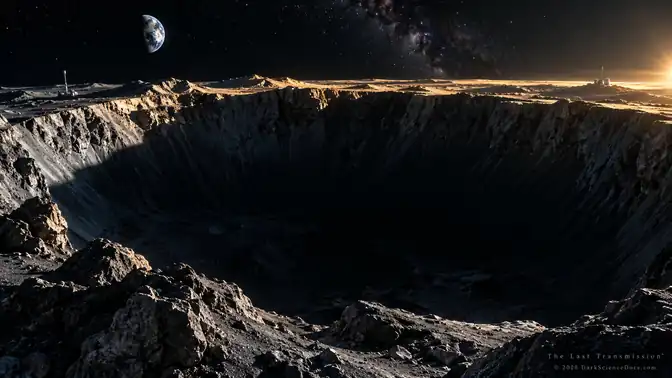
The Moon Has No Owner. Its Most Valuable Ground Is Already Being Contested.
Two space powers are racing toward a crater where the Sun has barely touched the ground for billions of years. What lies in the darkness could determine humanity's future on the Moon.