

03 / Space history / the life inside the achievement
Laika: When Care Could Not Bring Her Home
Before a spacecraft without a return system carried Laika into orbit, one of the doctors brought her home. Her story asks what care means when the people offering comfort also accept the decision that places a life beyond their help.
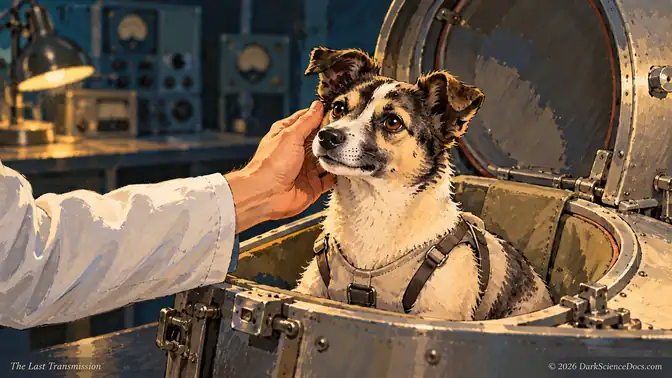
A mission can enter history as an achievement while leaving an individual life almost hidden inside the account. Laika’s story makes that separation difficult to maintain. The article begins with a reported visit to Vladimir Yazdovsky’s home, where a dog preparing for space could briefly receive the familiar attention of a household. Its question follows the distance between recognizing another being’s vulnerability and changing the plan that exposes that being to harm. The kindness matters, but the absence of a route home remains a decision that kindness could not reverse.
A home visit inside a flight program
The account of Yazdovsky taking Laika home is reported in the historical literature and retold by Smithsonian. It records an act of affection within a program preparing her for a fatal mission. The film’s domestic scene interprets that episode; the room, gestures and exact interaction are not documentary footage. Keeping the provenance visible allows the story’s emotional force to rest on the reported visit without claiming that an illustration preserves everything that happened there.
The missing return was a decision before launch
Sputnik 2 did not contain a system that could return Laika safely to Earth. That limitation preceded the thermal failure that shortened her life. It therefore belongs to a different part of the reasoning: an early death could be a failure of the spacecraft environment while the absence of rescue was already built into the mission. The history cannot be reduced to a promising return attempt that went wrong. No successful performance of the planned spacecraft would have supplied that return.
NASA History: the first animal in orbitMeasurements could arrive after help became impossible
Laika survived launch and reached orbit, while the instruments supplied information about a living body under the stresses of flight. Receiving such information did not provide a means to alter her circumstances in the way a handler beside her could. Later accounts describe overheating and survival limited to the early hours, correcting the public impression that she lived for days. The telemetry and historical reports have limits, so the reconstruction avoids pretending to know every sensation, gesture or final moment.
An imagined old age is a question, not a discovery
One illustration shows an older Laika resting at home. This scene is deliberately counterfactual: she never reached that age. It invites the viewer to consider the ordinary years a dog might have lived, rather than adding an invented episode to the space program’s history. The film’s ethical question follows from that distinction. What would it mean to value her life apart from a record, a national milestone or the knowledge others could claim from her flight?
Carry responsibility beyond the achievement
The companion Cassini documentary asks a different question about exploration and responsibility: why engineers ended a spacecraft’s mission deliberately to reduce the risk of contaminating potentially habitable moons. The cases have different subjects, evidence and moral circumstances. Reading them together can nevertheless focus attention on how a mission’s ending is chosen. In Laika’s case, the loss concerns an animal already known to the people making the decision; the imagined years at home keep that individual life in view.
The full investigation continues with the evidence, illustrations, and sources at The Last Transmission on Substack.
Continue reading on SubstackTHE EVIDENCE / THE OPEN QUESTION
What we know.
Laika reached Earth orbit aboard Sputnik 2 on November 3, 1957. The spacecraft had no recovery provision. Historical accounts place her survival in the early hours, with overheating central to the failure; the spacecraft itself reentered on April 14, 1958.
What remains open.
Surviving records do not reveal every detail of Laika’s experience or every moment of the family visit described in later accounts. A painted scene cannot recover those missing details. The older Laika shown in one illustration is an imagined alternative, not part of her actual life.
Why it matters.
Scientific ambition and moral responsibility belong in the same history. The case asks how we judge a result when the subject could neither consent to the experiment nor share in its later meaning. The documentary’s imagined alternative makes that loss visible without supplying an invented happy ending to the historical record.
WATCH THE DOCUMENTARY
Laika: The Dog We Sent to Space Without a Way Home
A reported act of kindness before Laika’s one-way flight opens a documentary about affection, scientific ambition and the responsibility that care requires.
COMPARE THE QUESTIONS
Continue the question of responsibility.
Compare this history with a different mission ending and with the research that distinguishes biological precautions from evidence of life.
FOLLOW THE EVIDENCE
Research behind the field note.
WATCH THE RELATED DOCUMENTARY
The story in motion.
VISUAL EVIDENCE
Inside the investigation.

FOLLOW THE THREAD
Related signals.
Phobos: The Moon That May Preserve Mars’s Past
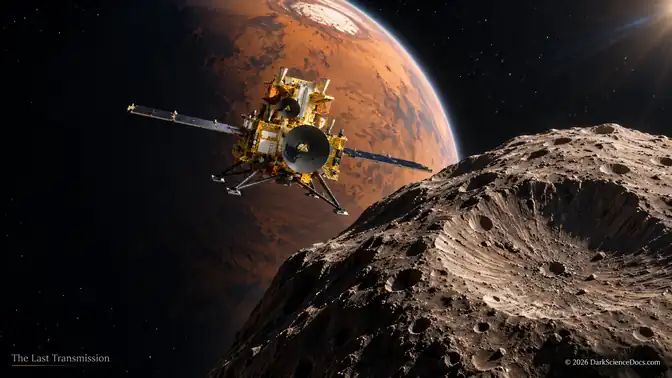
MMX will investigate how Phobos formed and whether its dust contains fragments ejected from Mars. Follow the mission, the sample-return plan, and the limits of the evidence.

The Moon Has No Owner. Its Most Valuable Ground Is Already Being Contested.
Two space powers are racing toward a crater where the Sun has barely touched the ground for billions of years. What lies in the darkness could determine humanity's future on the Moon.

The Moon Was Hit. The Damage Reached 140 Kilometers.
In the spring of 2024, something struck the Moon hard enough to leave an impact crater. When scientists finally discovered the impact, they found that its effects reached astonishing distances.