
3D ATLAS / LIVING SYSTEMS / HYDROLOGIC CYCLE

The water.
The world it connects.

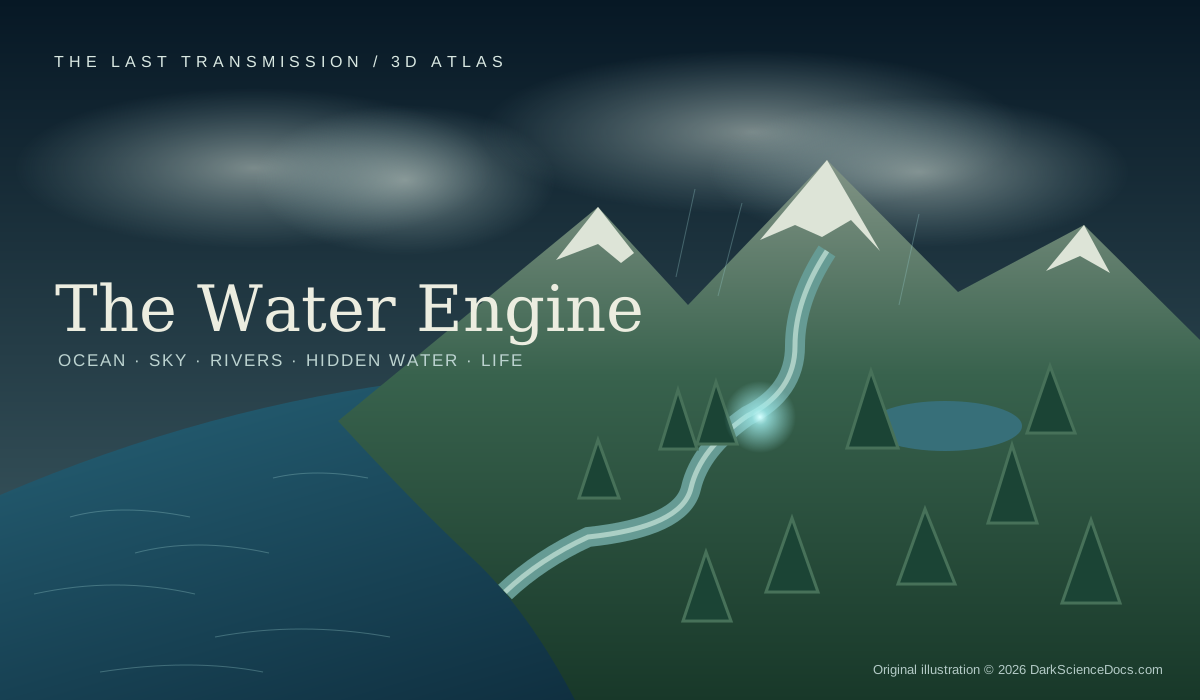
The hydrologic cycle connects ocean, sky, land, and living things through the movement and storage of water. Clouds carry moisture inland, and rain opens several possible journeys. Explore one illustrated watershed, follow a river, enter the ground, or travel through a living tree on the way back to the air.

An illustrated coast beneath clouds, with snowy mountains, forest, a lake, and a river flowing to the ocean
OCEAN & SKY
VAPOR / SYMBOLIC TRACERS
Original illustration © 2026 DarkScienceDocs.com

Choose a view to explore the water cycle.

01 / WATER CYCLE FILE

Ocean & Sky

Evaporation · cloud water · transport

How does an ocean become part of a cloud?

Energy allows liquid water to become invisible water vapor. Air currents transport and mix that moisture; cooling can turn some vapor into tiny cloud droplets or ice crystals. The faint rising lights here trace a selected process. Ocean & Sky begins under clear sunlight. Follow the Water to watch the marker rise, cloud droplets form, and rain return water inland. The journey can branch or pause.

02 / WATER CYCLE FILE

Rain & Rivers

Runoff · streamflow · snow and lake storage

What happens after water returns to the land?

Rain can soak into soil, be caught by foliage, evaporate, or join runoff. Streams gather water from a watershed and exchange water with the ground. Mountain snow and lakes provide storage: water need not complete a quick circuit. Make It Rain illustrates a passing storm over this composite landscape. The river route follows one selected passage toward the sea.

03 / WATER CYCLE FILE

Hidden Water

Infiltration · recharge · pores and fractures

Where does water go when it disappears beneath your feet?

Some infiltrating water reaches the saturated zone below the water table. There, water fills connected pores and fractures in sediment and rock. Groundwater moves in response to differences in hydraulic head and can discharge into springs, streams, and coastal waters. The enlarged grains and distributed blue tracers make that hidden setting visible. The selected route is symbolic, and its playback speed does not measure an aquifer’s travel time.

04 / WATER CYCLE FILE

Water & Life

Soil water · roots · xylem · transpiration

How does a tree become a route back to the sky?

Roots take up available soil water. Water then moves through the plant, and leaves release some of it as vapor through small pores. This transpiration connects a living canopy to the atmosphere. Follow the gold marker beside the highlighted tree: from rain into the soil, through its roots, up the trunk, and out of a leaf into the air. The enlarged marker and arrows reveal a process normally hidden inside tissue.

WHERE THE WATER LEADS

Follow the deeper questions.

ABOUT THIS HYDROLOGIC CYCLE

One landscape.
Many possible routes.

This is an original composite landscape with enlarged tracers, simplified structures, and compressed travel speeds. The highlighted tree uses gold arrows to trace uptake and upward xylem flow. Its marker remains visible inside soil and tissue. The three journeys select possible routes; real water can branch, return, or remain stored. Rising markers represent invisible vapor, and underground tracers represent movement through connected pores and fractures.

The storm illustrates weather. The scene does not calculate water budgets, aquifer travel times, contamination transport, or a forecast. Snow and the lake illustrate storage; the displayed routes do not include every water-cycle process.

SCIENTIFIC INQUIRY / APPLIED HERE

Explore all twelve principles
09 Model scope and predictions

A water journey is a chosen route through many possibilities.

The hydrologic cycle includes storage, mixing, and routes with very different timescales. The highlighted dot follows one teaching pathway rather than a measured water molecule. Use it to identify processes, then ask which observations establish their rates in a real watershed.

Ask yourself Which assumptions drive this result, and where would the model stop being useful?

THE SIGNAL CONTINUES

Some discoveries stay with you.

Get the illustrated investigations delivered to your inbox. Then follow the questions that refuse to leave.

Subscribe on Substack