DOCUMENTARIES / THE LAST TRANSMISSION
The Water-World Hypothesis: Why Too Much Water Could Prevent Complex Life
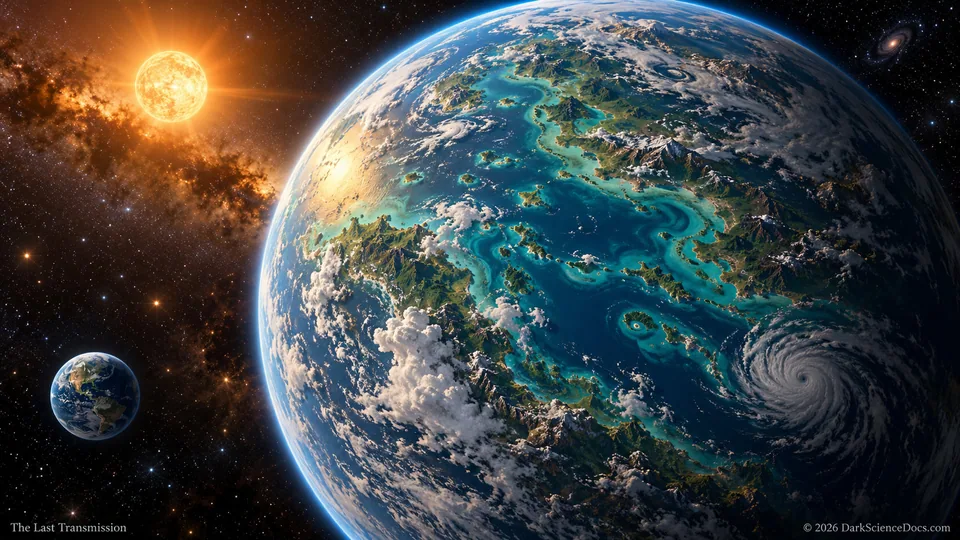
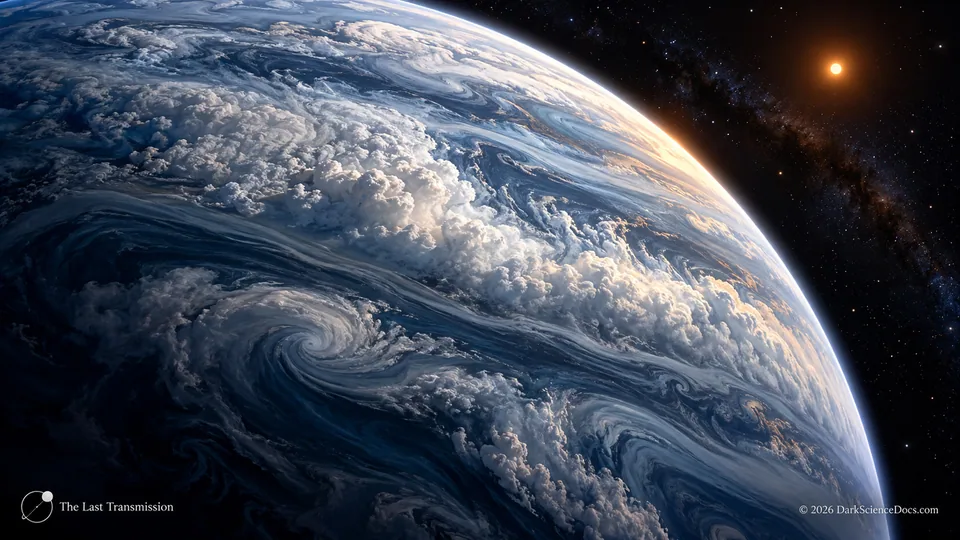
An ocean covering an entire planet sounds inviting. It may also change the exchange of minerals and gases that supports long-lived ecosystems.
On YouTube: The Water World Hypothesis: Why Alien Civilizations May Be Trapped Forever
If the player is unavailable, watch directly on YouTube ↗
THE QUESTION BEHIND THE FILM
Could an ocean planet have too much water for a familiar biosphere?
ORIGINAL VIEWING GUIDE
Look closer.
Water opens a possibility
Liquid water is a central clue in searches for life as we know it. A deep global ocean, though, could separate water from rock or change nutrient cycling in ways that differ from Earth.
A model is a starting point
Researchers test how pressure, ice phases, interior heat, and atmospheric chemistry might work on ocean-rich planets. Their answers depend on uncertain planet composition and cannot be read directly from a planet’s radius alone.
Complex life is the harder claim
The title asks about complex ecosystems. The same reasoning does not rule out microbial life, and the film is strongest when those two possibilities stay distinct.
THE EVIDENCE TRAIL / RESEARCH COMPANION
What the record says.
Water is necessary for life as we know it, yet a planet with far more water than Earth may run a very different geological and chemical cycle. The rock-ocean connection is the key question.
CHOOSE A CLUE / FOLLOW THE RECORD
These are research waypoints, not video timestamps. Explore them in any order, then return to the film.
Deep water changes its physical state
Observed or documented
Modelers find that pressure in a large water-rich planet can stabilize dense high-pressure ice beneath a liquid ocean. This layer could sit between the water and the rocky interior.
What it suggests
If ice separates the ocean from rock, delivery of rock-derived nutrients may be altered. That matters because water alone does not feed metabolism or build a rich biosphere.
Where the claim stops
The existence, thickness, and motion of an ice layer depend on planet mass, water inventory, temperature, and internal heat. A radius measurement cannot settle the structure.
Ice may still move materials
Observed or documented
The cited modeling explores salty high-pressure ice and transport processes rather than assuming an impermeable, static barrier. Solutes can behave differently as ice forms, melts, or convects.
What it suggests
A frozen layer could restrict some exchanges while permitting others over long periods. The habitability question becomes one of rates and chemical pathways, not a yes-or-no label.
Where the claim stops
Whether any proposed exchange supplies enough nutrients for a particular ecosystem remains unresolved. A mechanism in a model is not a measured biosphere.
Surface chemistry may also differ
Observed or documented
Worlds with global oceans need not expose silicate land to weathering as Earth does. The amount of submerged crust and the ocean’s chemistry enter models of carbon and nutrient cycling.
What it suggests
Without Earth-like continents, familiar climate regulation and phosphorus supply may work differently. Different need not mean impossible for all biology.
Where the claim stops
We have not sampled an exoplanet ocean floor. Claims about complex life require additional steps beyond a modeled water inventory or possible high-pressure ice.
One label hides many ocean worlds
Observed or documented
NASA’s habitable-zone framework considers whether surface water could exist, while an ocean-rich interior model considers where that water sits and what it touches.
What it suggests
Combining stellar, atmospheric, mass, and internal-structure observations could distinguish a shallow ocean over rock from a deep water layer over exotic ice.
Where the claim stops
Neither framework supplies a direct count of living worlds. A deep ocean might challenge familiar ecosystems and still be compatible with unfamiliar microbial niches.
If an ocean is isolated from rock, can ice convection and other pathways supply enough chemistry to sustain a persistent ecosystem?
EXPLORE IN 3D / ATLAS H-01
Descend through Earth’s ocean
Follow sunlight, sinking carbon, and vent chemistry in one Earth-ocean illustration, then return to the film’s different question about planetary oceans and exposed land.
Explore Ocean Descent in 3DFOLLOW THE EVIDENCE
Keep the question open.
Watch the documentary, check the research, and continue into the illustrated archive.
MORE DOCUMENTARIES
 The Zoo Hypothesis: The Chilling Reason Aliens Never Contact Us
 Why Intelligent Civilizations May Never Survive Their Own Biology
 The Full History of the Gray Goo Hypothesis