
40 / Gravity's quiet verdict
The Antiatoms That Fell Toward Earth
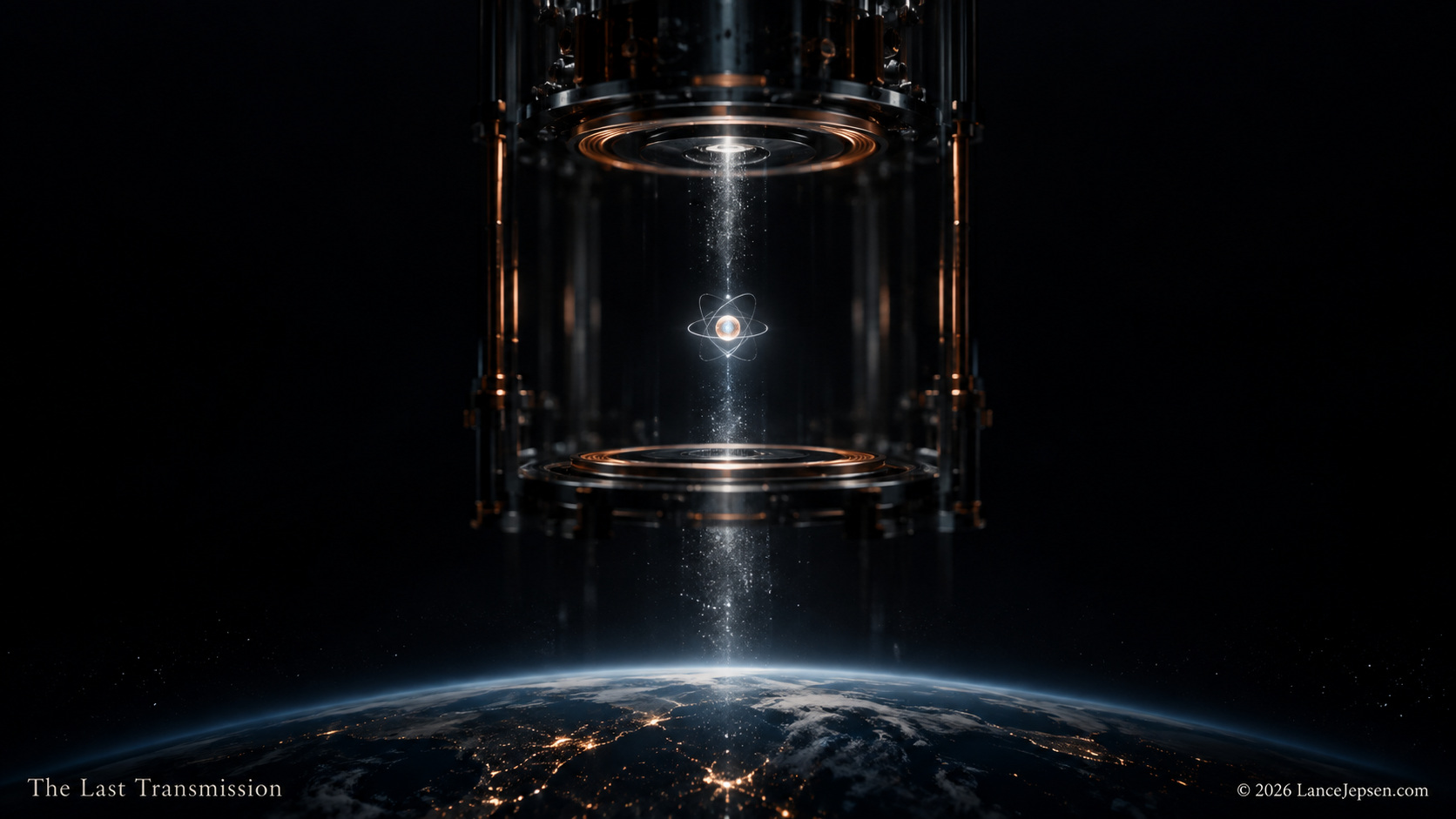
CERN's ALPHA-g experiment watched antihydrogen escape a magnetic trap. The antiatoms favored the downward exit, closing a simple antigravity escape route from the matter–antimatter mystery.
Ordinary walls cannot hold antihydrogen for long. An antiatom that touches matter annihilates, so physicists suspend it with magnetic fields and read its fate from the location where it disappears. In a vertical apparatus, more atoms escaped toward Earth as the confinement weakened. That small imbalance answered a remarkably direct question about the direction of gravity's pull on neutral antimatter. It did not answer the older cosmic question: why did enough ordinary matter survive the early universe to build stars and people at all?
The full investigation continues with the evidence, illustrations, and sources at The Last Transmission on Substack.
Continue reading on SubstackTHE EVIDENCE / THE OPEN QUESTION
What we know.
The ALPHA collaboration reported in 2023 that antihydrogen falls downward in Earth's gravitational field. Its best-fit acceleration was about 0.75 times the familiar value of g, but the uncertainty included ordinary gravity. The result ruled against the simple expectation that antihydrogen is repelled upward with an acceleration of roughly one g; it did not establish that antimatter falls twenty-five percent more slowly.
What remains open.
The exact acceleration can be measured more precisely as experiments produce and control more antiatoms. A difference from the gravitational behavior of ordinary hydrogen would demand careful replication. Even if the two prove identical, that comparison alone does not explain baryogenesis—the early process that left a slight surplus of matter after most matter and antimatter annihilated.
Why it matters.
The experiment is valuable partly because it removes a seductive shortcut. Separating matter and antimatter by opposite gravitational falls will not simply solve the cosmic imbalance. The surviving question has to be pursued through particle interactions, symmetry tests, and the conditions of the young universe. A successful measurement can deepen a mystery by making its boundaries sharper.
GO DEEPER / EVIDENCE FILE
Does Antimatter Fall Down? What ALPHA Actually Measured
ALPHA-g released trapped antihydrogen and counted where atoms annihilated. The result is consistent with downward gravitational attraction, with precision still improving.
FOLLOW THE EVIDENCE
Research behind the field note.
EXPLORE IN 3D / ATLAS I-06
Open the chamber behind the gravity test
Follow charged-particle capture, neutral antihydrogen confinement, and the separate ALPHA-g release stage before returning to what the experiment actually measured.
Explore Antimatter Containment Chamber in 3DWATCH THE RELATED DOCUMENTARY
The story in motion.
FOLLOW THE THREAD
Related signals.
A Star Blinked Twice. Whatever Caused It May Be Much Closer to Earth.
Two nearly identical optical disturbances, 4.4 seconds apart, appeared in HD 89389’s light. Follow the unexplained record, a foreground diffraction hypothesis, and the synchronized telescopes proposed to test it.
What If the Universe Is Accelerating Because Stars Die?
For nearly three decades, scientists have struggled to identify the mysterious force accelerating the expansion of the universe. Now a radical theory suggests the answer.
A Star Died 6.5 Billion Years Ago. Its Explosion Is About to Arrive Again.
NASA is watching for a supernova we have already seen. When that light finally reaches Earth, it could help answer one of the most troubling questions in modern cosmology.