
20 / Deep time / a fossil is an interpretation
The Hunters Whose Family Tree Is Still Being Rewritten
Ancient arthropods reveal predators long before familiar forests, but their evolutionary relationships can change when researchers reinterpret preserved anatomy. A vivid reconstruction must remain distinct from the fossil characters that support it.
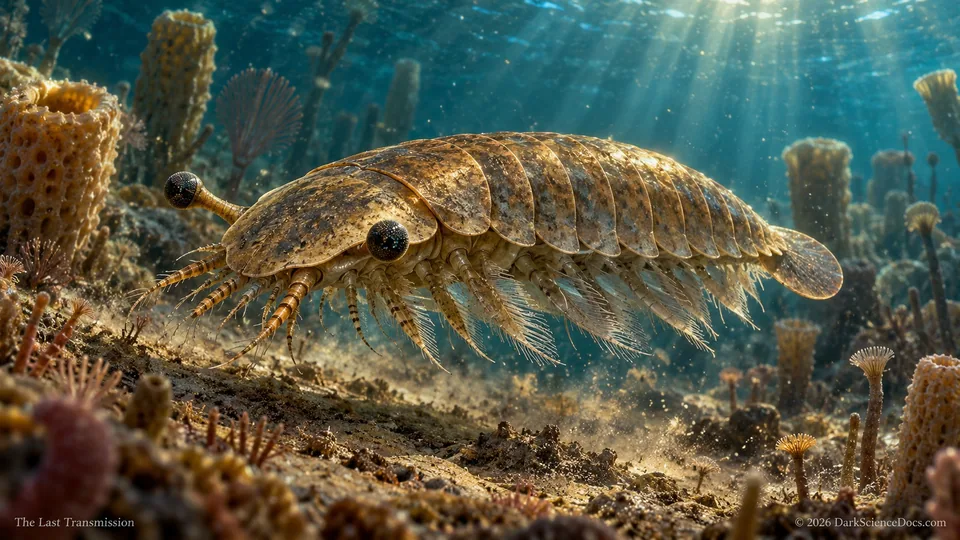
A flattened animal can preserve remarkable clues while destroying the depth and softness that made those clues easy to recognize in life. Researchers compare repeated structures, appendages and, in exceptional cases, traces interpreted as nervous tissue to infer relationships. A proposed arachnid connection for the Cambrian animal Mollisonia prompted a published challenge and a response. That debate is part of the evidence, rather than an obstacle to be removed from the story. A branching evolutionary relationship also differs from identifying one fossil as a direct ancestor of every later spider.
The full investigation continues with the evidence, illustrations, and sources at The Last Transmission on Substack.
Continue reading on SubstackTHE EVIDENCE / THE OPEN QUESTION
What we know.
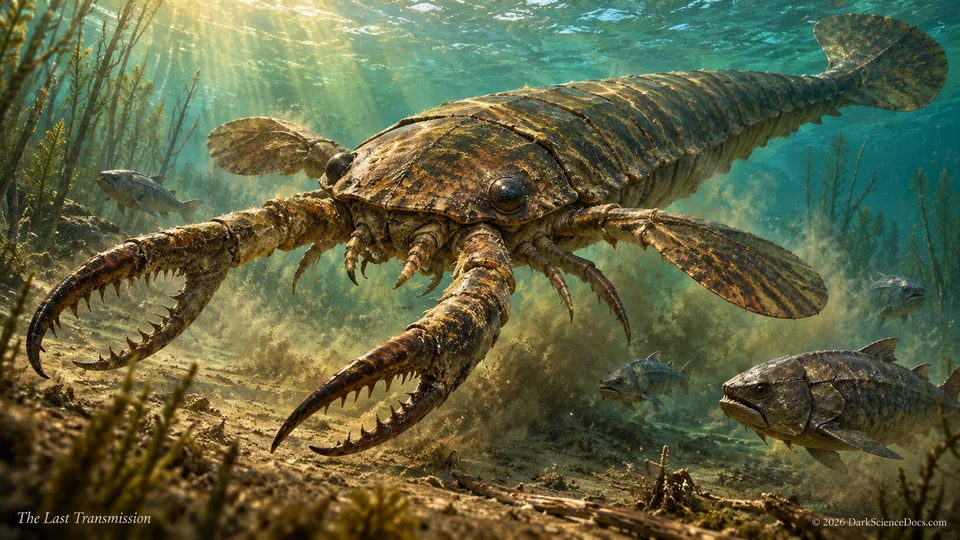
The literature contains competing interpretations of Mollisonia’s anatomy and arachnid affinities. Other famous animals require their own qualifications: eurypterids were aquatic relatives rather than enlarged modern scorpions, and Jaekelopterus size estimates extrapolate from a fossil claw. Reassessment of Parioscorpio likewise changes what it can securely establish about early terrestrial scorpions.
What remains open.
The precise positions of these animals depend on character interpretation, preservation and the sampled comparative tree. Fossils usually cannot recover exact coloration, behavior or the immediate scene around an animal. A Carboniferous forest explorer is a later illustrative environment, not a reconstruction of the Cambrian or Silurian community discussed here.
Why it matters.
A changing family tree demonstrates scientific revision at work. Specimens and explicit character comparisons can strengthen one placement or expose an earlier ambiguity. Keeping measured anatomy, reconstructed animals and evolutionary inference separate makes the deep past more interesting because the route to each conclusion remains visible.
FOLLOW THE EVIDENCE
Research behind the field note.
EXPLORE IN 3D / ATLAS L-01
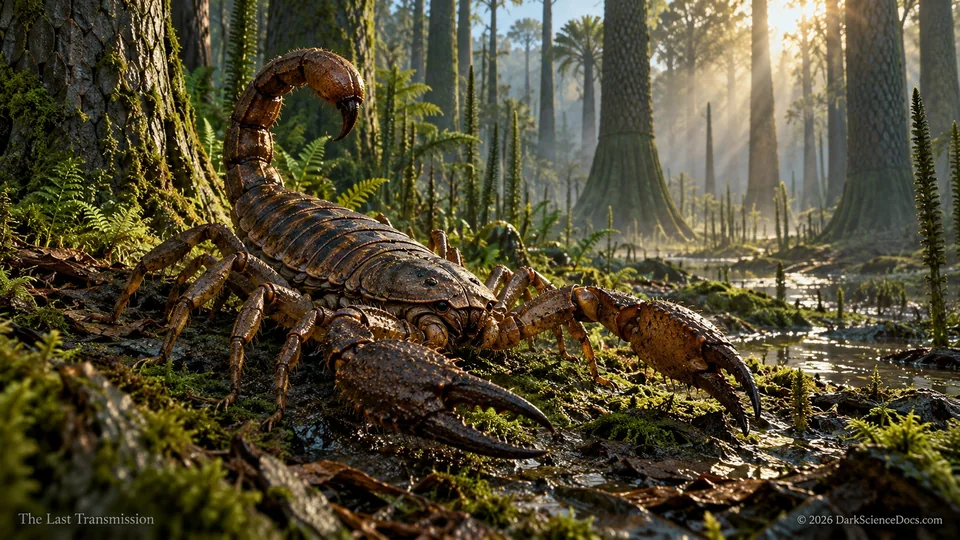
Walk through a later Carboniferous forest
Compare a later reconstructed forest environment. This is not the Cambrian or Silurian habitat of the earliest arthropods.
Explore Rainforest: The Hidden Engine in 3DVISUAL EVIDENCE
Inside the investigation.
FOLLOW THE THREAD
Related signals.
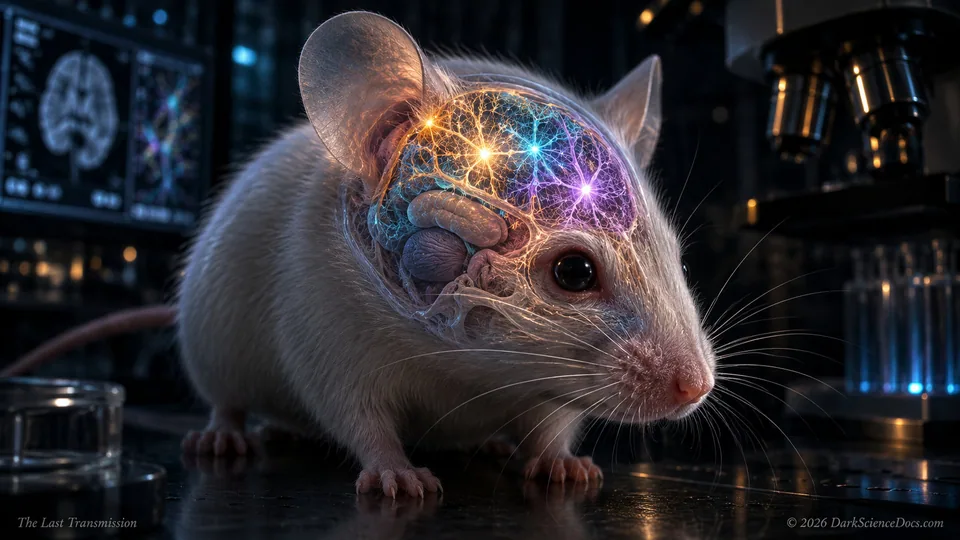
They Grew a Human Cortex Inside a Mouse. Then They Tested Its Memory.
Scientists created mice whose cortical tissue was almost entirely derived from human cells. The tissue grew, formed connections, generated electrical activity, and revealed something extraordinary.
They Found Plutonium at the Bottom of the Pacific. The Explosion That Made It May Be Over 95 Million Years Old.
Deep beneath the ocean, scientists discovered radioactive debris from beyond Earth. The most disturbing clue was an element they could not find.
The Blows That Nearly Killed Earth May Have Helped Bring It to Life
A model identifies a window for life’s chemistry 4.33 billion years ago. The unsettling question is whether Earth was the only world to take advantage of it.