
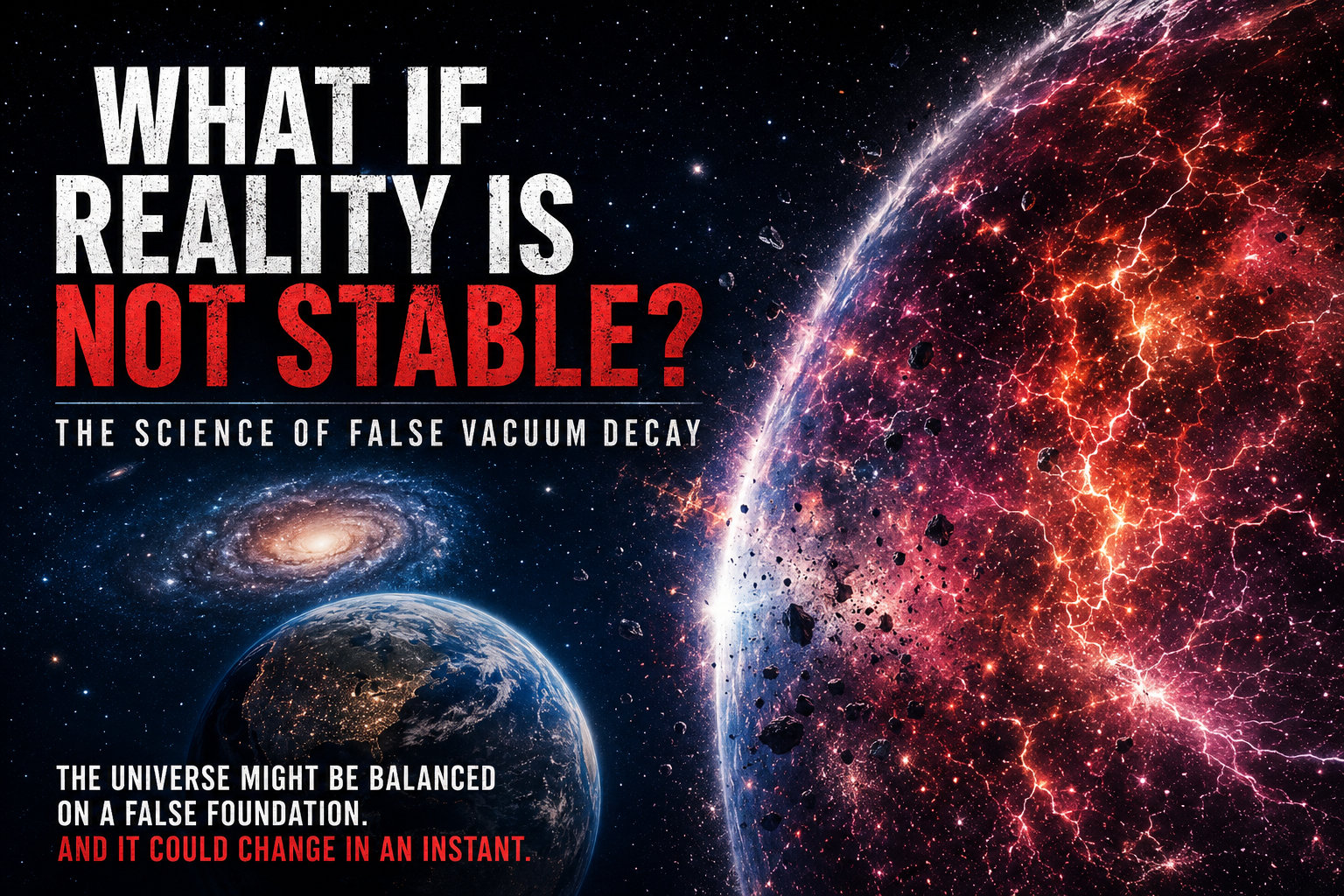
60 / A possible lower state
The Vacuum We Have Never Seen Change
In some field theories, a seemingly stable vacuum can have a lower-energy state separated by a barrier. A mathematical possibility is not an observed event or a prediction that our universe will decay.
A false vacuum is a configuration that can remain in a local energy minimum even if a deeper one exists. Quantum tunneling supplies a possible route through the barrier, and theorists calculate how such a transition might nucleate and spread under specified models. Those calculations are powerful because the assumptions are explicit. They do not reveal that the present cosmos is in a false vacuum, supply a measured decay rate for it, or turn a physics thought experiment into an approaching disaster. The boundary between a model's possible outcome and an astronomical forecast is the central fact to keep in view.
The full investigation continues with the evidence, illustrations, and sources at The Last Transmission on Substack.
Continue reading on SubstackTHE EVIDENCE / THE OPEN QUESTION
What we know.
Coleman's semiclassical work derives vacuum decay behavior for particular scalar-field models, and Coleman with De Luccia examined how gravitation changes the problem. These are established theoretical treatments of a defined scenario.
What remains open.
The vacuum's status in our universe depends on particle properties, high-energy physics, and assumptions about the theory beyond measured ranges. No observation has detected a vacuum-decay front or supplied an event date.
Why it matters.
The idea is unsettling because it shows how a local state can look final until the theory admits another. Its scientific value lies in making those assumptions testable where possible, not in treating the dramatic endpoint as a known fate.
FOLLOW THE EVIDENCE
Research behind the field note.
FOLLOW THE THREAD
Related signals.
A Star Blinked Twice. Whatever Caused It May Be Much Closer to Earth.
Two nearly identical optical disturbances, 4.4 seconds apart, appeared in HD 89389’s light. Follow the unexplained record, a foreground diffraction hypothesis, and the synchronized telescopes proposed to test it.
What If the Universe Is Accelerating Because Stars Die?
For nearly three decades, scientists have struggled to identify the mysterious force accelerating the expansion of the universe. Now a radical theory suggests the answer.
A Star Died 6.5 Billion Years Ago. Its Explosion Is About to Arrive Again.
NASA is watching for a supernova we have already seen. When that light finally reaches Earth, it could help answer one of the most troubling questions in modern cosmology.