DOCUMENTARIES / THE LAST TRANSMISSION
Cassini: The Spacecraft NASA Had to Kill to Protect an Alien Ocean
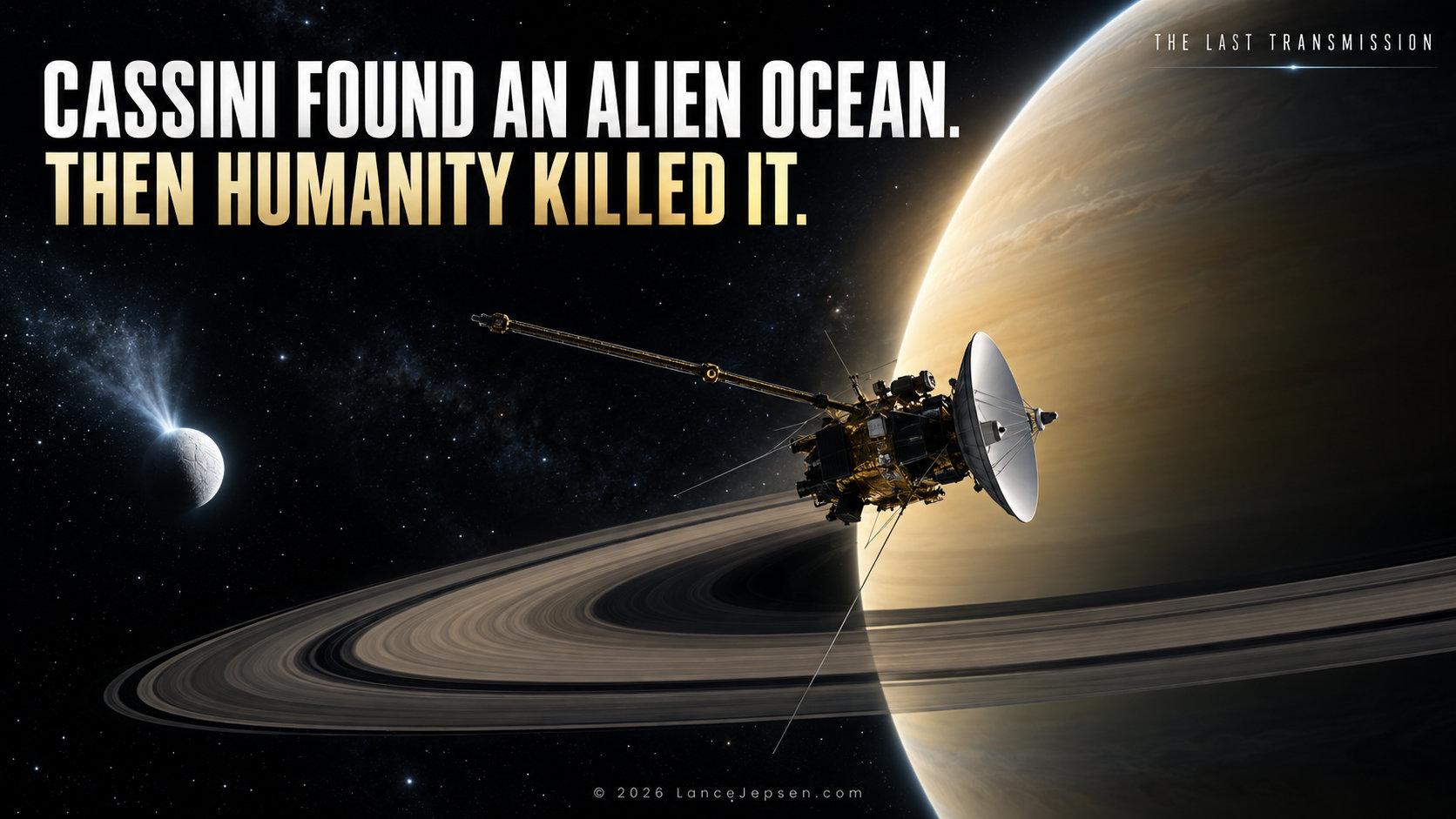
A spacecraft spent thirteen years revealing Saturn’s hidden worlds. Its last act was to avoid contaminating one of them.
On YouTube: The Spacecraft NASA Had to Kill to Protect an Alien Ocean
If the player is unavailable, watch directly on YouTube ↗
THE QUESTION BEHIND THE FILM
Why deliberately destroy a mission that was still sending back science?
ORIGINAL VIEWING GUIDE
Look closer.
The discovery changes the ending
Cassini found that Enceladus vents material from a subsurface ocean into space. That made the little moon a target for future life-detection missions and made a wandering, aging spacecraft a planetary-protection problem.
The final dive was a decision
With propellant nearly exhausted, controllers could no longer guarantee Cassini would avoid Enceladus or Titan indefinitely. They directed it into Saturn. The last orbits were designed to gather fresh measurements before the spacecraft was lost.
A question to carry out of the film
Cassini found environments that invite a search for life; it did not find life. The drama is in the restraint: protecting a place we want to investigate, even when we cannot yet say what is there.
THE EVIDENCE TRAIL / RESEARCH COMPANION
What the record says.
Cassini's ending makes sense only after the Enceladus discoveries. Follow the evidence from a plume, to an ocean, to a decision about what an aging spacecraft should never be allowed to touch.
CHOOSE A CLUE / FOLLOW THE RECORD
These are research waypoints, not video timestamps. Explore them in any order, then return to the film.
The moon was venting material into space
Observed or documented
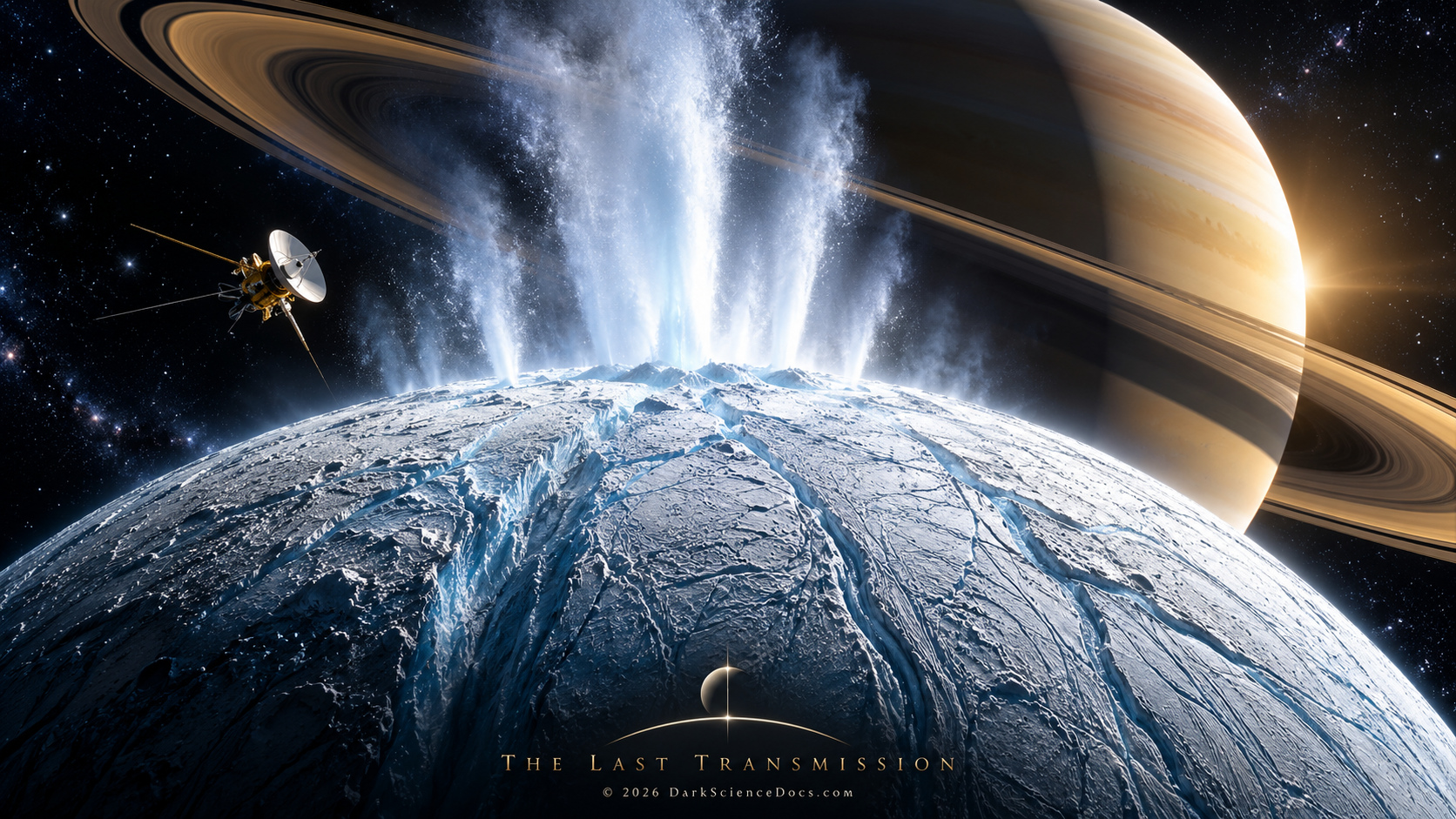
Cassini flew through plumes erupting from fractures near Enceladus's south pole. Its instruments detected water vapor and other material in the ejected particles. The spacecraft could investigate ocean chemistry without landing or drilling through ice.
What it suggests
A source of liquid water beneath the ice is the leading explanation for sustained plumes. The sampled material offers a route into the chemistry of a hidden ocean, although what reaches the spacecraft has traveled through fractures and space first.
Where the claim stops
A plume is a sample of an environment, not a sample of an organism. The presence of water and interesting chemistry does not establish that life exists there.
A chemical clue came from the seafloor
Observed or documented
Analysis of plume material identified molecular hydrogen. Researchers examined whether reactions between water and rock at the ocean floor could produce it, analogous to some hydrothermal processes on Earth.
What it suggests
Hydrogen could supply chemical energy in an ocean ecosystem. Together with an ocean and organic compounds, it makes Enceladus a compelling place to test habitability. That is a statement about available conditions, not a biological detection.
Where the claim stops
Cassini did not visit the seafloor, image a vent, or measure metabolism. The hydrothermal interpretation follows a chain from plume chemistry to processes inside the moon.
The flight team had to choose an ending
Observed or documented
Cassini had spent years orbiting Saturn and was approaching the end of its usable propellant. NASA chose a controlled plunge into Saturn on September 15, 2017, after a series of close passes through the space between the planet and its rings.
What it suggests
A spacecraft that could no longer reliably control its trajectory might eventually collide with Enceladus or Titan. Destroying it in Saturn reduced the risk of carrying terrestrial microbes into a world future missions may investigate for life.
Where the claim stops
Planetary protection addresses a possible contamination pathway; it is not evidence that either moon is inhabited. The final passes also returned science, so the decision had both protection and research value.
The unanswered question belongs to a future mission
Observed or documented
Cassini established that ocean material can reach space, providing a future spacecraft with a possible sampling opportunity. Its instruments were designed before all of Enceladus's astrobiology questions were known.
What it suggests
A mission designed specifically for life detection could test plume material with different measurements and stricter contamination controls. Independent evidence would be needed to distinguish biology from abiotic ocean chemistry.
Where the claim stops
No single intriguing molecule would settle the question. The strongest case would need multiple lines of evidence, careful controls, and an explanation for how the material reached the detector.
If we sample a plume again, what combination of chemistry, context, and contamination checks would justify calling a result biological?
EXPLORE IN 3D / MAP 01
Enter Cassini’s Saturn system
Navigate from Saturn’s rings to Enceladus and Titan after the film, with research links at each destination.
Open Saturn system mapFOLLOW THE EVIDENCE
Keep the question open.
Watch the documentary, check the research, and continue into the illustrated archive.
MORE DOCUMENTARIES
 The Man Who Waited 60 Years to Touch the Sun | Eugene Parker
 The Promise That Came Home: NASA’s Mission to Asteroid Bennu
 Nancy Grace Roman: The Woman Who Made Hubble Possible