
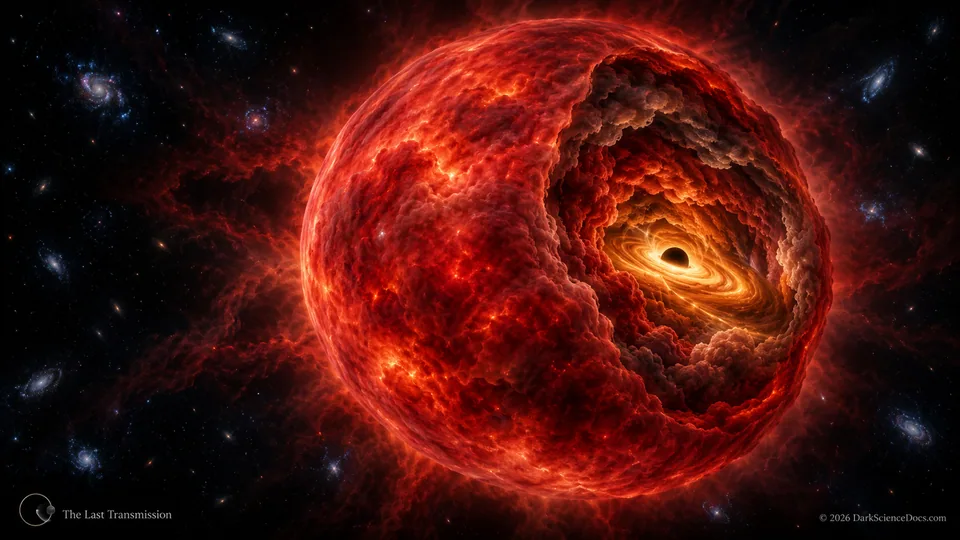
18 / Early galaxies / a spectrum behind a cocoon
What Is Hidden Inside the Little Red Dots?
Some compact red sources discovered by Webb may contain rapidly accreting black holes inside dense gas. The evidence comes from spectra and competing physical models, while the population may still contain more than one kind of object.
A small red source in a distant image does not reveal its internal engine. Dense stellar populations, dust and accretion can all affect the emerging light. Detailed spectra add constraints by connecting emission lines and continuum features with physical processes. In the black-hole-star picture, a gas cocoon surrounds an accreting black hole and reshapes the radiation before it escapes. This is different from assuming an ordinary fusion-powered star with a hidden black hole at its center. The model has to account for the entire observable pattern, including radiation that is unexpectedly weak.
The full investigation continues with the evidence, illustrations, and sources at The Last Transmission on Substack.
Continue reading on SubstackTHE EVIDENCE / THE OPEN QUESTION
What we know.
Studies of particular objects, including GLIMPSE-17775 and the separately analyzed MoM-BH*-1, support investigation of dense-gas accretion models. Electron scattering can broaden spectral lines, complicating a direct translation from line width to orbital velocity. Their spectra, ages and inferred structures must be kept separate rather than merged into one representative observation.
What remains open.
A successful interpretation of one detailed spectrum does not identify every little red dot. Host stars, dust, gas conditions and selection effects can differ across the population. Simulations of rapid black-hole seed growth supply possible pathways, rather than an observed movie of the early object forming. The bright envelope in an illustration remains an inferred structure.
Why it matters.
The opportunity is to turn a visually similar population into physically distinguishable classes. More complete spectra and repeatable predictions across wavelengths can test which objects require a dense accretion cocoon and which permit alternatives. The eventual account of early black-hole growth will have to explain both the exceptional sources and the broader survey.
FOLLOW THE EVIDENCE
Research behind the field note.
EXPLORE IN 3D / MAP 13
Explore the larger cosmic setting
Move through an illustrative cosmic map. Its arrangement does not directly image a black-hole cocoon or predict the future sky.
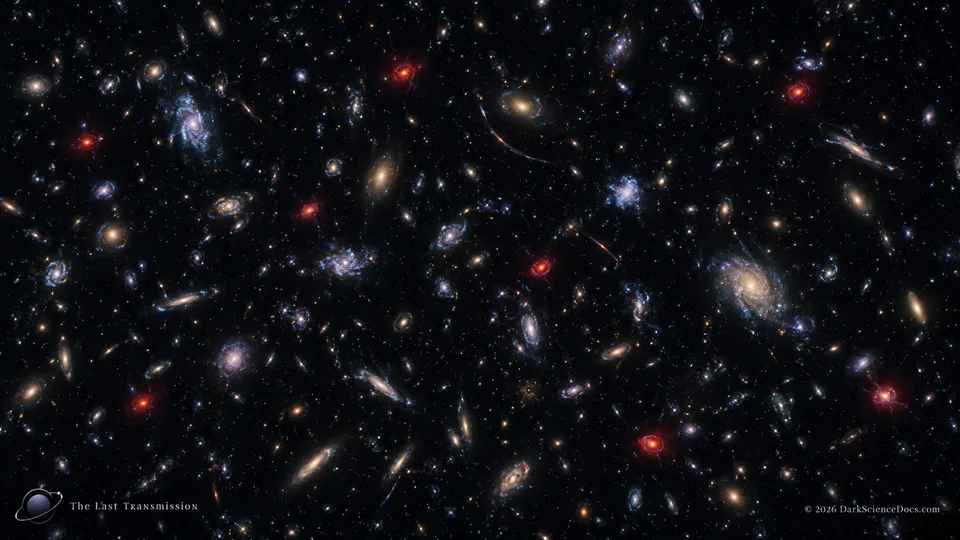
Open Universe mapVISUAL EVIDENCE
Inside the investigation.
FOLLOW THE THREAD
Related signals.
A Star Blinked Twice. Whatever Caused It May Be Much Closer to Earth.
Two nearly identical optical disturbances, 4.4 seconds apart, appeared in HD 89389’s light. Follow the unexplained record, a foreground diffraction hypothesis, and the synchronized telescopes proposed to test it.
What If the Universe Is Accelerating Because Stars Die?
For nearly three decades, scientists have struggled to identify the mysterious force accelerating the expansion of the universe. Now a radical theory suggests the answer.
A Star Died 6.5 Billion Years Ago. Its Explosion Is About to Arrive Again.
NASA is watching for a supernova we have already seen. When that light finally reaches Earth, it could help answer one of the most troubling questions in modern cosmology.