
15 / RESEARCH / OBSERVATION & INTERPRETATION
Tabby’s Star: Testing a Giant-Companion Candidate
A transit-like event and additional measurements motivate a giant-companion interpretation for Tabby’s Star. The candidate and the star’s irregular dusty dimming remain connected questions rather than one completed explanation.
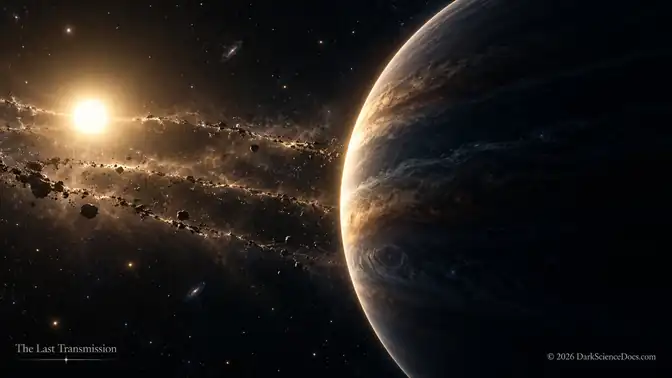
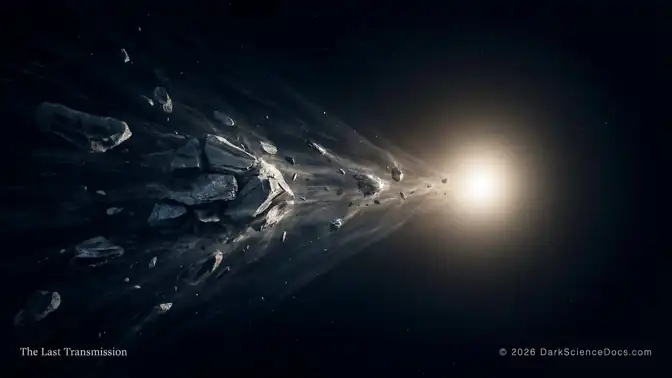
Tabby’s Star has a history of irregular dimming, and wavelength-dependent behavior supports a role for dust. A more symmetric event can be compared with transit models, but model consistency is not the same as a fully established orbital solution. The identity, orbit and surrounding material of a proposed companion require further constraints. A transit interpretation does not automatically explain all earlier dips, and a speculative debris illustration cannot reveal the actual arrangement of bodies.
A dip is measured before its cause is named
A crucial clue came from comparing the missing light at different wavelengths. Follow-up observations found that some dimming events affected shorter wavelengths more strongly than longer ones. Small dust grains can produce that selective filtering. A simple, solid, opaque screen generally would not. The 2017 dips studied by Boyajian and colleagues therefore favored optically thin dust over optically thick blocking material, although the researchers also allowed some explanations involving the star itself. Separate observations supported dust as an explanation for longer-term fading. These results narrowed the possibilities without establishing that every dip and every slow change shared one cause. CaltechAUTHORS Dust, however, leaves another mystery behind. A cloud can explain how light disappears while telling us little about where the cloud came from. If fragments or comets are responsible, what supplied them, and what placed them on the paths that cross our view?
A companion must survive independent checks
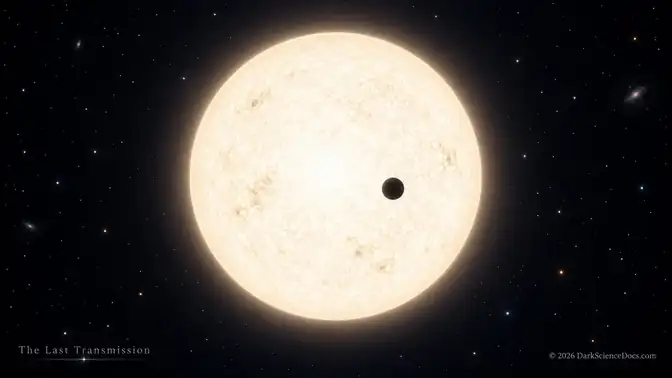
A 2026 paper led by Cristina Madurga-Favieres offers a possible missing actor. The team examined a single TESS event lasting about 21 hours, with a depth of approximately 1.1 percent. Its nearly symmetric shape favored a giant-companion interpretation over the exocomet models they tested. The event was much shallower than the spectacular Kepler dips. Its importance lies in what it might reveal alongside them. Combining the transit with radial-velocity measurements, the researchers obtained a tentative mass estimate of about 9.4 Jupiter masses, with substantial uncertainty, and an inferred radius around 1.7 times Jupiter’s. The mass signal has a reported significance of 2.3 sigma, and the authors explicitly call for more observations. Those qualifications matter because the candidate could occupy the uncertain territory between giant planets and brown dwarfs. The available estimate does not establish its formation history or demonstrate that it burns deuterium. Calling it a confirmed brown dwarf—or a discovered hybrid—would make the story tidier than the evidence allows.
Dust and a candidate are not a complete system
The most direct test of the candidate companion is especially satisfying because it asks the sky to repeat itself. One transit does not provide a securely measured orbital period. Observations taken before and after the TESS event nevertheless constrain the possibilities: if an orbit predicts another transit during a well-observed interval and none appears, that orbit becomes harder to defend. Gaps in coverage leave other possibilities open. A repeat event with the expected timing and shape would make the companion interpretation more persuasive. Additional radial-velocity measurements could test the gravitational signal, and future Gaia astrometry could help constrain the system through the star’s motion across the sky. Even then, the result would open another investigation. Astronomers would need to determine how the companion interacts with smaller bodies, whether it helps produce the dust, and which parts of the star’s behavior belong to the same physical story.
Read the illustrated companion article for the full narrative and its source trail. The selected passages above follow that article’s investigation.
Continue reading on SubstackTHE EVIDENCE / THE OPEN QUESTION
What we know.
Tabby’s Star has a history of irregular dimming, and wavelength-dependent behavior supports a role for dust. A more symmetric event can be compared with transit models, but model consistency is not the same as a fully established orbital solution.
What remains open.
The identity, orbit and surrounding material of a proposed companion require further constraints. A transit interpretation does not automatically explain all earlier dips, and a speculative debris illustration cannot reveal the actual arrangement of bodies.
Why it matters.
Repeated transits, velocity measurements and multicolor monitoring offer complementary tests. Keeping the candidate separate from the established dimming record helps a future observation strengthen or challenge a specific prediction.
COMPARE THE QUESTIONS
Follow what the light reveals.
Follow the relevant evidence and teaching models. Each model explains a mechanism and retains its own stated assumptions and limits.
FOLLOW THE EVIDENCE
Research behind the field note.
EXPLORE IN 3D / MAP 12
Explore the related science model
Repeated transits, velocity measurements and multicolor monitoring offer complementary tests. Keeping the candidate separate from the established dimming record helps a future observation strengthen or challenge a specific prediction.
Open Milky Way mapVISUAL EVIDENCE
Inside the investigation.
FOLLOW THE THREAD
Related signals.
Something Huge May Be Hiding Around the “Alien Megastructure” Star
A 21-hour shadow may point to a giant companion disturbing the system around Tabby’s Star. The most revealing test is whether that shadow returns.
The Black Hole Hid Its Light. The Neutrinos Escaped.
Scientists buried a telescope beneath Antarctica to catch particles from the universe’s most violent places. What they discovered is shocking.
A Signal Crossed 10 Billion Years of Darkness. We Still Don't Know What Sent It.
The James Webb Space Telescope has traced an extraordinarily powerful radio flash to a galaxy so small that Earth's largest telescopes couldn't see it.