
49 / Chemistry before biology
Why a Planet of Silicon Built Carbon Life
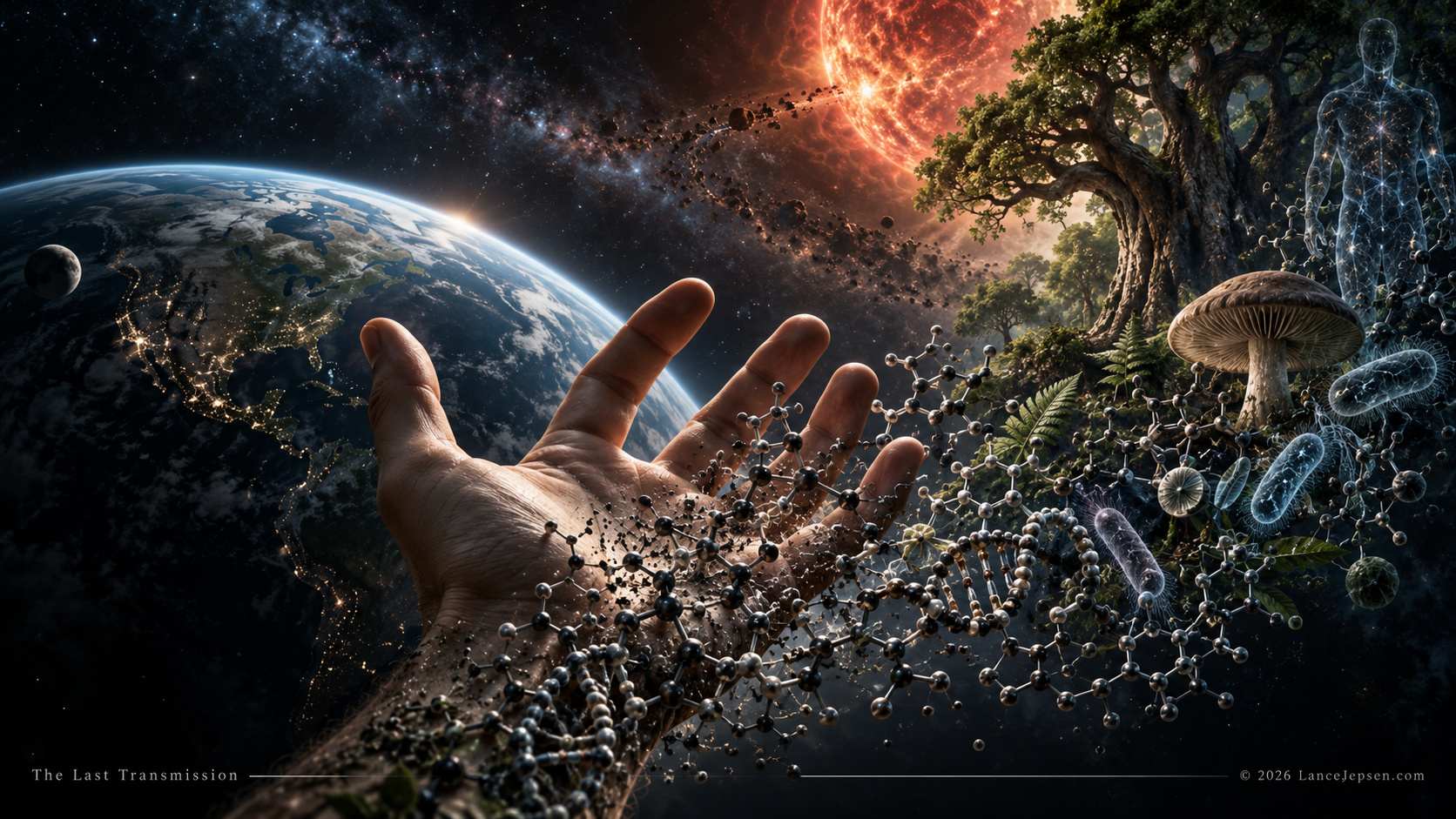
Silicon is plentiful in Earth's crust, yet known cells build their information and metabolism around carbon. Elemental abundance alone cannot tell us which chemistry can make a working organism.
Counting atoms in rock seems to give silicon an overwhelming advantage. But life requires molecules that can be assembled, altered, and broken down in a particular environment. Carbon's varied bonding patterns support chains, rings, and reactive groups in water; much accessible silicon here is locked into minerals. Researchers have also shown that enzymes can make carbon-silicon bonds, a useful reminder that silicon is not chemically forbidden from biology. The evidence tells us why Earth's biology works with carbon, not that every possible ocean and atmosphere must repeat Earth's choice.
The full investigation continues with the evidence, illustrations, and sources at The Last Transmission on Substack.
Continue reading on SubstackTHE EVIDENCE / THE OPEN QUESTION
What we know.
All confirmed life uses carbon-based molecular frameworks. Chemical analyses compare silicon's bonding and thermodynamic constraints with carbon, and directed evolution experiments have produced enzymes that form carbon-silicon bonds under controlled conditions.
What remains open.
There is no known independent silicon-based biosphere to test against these predictions. A model of viable chemistry depends on solvent, temperature, available elements, and how energy and waste move through an environment. Earth's rock abundance alone cannot settle the question.
Why it matters.
The distinction changes the search for life. Instead of asking which atom is most abundant, we can ask what network of reactions an alien environment could sustain and which products a detector would recognize as chemistry rather than geology.
FOLLOW THE EVIDENCE
Research behind the field note.
WATCH THE RELATED DOCUMENTARY
The story in motion.
FOLLOW THE THREAD
Related signals.
A Star Blinked Twice. Whatever Caused It May Be Much Closer to Earth.
Two nearly identical optical disturbances, 4.4 seconds apart, appeared in HD 89389’s light. Follow the unexplained record, a foreground diffraction hypothesis, and the synchronized telescopes proposed to test it.
What If the Universe Is Accelerating Because Stars Die?
For nearly three decades, scientists have struggled to identify the mysterious force accelerating the expansion of the universe. Now a radical theory suggests the answer.
A Star Died 6.5 Billion Years Ago. Its Explosion Is About to Arrive Again.
NASA is watching for a supernova we have already seen. When that light finally reaches Earth, it could help answer one of the most troubling questions in modern cosmology.